


Imagine a horse about to enter a trailer. The ramp is unfamiliar, the space is confined, and the animal has no idea where the journey leads. If something as simple as a scent could take the edge off that experience, it would be an appealing tool to have.
Lavender is one of the scents researchers have tested, and some of the results are genuinely intriguing. Horses exposed to it have shown differences in cortisol, heart rate, heart-rate variability, and behavior. But those findings come from very different experiments, and they lead to a more interesting question than simply asking whether lavender “works.”
When a horse’s body responds differently to a smell, does that actually mean the horse is calmer?
The answer, so far, is promising in places and uncertain in others.
What Happened When Horses Smelled Lavender During Transport?
One of the most interesting experiments looked at a situation many horse owners already associate with stress: traveling in a trailer.
In a 2018 study published in the Journal of Equine Veterinary Science, researchers studied eight horses in a crossover experiment. Each horse completed two separate 15-minute trailer journeys: one with lavender aromatherapy and one with water aromatherapy as a control.
The researchers measured heart rate and blood cortisol before transport, immediately afterward, and again 50 minutes later. Cortisol rose after both journeys, but the increase was significantly lower in the lavender condition. Heart rate, on the other hand, did not differ significantly between lavender and control.
At first glance, lower cortisol sounds like a straightforward sign that the horses were less stressed. But that interpretation goes further than the experiment can take us. Heart rate was measured at particular time points rather than continuously throughout the journey, and the study did not directly assess whether the horses behaved more calmly or experienced better welfare.
What it showed was narrower, but still interesting: lavender appeared to change one measured part of the physiological stress response during transport, while another measure did not change.
The trailer was not the first place scientists had looked for an effect.
So, Does Lavender Actually Make Horses Calmer?
Other experiments have found changes too, although not always in the same measures or under the same circumstances.
A 2013 study involving seven horses used an air horn to trigger an acute stress response. The horses then recovered for 15 minutes while breathing either humidified air or humidified air containing 20% lavender oil.
Their heart rates fell more during recovery with lavender, while respiratory rate did not differ significantly between the treatments.
That sounds promising—until you look at what the experiment was actually asking. These horses were recovering from the sudden blast of an air horn. They were not being loaded into a trailer, examined by a veterinarian, or facing a situation they had learned to fear. The study tells us something interesting about recovery from one stressor, not what lavender will do whenever a horse is anxious.
Another experiment brought behavior into the picture. Researchers studied 28 young Welsh fillies, applying either carrier oil alone or 10% lavender oil in vegetable oil around their nostrils. The horses then encountered several challenges, including a novel area, a novel object, social isolation, and a sudden appearance.
The results changed with the situation. In the novel-object test, horses in the lavender group had lower heart rates and defecated less. During social isolation, they showed fewer alert postures. When something suddenly appeared, their maximum heart rate was lower.
That gives us something the trailer study could not: observable differences in behavior as well as physiology. But even here, lavender did not change everything in every test. Its apparent effects depended on what the horses were experiencing.
There is another wrinkle too. These horses were not simply smelling lavender somewhere in their environment; the oil was applied around their nostrils. That is a very different kind of exposure from scent dispersed during a trailer journey, and later we will see why that difference matters for welfare as well as experimental design.
A third experiment looked at yet another piece of the puzzle. In eight dressage horses, researchers measured heart-rate variability, which describes variation in the timing between heartbeats and can offer information about autonomic regulation.
Lavender was associated with a temporary increase in RMSSD, a heart-rate-variability measure the researchers treated as reflecting parasympathetic activity. The effect appeared immediately after treatment and did not last long.
Taken together, these studies suggest that lavender can produce measurable effects under certain conditions. What remains unclear is whether those changes consistently translate into a calmer horse.
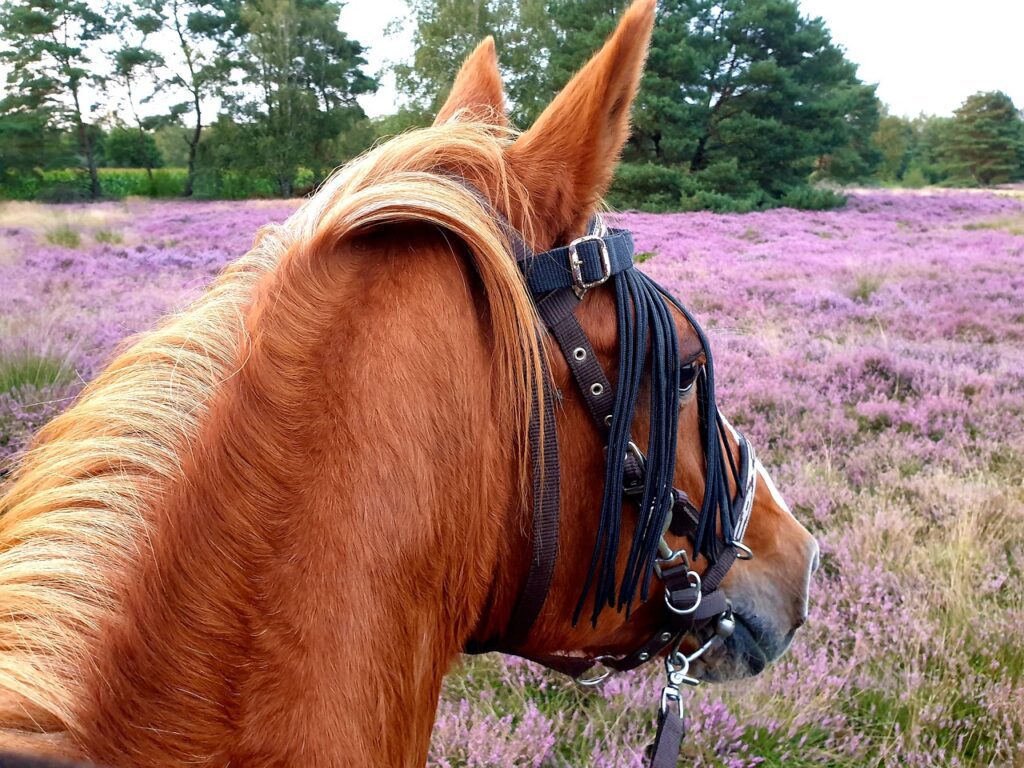
Horses Notice More Through Smell Than We Might Realize
Lavender becomes more interesting when we step back from aromatherapy for a moment.
Horses live in a sensory world that is not identical to ours, and smell helps them investigate their surroundings and gather social information. Odors may carry information that a person standing beside them barely notices.
A particularly striking example comes from a 2026 study published in PLOS One. Researchers presented 43 Welsh mares with human underarm odors collected during situations designed to evoke fear or joy. The samples were placed on cotton pads in front of the horses’ nostrils before the mares completed tests involving a person, a novel object, and a sudden event.
The horses did not respond identically to the two types of odor. Those exposed to fear-associated human scent touched the experimenter less during an approach test, looked more at a novel object, and showed a stronger startle response and higher maximum heart rate when something appeared suddenly.
This was not an aromatherapy experiment, and it does not prove that horses can simply “smell how you feel” in every situation. What it does show is that olfactory information from humans can influence equine behavior and physiology under particular experimental conditions.
That makes scent harder to dismiss as background noise.
If one odor can contribute to greater vigilance in some circumstances, it becomes reasonable to ask whether another might shift a horse’s response in the opposite direction.
Lavender May Not Be the Most Interesting Scent
Lavender is not the only scent scientists have investigated.
A 2021 experiment involving nine horses compared lavender with vetiver, spikenard, Roman chamomile, and a water control. Unlike the transport or air-horn studies, these horses simply stood in a stable during 15-minute exposures. There was no deliberate external stressor.
Researchers looked at physiological measurements alongside facial expressions and muscle activity. Spikenard produced the longest duration of facial expressions categorized as relaxed, while Roman chamomile showed the greatest reported reduction in spontaneous contractions in the two muscles being measured. The study also reported changes in heart rate and respiratory tidal volume.
It would be easy to turn those findings into a list of “best calming oils for horses.” The experiment does not justify that.
There were only nine horses, they were standing in a relatively quiet setting, and the testing environment itself may have influenced their behavior. A scent associated with a particular result in a stable cannot automatically be expected to do the same thing during transport, isolation, veterinary treatment, or another stressful event.
What the experiment does suggest is that the larger subject may be equine responses to scent, rather than lavender alone.
Why a Positive Result Is Not Yet a Calming Method
At this point, there is a pattern: several experiments report interesting effects, but the effects are not especially uniform.
That matters because “calming” sounds like one outcome, while researchers are actually measuring many different things.
A lower cortisol concentration is not the same measurement as a lower heart rate. A change in heart-rate variability is not the same as fewer alert postures. A facial expression categorized as relaxed tells us something different again.
Each may contribute information about how a horse is responding, but none is a direct window into the horse’s subjective experience.
The studies themselves also differ considerably. Some involve seven or eight horses; others include more. Some expose horses to an obvious stressor, while others observe them standing quietly. Concentrations, scents, application methods, exposure times, and outcome measures vary from one experiment to another.
A 15-minute trailer journey and recovery from an air horn may both involve stress, but they are not interchangeable experiences.
A 2021 systematic review of complementary and alternative veterinary therapies illustrates the problem. The reviewers identified four aromatherapy trials involving 24 horses and five dogs. Three were judged to have a moderate-to-high risk of bias and one a high risk, with concerns including small sample sizes, limited statistical power, and the way outcomes were measured. Their conclusion was that the evidence was not sufficient to establish clinical effectiveness.
Later studies give researchers more clues, but they do not automatically solve those methodological problems.
We still need to know whether effects persist, whether they reproduce reliably in different environments, and whether individual horses respond very differently to the same odor.
There Is Another Question: Can the Horse Walk Away?
How a scent is delivered matters for another reason.
Imagine placing an unfamiliar smell somewhere in an enclosure. A horse can approach it, investigate it, ignore it, or move away. Now compare that with applying an oil directly around the nostrils.
Those are not the same experience.
A 2023 review of olfactory enrichment in horses points out that applying scent around the nostrils removes the horse’s ability to choose whether to investigate or avoid it.
That distinction becomes especially important if scent is being described as enrichment. Enrichment is not simply about adding stimulation to an animal’s environment; the way an animal can interact with that stimulation matters too.
A horse that voluntarily approaches an odor is giving us different information from one that turns away or tries to escape it. Allowing that choice may tell us more about the animal’s preference than forcing a prolonged exposure ever could.
What Does This Mean for Everyday Horse Care?
For horse owners and caretakers, the appeal of aromatherapy is understandable. If a simple scent could make transport, training, or veterinary care easier, it would be tempting to use it.
The evidence is not there yet.
Research has not established a dependable aromatherapy protocol for stressful situations in horses, nor has it given owners a general safe concentration or application method to follow at home.
That makes improvisation a poor next step. “Plant-derived” does not automatically mean harmless, and a study that used a particular oil concentration under controlled conditions is not an invitation to apply concentrated essential oils around a horse’s nostrils or fill an enclosed trailer with fragrance.
This does not mean every exposure to a scent is dangerous. It means that more scent is not automatically more effective, and direct exposure is not automatically better exposure.
If a scent is offered as enrichment, the horse’s response should matter. Approaching, sniffing, and investigating willingly look very different from avoidance, head-turning, or attempts to move away.
Extra care makes sense with direct or prolonged exposure, particularly in horses with respiratory or other relevant health concerns.
But there is also a practical limit to what any scent could achieve.
If a horse finds transport difficult, scent does not replace careful loading training, gradual familiarization, appropriate vehicle conditions, or competent handling. The European Food Safety Authority’s assessment of equine transport welfare describes a much wider set of factors that can influence horses during transport.
Even if future research identifies a scent that reliably helps some horses, it would make most sense as an addition to good management rather than a substitute for it.
A calmer-smelling trailer is still a poor environment if everything else about the journey is stressful.
The Bigger Story May Be Smell Itself
It is tempting to come away with a simple verdict on lavender: yes, it works, or no, it does not. The evidence cannot support either conclusion.
What it does offer is a broader question: what do horses notice through smell, how differently might individuals respond, and what changes when they are free to investigate—or leave—an odor?
Future studies may show whether particular scents can help horses cope with specific stressful situations. For now, the most compelling message is that smell deserves a bigger place in how we think about the world horses experience.
Sources & Further Reading
- Heitman, K., Rabquer, B., Heitman, E., Streu, C., & Anderson, P. (2018). The Use of Lavender Aromatherapy to Relieve Stress in Trailered Horses. Journal of Equine Veterinary Science, 63, 8–12.
- Ferguson, C. E., Kleinman, H. F., & Browning, J. (2013). Effect of Lavender Aromatherapy on Acute-Stressed Horses. Journal of Equine Veterinary Science, 33(1), 67–69.
- Poutaraud, A., Guilloteau, L., Gros, C., Lobstein, A., Meziani, S., Steyer, D., Moisan, M.-P., Foury, A., & Lansade, L. (2018). Lavender Essential Oil Decreases Stress Response of Horses. Environmental Chemistry Letters, 16(2), 539–544.
- Baldwin, A. L., & Chea, I. (2018). Effect of Aromatherapy on Equine Heart Rate Variability. Journal of Equine Veterinary Science, 68, 46–50.
- Kosiara, S., & Harrison, A. P. (2021). The Effect of Aromatherapy on Equine Facial Expression, Heart Rate, Respiratory Tidal Volume and Spontaneous Muscle Contractures in M. Temporalis and M. Cleidomastoideus. Open Journal of Veterinary Medicine, 11, 87–103.
- Jardat, P., et al. (2026). Human Emotional Odours Influence Horses’ Behaviour and Physiology. PLOS ONE, 21(1), e0337948.
- Bergh, A., Lund, I., Boström, A., Hyytiäinen, H., & Asplund, K. (2021). A Systematic Review of Complementary and Alternative Veterinary Medicine: “Miscellaneous Therapies”. Animals, 11(12), 3356.
- Bini de Lima, A. C., Sebastião da Fé, V. C., Palermo Hernandes, M. S., & Oliveira dos Santos, V. M. (2023). Olfactory Stimulation as Environmental Enrichment for Domestic Horses—A Review. Animals, 13(20), 3180.
- EFSA Panel on Animal Health and Welfare (AHAW). (2022). Welfare of Equidae During Transport. EFSA Journal, 20(9), e07444.
Featured image by LensPulse