
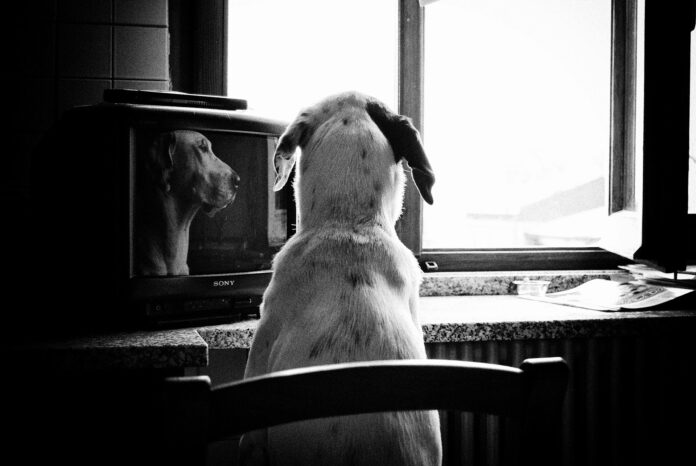
You’re watching a wildlife documentary when a fox suddenly runs across the television. Your dog, who seemed perfectly content sleeping beside the sofa, lifts their head and stares at the screen. As the fox disappears from view, the dog moves closer, perhaps even investigating the space behind the television.
Another dog might watch exactly the same scene without showing the slightest interest.
It’s a familiar contrast for people who live with dogs, and it raises an intriguing question: what do dogs actually see when they watch television, and why do some respond so strongly while others barely notice it?
Research has shown that dogs can recognize certain animals in photographs and videos, distinguish familiar human faces, and respond to voices they know. More recent studies have also begun exploring how temperament, age, and the type of content influence dogs’ reactions to screens.
But there’s an important distinction between recognizing something in an image and understanding what that image represents. A dog may identify another dog on television without necessarily believing that a real animal has entered the room.
Understanding the difference takes us into canine vision, perception, memory, and the ways individual dogs experience the world around them.
Dogs See Television Differently From Us
When you settle down to watch a film, you’re looking at images designed primarily for human eyes. Your dog encounters the same screen through a visual system with somewhat different capabilities.
Contrary to the old belief that dogs see only in black and white, dogs have color vision, although it is more limited than ours.
Most humans have three types of cone photoreceptors involved in color vision, while dogs have two. This arrangement, known as dichromatic vision, means dogs distinguish colors differently, with relatively good discrimination in the blue and yellow ranges but more difficulty separating certain reds and greens.
A brightly colored landscape on television may therefore look quite different to a dog. Some contrasts that immediately stand out to us may be less distinctive to them, while movement and other visual features can remain highly noticeable.
Dogs are also responsive to moving objects, which helps explain why a running animal may attract attention when a relatively motionless scene does not. But their interest isn’t determined by movement alone. The animal being shown, the accompanying sounds, and the dog’s previous experiences can all influence what happens next.
Does the Television Itself Make a Difference?
The type of screen can also affect what a dog perceives.
Older televisions, particularly traditional cathode-ray tube models, displayed images through rapidly repeated scanning and light emission. Depending on the refresh rate, this could produce visible flickering for animals capable of detecting faster changes in light than humans.
Experiments on canine visual perception have shown that dogs can distinguish flicker at relatively high frequencies. Consequently, a television image that seemed smooth to a person could have appeared less continuous to a dog under certain conditions.
Modern flat-panel displays generally produce images differently, and many offer higher refresh rates. However, the result still depends on the particular screen, its settings, the content being shown, and the way light is emitted.
Screen size and viewing distance matter too. A small animal moving across a phone may be less visually informative than the same animal appearing on a large television.
These differences help explain why the quality of the visual stimulus matters, but they don’t give us a simple rule that newer televisions automatically attract every dog.
Even when the image is clear, the more interesting question remains: does a dog recognize what appears on the screen?
Can Dogs Recognize Other Dogs on Television?
Think about how different domestic dogs can look. A Chihuahua, a Great Dane, a Pug, and a Greyhound vary enormously in size, body shape, and facial appearance, yet people recognize them all as members of the same species.
Researchers have investigated whether dogs can make a comparable distinction when looking at pictures.
In a study published in 2013, scientists trained nine pet dogs to select photographs of dog heads displayed on computer screens. Correct choices were rewarded, allowing the researchers to test whether the animals could learn to distinguish dog images from photographs of other mammals, including humans.
The dogs subsequently generalized what they had learned to unfamiliar breeds and crossbreeds. Despite considerable differences in appearance, they were able to select new dog-head images rather than the alternatives presented.
That finding suggests dogs can recognize visual features shared by members of their own species, even when those features vary substantially between breeds.
However, this was a trained discrimination task involving still photographs. It doesn’t establish that dogs spontaneously identify every animal appearing on television, or that they interpret photographs as equivalent to living animals.
What Happened When Researchers Used Videos?
A study published in 2021 took the investigation further by introducing moving images and animal sounds.
Researchers presented 32 pet dogs with videos showing either another dog or an unfamiliar four-legged animal. The images were paired with vocalizations, including dog barks and sounds from another species.
This allowed the scientists to examine whether the dogs responded differently when the picture and sound represented the same kind of animal.
The results were revealing. Dogs showed different patterns of attention depending on the combination presented. In particular, their responses suggested that a video of a dog accompanied by barking matched their expectations better than certain combinations involving an unfamiliar animal or vocalization.
The researchers interpreted these findings as evidence that dogs could recognize another dog in a video and connect the visual representation with an appropriate sound.
This matters because it shows that moving, two-dimensional images can convey recognizable information to dogs. They aren’t necessarily reacting to meaningless flashes of color or movement.

But recognizing a dog in a video doesn’t prove that the viewer believes a living dog is standing in front of them.
A dog may identify the animal shown without understanding the screen in the same way a person does. Recognizing the category of animal, identifying an individual, and interpreting the relationship between an image and reality are different cognitive achievements.
The research establishes that dogs can perform certain recognition tasks. It doesn’t yet tell us precisely how they understand everyday television.
Why Do Some Dogs Watch TV More Than Others?
If dogs can recognize animals on screens, why does one dog watch television enthusiastically while another ignores it?
The answer seems to involve more than visual ability. Recent research suggests that individual characteristics and the type of content play important roles.
Two large owner surveys, published in 2024 and 2025, provide useful evidence about these differences.
What a Survey of 1,246 Dogs Found
A study published in Applied Animal Behaviour Science in 2024 examined how companion dogs interacted with screens in their homes.
Researchers collected 1,246 usable responses from dog owners, asking about their animals’ viewing habits, reactions to different kinds of content, and characteristics such as age, breed, and perceived visual ability.
The results showed that animal-related content attracted considerable interest among the dogs described by their owners. Images and videos featuring other dogs were particularly popular, while movement appeared to be an important feature of attention-grabbing content.
Many owners also reported excited reactions, including approaching the screen or vocalizing in response to something being shown.
Interestingly, the researchers found associations between screen interaction and several characteristics of the dogs.
Age and owner-reported visual status were related to how frequently dogs interacted with screens. Certain breed groups, particularly sporting and herding breeds, were relatively well represented among dogs reported to engage with television.
That doesn’t establish that every Border Collie will enjoy watching television or that dogs belonging to other breed groups generally won’t. Breed groups encompass considerable individual variation, and owners’ descriptions of their dogs can be influenced by expectations about breed behavior.
The study was also based on a voluntary survey, so its participants were not a representative sample of all companion dogs. Although many respondents reported that their dogs watched screen content, those figures cannot be treated as the viewing rate for the dog population as a whole.
Nevertheless, the findings suggest that what appears on the screen, along with the dog’s age, visual abilities, and individual characteristics, can influence how much attention television receives.
What a 2025 Study Revealed About Temperament
A subsequent study from Auburn University examined another part of the question: the relationship between canine temperament and television-viewing behavior.
Published in Scientific Reports in 2025, the research introduced the Dog Television Viewing Scale, a questionnaire designed to characterize how dogs responded to different television stimuli.
After exclusions, the researchers analyzed information about 453 dogs whose owners reported that they watched television.
Rather than treating all screen reactions as equivalent, the study distinguished between different kinds of responses. Some involved animals appearing on screen, others concerned people or inanimate objects, while another group involved following behaviors.
Following behaviors included actions such as tracking something as it moved toward the edge of the screen or looking behind the television after it disappeared.
The researchers then examined whether these patterns were associated with the dogs’ temperament.
They found that dogs described as more excitable tended to show higher levels of following behavior. A dog inclined to become enthusiastic or highly engaged with rewarding stimuli might therefore be more likely to track an animal as it moved across the television and investigate where it seemed to go.
Another association involved what the researchers called negative activation, a temperament measure related to fearful or negatively reactive responses.
Dogs scoring higher on this measure were more likely to respond to non-animal television stimuli, such as vehicles, people, or sounds associated with everyday events.
Think of a dog that barely notices animals in a documentary but immediately reacts when a televised doorbell rings. The content that attracts that dog’s attention may be very different from the content that interests a dog which eagerly tracks moving animals.
These findings help explain why television isn’t a uniform experience for dogs. Two animals looking at the same screen may be attending to entirely different information.
There are important limits, however. The study relied on owners reporting their dogs’ behavior, so the researchers could not directly determine what the animals were thinking or whether particular reactions were enjoyable or stressful.
The sample was also heavily weighted toward dogs that already watched television. It therefore cannot tell us how common television watching is among all dogs or definitively explain why some dogs never show interest.
Even so, the two surveys provide complementary insights. The 2024 study highlights the influence of content, age, visual status, and some breed-related differences. The 2025 research adds evidence that temperament helps shape the kinds of television stimuli and movements to which dogs respond.
That makes television viewing less a question of whether dogs are generally interested in screens and more a question of what a particular dog notices and how they react to it.

Your Dog May Be Listening More Than Watching
Not every apparent television reaction begins with the picture.
A dog might lie quietly beside the sofa while another dog appears on screen, then suddenly lift their head when the televised animal barks. The movement may have gone unnoticed; the sound was what prompted the response.
Dogs rely heavily on hearing in everyday life, and familiar sounds can carry information even when the source is not visible.
A doorbell, a bark, the noise of a vehicle, or a familiar voice may be enough to attract attention from across the room.
There is also experimental evidence that dogs can identify particular human voices.
In a study published in 2022, researchers played recordings of owners and unfamiliar speakers from loudspeakers positioned behind screens. They examined whether dogs could distinguish their owners using acoustic information without relying on the person’s appearance.
The results showed that dogs could recognize their owners’ voices from the recordings, drawing on characteristics of the speech itself.
This means a dog responding to a familiar voice through a television or phone may genuinely recognize something meaningful.
But sound and vision can work independently. If a dog becomes excited when their owner speaks from a device, we cannot automatically conclude that the dog has recognized the owner’s face on the screen.
That distinction becomes particularly important with video calls.
Do Dogs Recognize Their Owners on Video Calls?
Imagine being away from home while someone holds a phone in front of your dog. Your face appears on the screen, you say their name, and the dog raises their ears before moving closer.
It would be natural to interpret the reaction as recognition. And there are scientific reasons to think at least some of the information in a video call could be familiar to a dog.
Alongside their ability to recognize voices, dogs have demonstrated recognition of familiar human faces in photographs.
In a 2020 study involving 60 pet dogs, researchers briefly separated the animals from their owners. The dogs then had to choose between locations indicated by photographs of their owner’s face and an unfamiliar person’s face.
Under the tested conditions, dogs selected the location associated with their owner more often than chance would predict.
The findings provide evidence that dogs can recognize familiar human faces using two-dimensional images, without needing the person to be physically present.
A video call, however, is a more complicated situation.
The screen may be small, the image may move or change angle, and the voice comes from a speaker rather than the person’s actual location. The dog also lacks many of the other signals normally associated with someone familiar, particularly their scent.
An enthusiastic response could involve recognition of the voice, the face, or both. It might also reflect excitement at hearing a sound associated with the owner.
We know that dogs can recognize familiar faces in photographs and familiar voices in recordings. We don’t yet know how reliably they recognize owners during ordinary video calls or how they interpret that experience.
A dog may find a call interesting without understanding that the person on the screen is communicating from another location.
For now, that’s a distinction worth preserving rather than assuming that a reaction tells us exactly what the animal recognizes.

Does Your Dog Think the Animals on TV Are Real?
One of the most amusing television-related behaviors is watching a dog search behind the screen after an animal disappears from view.
It can look remarkably like the dog expects to find the animal somewhere in the room.
And that interpretation is certainly tempting, especially when the dog follows a moving image with obvious concentration.
But there are several possible explanations.
A dog might be tracking movement, reacting to a sudden disappearance, or investigating something unfamiliar. Alternatively, the behavior could reflect an expectation that the object continues beyond the visible boundary.
In everyday life, dogs frequently encounter objects that disappear from view without ceasing to exist. A ball rolling behind furniture, for example, is still there even when it can no longer be seen.
Television creates a different situation. The image of a ball can move beyond the edge of the screen without any physical object entering the room.
Some of the following behaviors documented in the 2025 television study are consistent with dogs responding to on-screen movement in ways that resemble their responses to real objects.
However, the researchers couldn’t establish exactly what the dogs believed was happening. Following something off-screen is not, by itself, proof that a dog thinks the pictured object has physically moved behind the television.
The distinction becomes even clearer when we consider what television leaves out.
A real dog provides information through scent, body movement, three-dimensional position, vocalizations, and social interaction. An image on a television reproduces only some of those signals.
A dog may recognize the appearance of another dog and respond to its barking without treating that representation as a complete substitute for a living animal.
Rather than asking whether dogs believe everything on television is real, a more useful question is which features of an on-screen animal they recognize and how those features influence their behavior.
That is a question researchers can investigate through controlled experiments, without assuming that a dog’s interpretation must match our own.
Is Watching Television Good for Dogs?
Television programmes designed specifically for dogs have become increasingly common. Some feature animals moving through landscapes, others use gentle sounds or visual sequences intended to provide stimulation or relaxation.
But does watching television actually improve canine wellbeing?
For some dogs, a suitable programme may offer an interesting form of visual or auditory stimulation. An animal that calmly watches moving images and remains relaxed afterward might find the experience engaging.
Other dogs may respond very differently. Barking, sudden movement, doorbells, or unfamiliar sounds can trigger excitement, frustration, or fear.
Research on using audiovisual material as enrichment for dogs, including animals living in shelters, has produced mixed findings. Some studies have reported changes in particular behaviors, but improvements in overall welfare have not been established consistently.
The 2025 television study also emphasizes that a dog’s engagement with a screen cannot automatically be classified as positive. An attentive dog may be interested, excited, frustrated, or worried, and those experiences may produce superficially similar behaviors.
Pay Attention to Your Dog, Not Just the Programme
If you’re curious about whether your dog enjoys television, their behavior is a better starting point than the marketing claims attached to the content.
A dog that watches briefly, remains relaxed, and then settles comfortably may be experiencing the screen very differently from one that repeatedly rushes toward it, barks intensely, or becomes unable to relax.
You can make simple observations to understand what seems to attract attention. Does your dog react whenever an animal appears, or only when it moves quickly? Does muting the television change the response? Do familiar sounds draw attention even when the dog isn’t looking at the screen?
These observations won’t establish exactly what the animal understands, but they can help distinguish between reactions driven mainly by sound and those associated with visual events.
There’s no need to encourage intense responses or insist that a dog watch something simply because the programme is advertised as canine entertainment.
If particular content repeatedly causes barking, pacing, tension, or other signs of distress, lower the volume, choose something less stimulating, or switch the television off.
And if your dog ignores the screen completely, that isn’t necessarily a problem. Lack of interest in television doesn’t demonstrate poor intelligence, impaired vision, or a lack of curiosity.
Sudden changes in vision or hearing may deserve veterinary attention when accompanied by other signs, but ignoring television alone isn’t enough to suggest a medical issue.
Television may provide occasional enrichment for some dogs, but it cannot replace exercise, exploration, sniffing, play, social interaction, and other activities suited to their individual needs.
A screen might show a squirrel running across a field. It cannot provide all the experiences involved in exploring that field.
What Your Dog’s TV Habits Really Tell You
Watching a dog become absorbed in a television programme can be entertaining. One might track a bird across the screen, another might bark when a horse appears, while a third sleeps through the entire documentary.
Those different responses reflect something important about canine perception: dogs don’t all notice or respond to the same information in the same way.
Their visual systems differ from ours, but they can still extract meaningful information from photographs and videos. Experimental studies have demonstrated recognition of other dogs in two-dimensional images, familiar human faces in photographs, and owners’ voices in recordings.
The newer surveys add another dimension, suggesting that age, visual abilities, temperament, and the kind of content being shown can influence how individual dogs respond to television.
Yet recognizing an image isn’t necessarily the same as understanding what that image represents. A dog may identify an animal, react to its movement, or recognize a familiar sound without following the story on screen as a person would.
The next time your dog joins you in front of the television, notice what captures their attention. It might be a familiar bark, the movement of an animal, or something in the scene that barely registers with you.
Those small observations can offer a glimpse into the different ways dogs experience their surroundings.
And if your dog decides to investigate behind the television after an animal disappears, you may be witnessing something more interesting than simple entertainment: an animal trying to make sense of a world in which familiar sights and sounds can appear in unfamiliar places.
Sources & Further Reading
- Montgomery, L. I., Krichbaum, S., & Katz, J. S. (2025). Characterizing TV Viewing Habits in Companion Dogs. Scientific Reports, 15, 20274.
- Donohue, L. K., Buesing, M., Peterson, K. D., Ersoz, C., Russell, L. J., & Mowat, F. M. (2024). Screen Interaction Behavior in Companion Dogs: Results From a Dog Owner Survey. Applied Animal Behaviour Science, 270, 106151.
- Autier-Dérian, D., Deputte, B. L., Chalvet-Monfray, K., Coulon, M., & Mounier, L. (2013). Visual Discrimination of Species in Dogs (Canis familiaris). Animal Cognition, 16, 637–651.
- Mongillo, P., Eatherington, C., Lõoke, M., & Marinelli, L. (2021). I Know a Dog When I See One: Dogs (Canis familiaris) Recognize Dogs From Videos. Animal Cognition, 24, 969–979.
- Eatherington, C. J., Mongillo, P., Lõoke, M., & Marinelli, L. (2020). Dogs (Canis familiaris) Recognise Our Faces in Photographs: Implications for Existing and Future Research. Animal Cognition, 23, 711–719.
- Gábor, A., Kaszás, N., Faragó, T., Pérez Fraga, P., Lovas, M., & Andics, A. (2022). The Acoustic Bases of Human Voice Identity Processing in Dogs. Animal Cognition, 25, 905–916.
- Neitz, J., Geist, T., & Jacobs, G. H. (1989). Color Vision in the Dog. Visual Neuroscience, 3(2), 119–125.
- Coile, D. C., Pollitz, C. H., & Smith, J. C. (1989). Behavioral Determination of Critical Flicker Fusion in Dogs. Physiology & Behavior, 45(6), 1087–1092.
- Epstein, J., Dowling-Guyer, S., McCobb, E., Glotzer, C., & Dodman, N. H. (2021). Addressing Stress in Dogs in Shelters Through a Novel Visual and Auditory Enrichment Device. Applied Animal Behaviour Science, 236, 105215.
- Horowitz, A. (2025 revised edition). Inside of a Dog: What Dogs See, Smell, and Know. Scribner.
Featured image by Massimiliano Sarno

