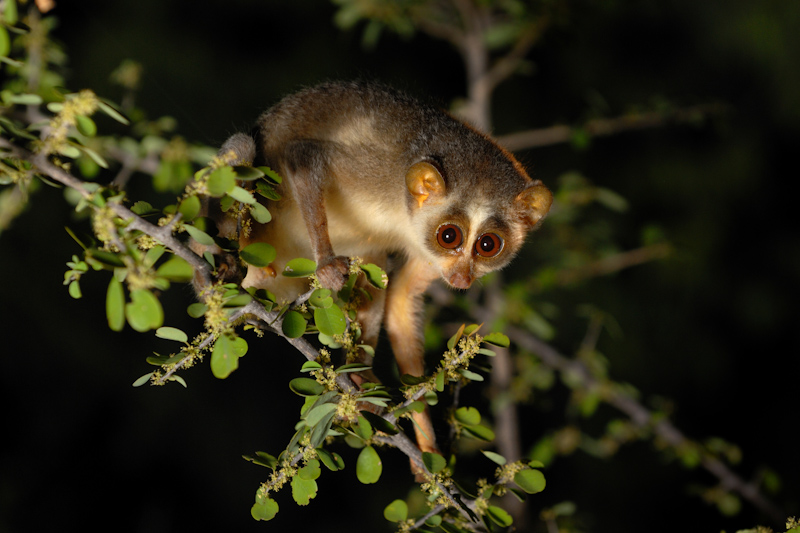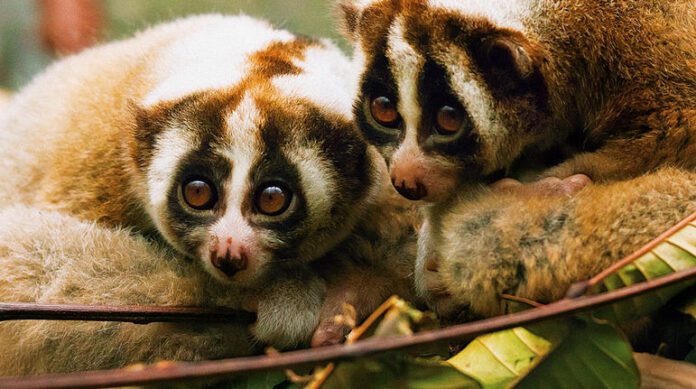
A slow loris raises its little arms while someone tickles its belly. With enormous eyes, tiny hands, and a face that seems almost designed for the internet, the animal looks impossibly cute.
It is easy to understand why videos like this became viral. You watch for a few seconds, smile, perhaps send the clip to someone, and keep scrolling. But a short video can leave out almost everything that would help you understand what the animal is actually experiencing.
Slow lorises are nocturnal primates adapted to life in the trees. They are not domesticated pets, and close handling by people is not part of their normal daily life. Even familiar-looking expressions and gestures can be easy for us to misread.
The famous slow loris videos gave researchers an early opportunity to study that problem. More than a decade later, the same questions now apply to monkeys dressed like children, wild animals filmed inside homes, exotic pets performing for TikTok, and countless other clips competing for attention.
Much of the strongest research in this area has focused on primates, especially slow lorises, so they provide a useful case study for a much broader question:
What happens when the version of a wild animal we see online begins to replace the animal as it really lives?
The Slow Loris Video That Looked Like a Tickle
Slow lorises have several features that make them unusually easy for people to anthropomorphize. Their large, forward-facing eyes suit a nocturnal animal but can look almost baby-like to us. Their movements often seem gentle and deliberate, while their small hands grip objects in ways we easily interpret as human-like.
That makes a slow loris in somebody’s home look strangely familiar. But its biology tells a very different story.
Slow lorises spend much of their active time moving through trees at night, feeding on foods that can include tree gums, nectar, insects, and other natural foods. They are also unusual among primates because they are venomous.
Glands on the upper arms produce an oily secretion. As part of their defensive behavior, slow lorises can raise their arms, mix that secretion with saliva, and deliver the resulting venom through a bite.
That matters when we look again at the familiar image of a loris raising its arms while somebody touches or “tickles” it. The posture should not automatically be read as an invitation for more touching. Raising the arms is part of the species’ defensive sequence, although a few seconds of video cannot tell us everything an individual animal is experiencing at that moment.
The same caution applies to its face. Those huge eyes may look sweet, surprised, or pleading to a human viewer, but they are first and foremost the eyes of a nocturnal primate.
Looking cute to us is not evidence that the animal is enjoying what is happening.
What Researchers Found in 100 Slow Loris Videos
Researchers later examined 100 online videos of slow lorises and looked for conditions that raised welfare concerns. Every one of those 100 videos contained at least one of the five negative conditions they assessed, and about a third contained all five.
The researchers recorded slow lorises being shown in daylight, kept in unnatural surroundings, handled by people, isolated from other lorises, or displaying signs of stress or poor health.
Some of the numbers were striking. Daylight appeared in 87% of the videos, unnatural environments in 91%, and signs of stress or ill health in more than half.
Perhaps more unsettling was the audience response. Videos in which lorises were exposed to daylight or showed signs of stress were more likely to receive positive reactions.
That does not mean viewers knowingly enjoyed seeing an animal suffer. A much simpler explanation is possible: people may not have understood what they were looking at.
A wide-eyed loris gripping a person’s hand may look charming if you do not know how that species normally lives. Bright lighting may make the video easier to watch even though the animal itself is nocturnal, while close human contact can look affectionate because we interpret it through our experience with dogs, cats, and other domesticated animals.
The problem is not necessarily a lack of compassion. Sometimes the welfare problem is almost invisible unless you know something about the species.
The Same Problem Followed Wildlife Onto New Platforms
Those early videos belonged to an older internet dominated by YouTube. The platforms changed, but the way slow lorises were presented did not disappear.
In 2023, researchers examined 100 popular loris videos from YouTube, TikTok, and Giphy. They used the term decontextualization for something fairly simple: showing a wild animal disconnected from the ecological and behavioral setting that helps us understand what it is.
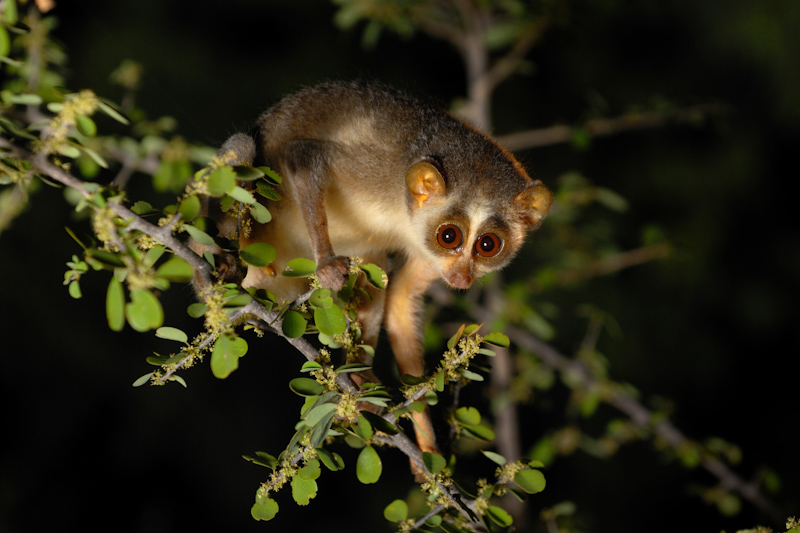
A loris moving through vegetation at night is shown in context. A loris sitting beneath bright lights in a kitchen, holding human food, wearing clothing, or being passed between people is not.
Only two of the 100 videos contained none of the decontextualizing conditions the researchers were looking for. Seventy-seven showed four or all five. Daylight appeared in 93%, human-made surroundings in 91%, and signs of stress or ill health in 76%.
The study also found higher viewing figures on YouTube and TikTok when lorises were shown in human-made settings, unnatural conditions, or displaying signs of stress or poor health.
Again, that does not prove that viewers were searching for suffering. What it does show is that removing an animal from its natural context certainly does not prevent a video from succeeding online. In some cases, the very situations that make an animal easier for us to relate to may also be the ones that hide what is wrong.
When a Wild Primate Starts Looking Like a Pet
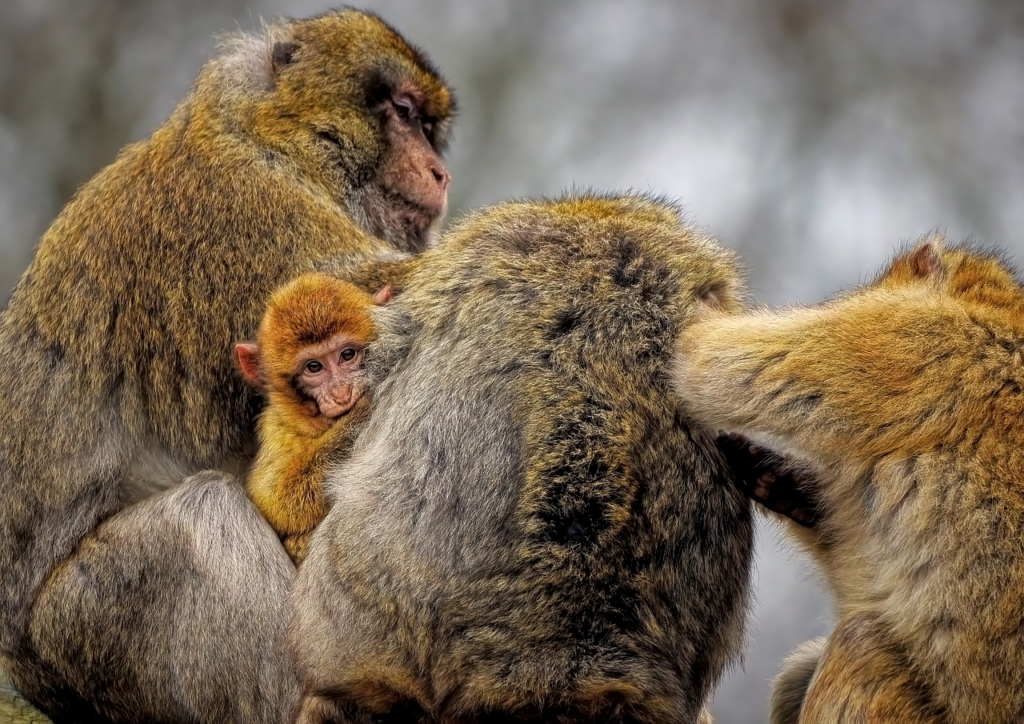
Imagine scrolling past a monkey wearing children’s clothes, eating from a plate at a kitchen table, riding in a car, or being cuddled on a sofa.
Nothing in the frame may explicitly say, This animal makes a suitable pet. It does not need to. Repeatedly seeing wild animals in homes can make that setting begin to feel normal.
A 2025 study examined 1,378 TikTok videos from 173 creators sharing primate content. The largest single setting was the household: 43.1% of the videos showed primates there, often in ways that presented them as pets.
The researchers also looked at what kinds of videos attracted engagement. The relationships were not simple or strong enough to say that one feature makes a video popular, but several patterns involving human contact, humanized presentation, clothing, household objects, and commercial treatment of primates were associated with engagement.
The bigger point does not depend on one algorithmic effect. Nearly half of a large sample of primate videos placed wild animals in homes.
If that is the version of a monkey someone sees again and again, it becomes easier to think of the animal as an unusual companion rather than as a wild primate with social, physical, environmental, and behavioral needs that are extremely difficult to meet in an ordinary household.
A diaper can make a monkey look more like a baby. It does not make the monkey more domesticated.
Why It Can Be So Hard to See Suffering in a Cute Video
People are very good at reading other people. We also become familiar with the body language of animals we live with, particularly dogs and cats. Wild animals are harder.
A primate staying very still might look calm. An animal clinging tightly to a person might look affectionate. A facial expression may remind us of fear, happiness, guilt, or surprise even when the species does not use that expression in the way we assume.
Then the video adds another layer. Cheerful music tells us the moment is funny. A caption says the animal “loves cuddles.” Thousands of heart emojis suggest everybody else sees a happy animal too.
By the time we make a judgment, we are not looking at behavior in isolation. We are looking at behavior that has already been framed for us.
A 2024 survey of 3,246 people illustrates the difficulty. Only 45.8% said they often recognized animal suffering in social-media videos, while more than 90% said they would like warning labels on videos depicting animal suffering.
Those answers do not tell us whether each participant could correctly identify distress in a particular clip. They do show that viewers themselves recognize the problem: welfare problems can be easy to miss in entertainment.
The shorter the clip, the less context we may have. We often do not know where the animal came from, what happened before recording started, what happened afterward, why it is behaving that way, or whether the account presenting it as a beloved pet is also using it to attract followers, customers, or buyers.
From “I Want One” to the Exotic Pet Trade
The most difficult question is whether cute wildlife videos actually make people buy wild animals. That connection is much harder to prove than it may seem.
One famous slow loris video gives us an intriguing glimpse into attitudes rather than purchases. Researchers analyzed 12,411 comments posted over 33 months beneath a viral “tickling slow loris” video, and during the early period, around a quarter of commenters said they wanted a loris as a pet.
As information about slow loris conservation, venom, and the wildlife trade became more visible around the video, the proportion expressing that desire fell substantially.
A comment saying I want one! is not a purchase, and the study cannot tell us how many lorises, if any, were captured because somebody watched that particular video. What it does show is how quickly an unfamiliar threatened animal can be reframed in the viewer’s mind as something desirable to own.
That matters because the pet trade is not an abstract concern for slow lorises.
Animals entering the trade may face capture, transport, unsuitable diets, stressful housing, and repeated human handling. Their venomous bite creates an additional cruelty: lorises in the pet trade may have their teeth cut or removed so they cannot bite people.
Removing the bite does not turn a wild primate into a pet. It can cause serious pain and health problems while making rehabilitation and release much more difficult.
Social Media Is Also a Marketplace
There is another reason to be cautious about separating viral entertainment from wildlife trade too neatly: the same platforms can host both.
A joint 2026 report from WWF, the Association of Zoos and Aquariums, and the International Fund for Animal Welfare examined primates advertised on major social-media platforms in the United States. During just six weeks of monitoring in 2025, researchers found more than 1,600 primates advertised for sale across Facebook, Instagram, TikTok, and YouTube.
That figure represents advertised animals, not 1,600 confirmed transactions. The report also does not show that people saw a cute monkey video and then bought one because of it.
But it makes one thing difficult to ignore: wildlife entertainment and wildlife commerce can exist inside the same digital environment. A person can encounter a monkey because an algorithm recommends an entertaining video and, elsewhere on the same kinds of platforms, encounter primates being offered as pets.
The path from attention to trade is not simple enough to draw as a straight arrow, but the two worlds are not completely separate either.
Why a Caption May Not Fix the Picture
Perhaps the solution seems obvious: if an image could be misleading, just explain it.
That helps—but perhaps not as much as we might hope.
In a 2024 experiment, 2,977 people were shown mock Instagram posts featuring a person close to a gorilla or slender loris. Some posts included captions explaining that the interaction was taking place as part of wildlife research and with appropriate professional context.
The captions worked in one sense: people who saw them were more likely to understand that the image showed research. But the added explanation did not significantly change responses about whether participants wanted the primates as pets or how they understood their conservation status.
The image had already communicated something of its own, which helps explain why responsible wildlife communication involves more than putting a disclaimer underneath an eye-catching photograph.
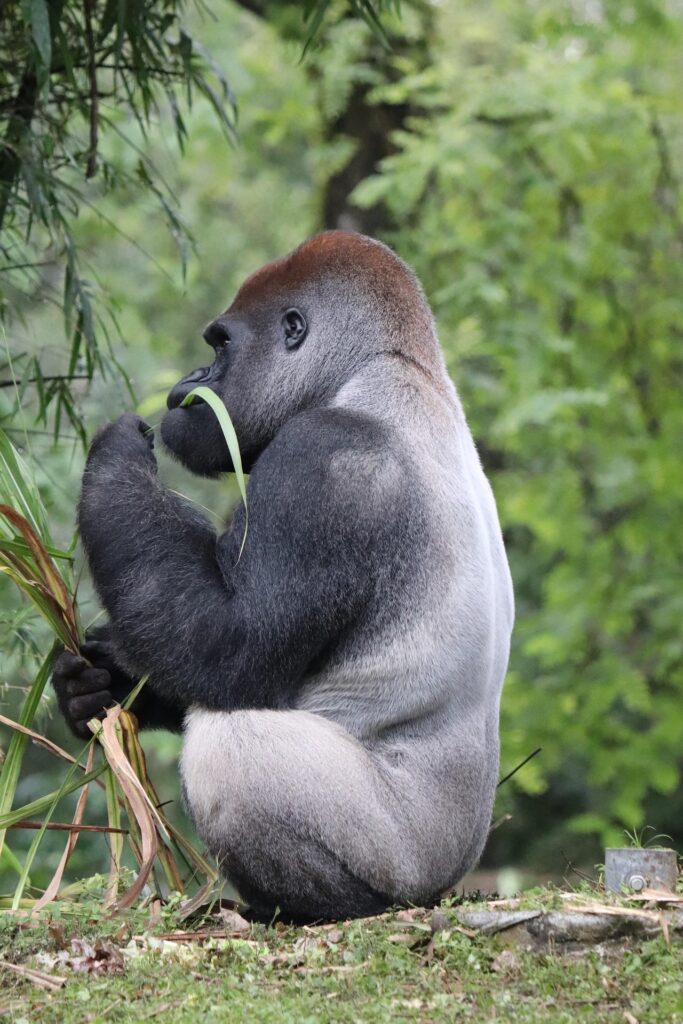
The IUCN Primate Specialist Group’s guidance on responsible images recommends avoiding public images that normalize people being in close proximity to nonhuman primates. The principle is straightforward: what we show matters as much as what we write underneath it.
Social Media Can Help Wildlife Too
None of this means we should stop watching animals online. Social media can do something extraordinary for conservation: bring animals into the lives of people who may never see them in the wild.
A camera-trap clip can show secretive behavior that would otherwise remain invisible. A researcher can explain why a species behaves in a particular way. Rescue centers can show rehabilitation without turning animals into props. Conservation organizations can take audiences into forests, wetlands, oceans, and field sites thousands of miles away.
The same 2013 slow loris study that found so many I want one comments also recorded changes as conservation information became more visible around the video. Online attention, then, is not automatically harmful. What matters is what that attention teaches people to see.
A slow loris shown moving through trees at night can still be captivating. A monkey behaving like a monkey does not need pajamas to be interesting, and ethical wildlife content has something exploitative content often lacks: it gives the animal back its own life.
Before You Share a Cute Wildlife Video
You do not need to become a wildlife-behavior expert before enjoying a video. But a few seconds of curiosity before sharing can make a difference.
Ask yourself:
- Where is the animal? Is this a natural setting, a reputable zoo or sanctuary, a research context, or an ordinary home?
- Is the animal being treated like a wild animal or a human prop? Clothing, staged performances, forced handling, unusual foods, and repeated close contact deserve a second look.
- Do I actually know what this behavior means? Something that looks like smiling, hugging, relaxing, or asking to be touched may mean something very different in another species.
- Who posted it? Does the account explain where the animal came from and why it is there, or does the entire presentation depend on the animal being cute and unusual?
- What would sharing accomplish? Even an angry repost can send more viewers toward the original account.
If a video appears to show cruelty or the sale of protected wildlife, using the platform’s reporting tools may be more useful than reposting the original clip.
And if you want more animal content in your feed, there is plenty worth rewarding: wildlife researchers, reputable conservation groups, responsible zoos and sanctuaries, field projects, nature filmmakers, and creators who let wild animals remain wild.
The Animal Behind the Screen
The slow loris became an internet star because millions of people saw an extraordinary animal and responded to something familiar: a tiny creature that seemed to enjoy being tickled.
The problem was not that people found it cute. The problem was how much the frame left out.
It did not show a nocturnal primate’s natural life in the trees. It did not explain its defensive behavior or venom. It did not show the wider pet trade or what can happen to lorises before they reach a human home.
Later research found the same basic problem across new platforms and other primates: animals removed from their natural context can begin to look like pets, props, or miniature people.
Yet the internet can reveal the opposite story too. It can show animals behaving naturally, introduce audiences to conservation work, and make a species more fascinating once we understand it rather than less.
The question is not whether a wild animal is cute. It is whether the version we choose to watch, like, and share leaves enough of the animal’s real life in the picture.
Sources & Further Reading
- Nekaris, K. A.-I., Campbell, N., Coggins, T. G., Rode, E. J., & Nijman, V. (2013). Tickled to Death: Analysing Public Perceptions of ‘Cute’ Videos of Threatened Species (Slow Lorises – Nycticebus spp.) on Web 2.0 Sites. PLOS ONE, 8(7), e69215.
- Nekaris, K. A. I., Musing, L., Vazquez, A. G., & Donati, G. (2016). Is Tickling Torture? Assessing Welfare Towards Slow Lorises (Nycticebus spp.) Within Web 2.0 Videos. Folia Primatologica, 86(6), 534–551.
- Quarles, L. F., Feddema, K., Campera, M., & Nekaris, K. A. I. (2023). Normal Redefined: Exploring Decontextualization of Lorises (Nycticebus & Xanthonycticebus spp.) on Social Media Platforms. Frontiers in Conservation Science, 4, 1067355.
- Stumpf, A., Herbrandt, S., Betting, L., Kemper, N., & Fels, M. (2024). Societal Perception of Animal Videos on Social Media—Funny Content or Animal Suffering? A Survey. Animals, 14(15), 2234.
- Freund, C. A., Cronin, K. A., Huang, M., Robinson, N. J., Yoo, B., & DiGiorgio, A. L. (2024). Effects of Captions on Viewers’ Perceptions of Images Depicting Human-Primate Interaction. Conservation Biology, 38(3), e14199.
- Strong, K. K., Frakes, L. A., Mayhew, J. A., Thompson, C. J., & Ratliff, C. P. (2025). Behind the Trend: An Examination of Primate Content on TikTok. American Journal of Primatology, 87(8), e70063.
- WWF, Association of Zoos and Aquariums, & International Fund for Animal Welfare. (2026). Primates for Purchase: The Surge in Sales on Social Media in the US. World Wildlife Fund.
- IUCN SSC Primate Specialist Group, Section on Human-Primate Interactions. (n.d.). Best Practice Guidelines for Responsible Images of Non-Human Primates. IUCN SSC Primate Specialist Group.
- World Wildlife Fund. (2025). Slow Lorises: Cute, Venomous, and Fiercely Territorial. World Wildlife Fund.
- Ementu-Maxwell, M. C., Wonte, P. K., & Halloway, A. H. (2026). Viral Yet Vulnerable: The Double-Edged Impact of Social Media on Primate Conservation. Biodiversity and Conservation, 35, 25.