
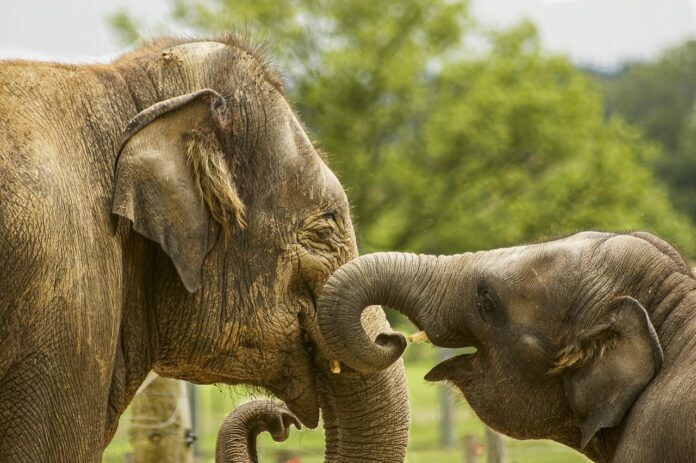
An elephant’s communication can begin with a sound you may barely hear. Low rumbles travel through the air, and some of their energy can also be felt as vibration. But sound is only part of the picture. Elephants also communicate through touch, scent, and visible movement.
The interesting part is not simply that elephants produce all these signals, but how other elephants respond to them. A call, a touch, or a change in posture can carry useful information without having one fixed translation. To understand elephant communication, it helps to look at the whole interaction rather than searching for a dictionary of elephant words and gestures.
The Power of Sound: More Than Meets the Ear
Trumpets are easy to notice. Lower rumbles are much less obvious, and some elephant calls include frequencies below about 20 Hz, the conventional boundary for infrasound. Recordings of captive Asian elephants, for example, have included calls ranging from about 14 to 24 Hz.
That does not mean every low elephant call is completely inaudible to every person. Human hearing varies, and sounds near that boundary may sometimes be heard or felt. The important point is that elephants can produce very low-frequency sounds that extend beyond the range we normally hear clearly.
Those low frequencies can also be useful over distance. How far a call travels depends on the call itself and on conditions in the atmosphere and surrounding environment. In Etosha National Park, acoustic models based on measured weather conditions suggested that elephant calls could travel more than 10 kilometers—about six miles—under particularly favorable conditions, especially during calm, cool periods after sunset.
That figure is an estimate of how far the sound could travel, not proof that an elephant actually received a particular call from 10 kilometers away. Even so, playback experiments show that sound can connect elephants across meaningful social distances.
Female African elephants can distinguish calls from members of their own family and closely associated groups from those of other elephants they know less well. In one study, the familiar callers represented about 14 families, or roughly 100 adult females across those families.
That does not mean researchers showed that every elephant could individually identify all 100 animals. What it does show is an unusually broad network of vocal familiarity.
There is a useful human parallel here. You can recognize a familiar voice without needing someone to say their name, and knowing who is speaking changes how you understand what you hear. For elephants, recognizing the caller can make a rumble socially meaningful even when the call itself is not a complete message.
A Symphony of Calls
Elephant calls vary in ways that can carry information about the caller. Researchers have found differences in rumbles associated with individual identity and emotional state, but that does not turn every call into the equivalent of a human word.
Context still matters. A trumpet that sounds dramatic to us does not always mean “warning,” and a soft rumble does not automatically reveal exactly what an elephant is feeling.
Young elephants add their own variety. In a small study of six captive Asian elephant calves, chirps and trumpets were especially common during play. That does not tell us how every calf communicates in every setting, but it offers a glimpse of how vocal behavior develops within social interaction.
The Language of Touch
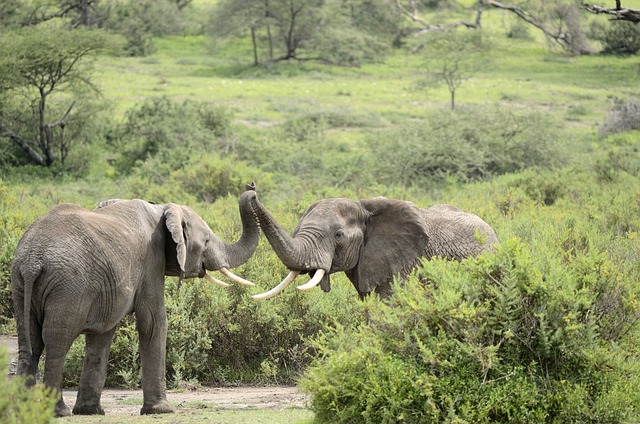
An elephant’s trunk is not only a tool for feeding, drinking, and exploring. It is also highly sensitive and dexterous, making it particularly useful during close social encounters.
When elephants meet, one may reach its trunk toward another elephant’s face or mouth. This can be part of a greeting or another familiar social exchange. The gesture may remind us of a handshake or embrace, but its meaning depends on what the elephants are doing and on their relationship with one another.
Mother and Calf
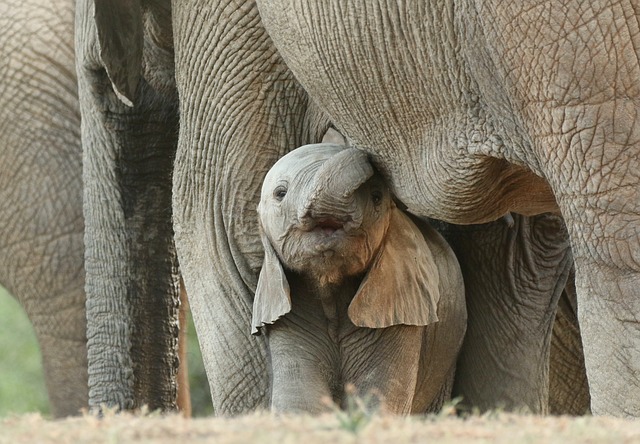
Close contact is especially easy to see between mothers and calves. A calf may reach toward its mother’s mouth with its trunk or remain in frequent physical contact as the pair move and interact.
Touch also appears when elephants respond to another elephant in distress. Asian elephants have been observed gathering closely around a distressed individual in a behavior known as bunching, sometimes while making physical contact. The group formation can have a defensive role, while the contact itself forms part of the social response.
It can look comforting to human observers, and researchers have described affiliative responses in these situations. Still, what an elephant actually feels cannot be read from a single touch alone.
Chemical Communication: Scent and Musth
Elephants also live in a chemical world that is much less obvious to us. Temporal glands between the eyes and ears can release secretions, while urine and other bodily substances can carry chemical information.
This becomes particularly interesting during musth, a reproductive state in adult males associated with major hormonal and behavioral changes. Female Asian elephants have been shown to respond differently to urine from males in musth and males that are not in musth. Their responses can also vary with the female’s own reproductive condition and with characteristics of the male.
In other words, scent can provide information that another elephant can detect and respond to. It is tempting to imagine elephants reading an invisible olfactory map around them, but the evidence is more specific than that: particular chemical cues can carry socially and reproductively relevant information.
Visual Signals and Body Language
An elephant’s enormous body gives other elephants plenty to watch. Ear position, head movement, trunk posture, and changes in the way the animal stands or moves can all contribute to an interaction.
The challenge is that these signals rarely have one universal meaning. An elephant may spread its ears during a display or while reacting to something around it, but ear movement also has other functions, including helping with heat loss. A head movement that appears to direct a calf makes most sense when you can also see where the animals are, what they were doing beforehand, and how the calf responds.
The trunk offers similar clues. A loosely carried or gently swinging trunk may appear during a relaxed moment, while a raised or stiff trunk may appear when an elephant becomes more alert. No single position reliably tells you an elephant’s emotional state.
Body language therefore works best as part of a pattern. Calls, movement, scent, physical contact, and the reactions of nearby elephants all add context.
Communication Across a Social Network
Different signals become useful at different distances. A low-frequency call can reach elephants that are far apart, while scent carries information that another elephant can detect and respond to. Touch and subtle changes in posture become important when elephants are close enough to interact directly.
These channels do not need to work separately. In real elephant societies, animals can hear, smell, see, and touch one another as relationships unfold over time. Research often studies these signals one at a time because that makes them easier to test, but an elephant experiences them as parts of the same social world.
Elephant communication, then, is not one secret language waiting for us to translate. It is a collection of overlapping channels: low rumbles that can travel across distance, chemical cues carrying information we cannot perceive as elephants do, and movements or touches that shape close encounters.
From a rumble across the savanna to a calf reaching toward its mother, elephant communication makes the most sense when we see the signal as part of a relationship—not as a word waiting for a human translation.
Sources & Further Reading
- Payne, K. B., Langbauer, W. R. Jr., & Thomas, E. M. (1986). Infrasonic Calls of the Asian Elephant (Elephas maximus). Behavioral Ecology and Sociobiology, 18(4), 297–302.
- Garstang, M., Larom, D., Raspet, R., & Lindeque, M. (1995). Atmospheric Controls on Elephant Communication. Journal of Experimental Biology, 198(4), 939–951.
- Rasmussen, L. E. L., & Munger, B. L. (1996). The Sensorineural Specializations of the Trunk Tip (Finger) of the Asian Elephant, Elephas maximus. The Anatomical Record, 246(1), 127–134.
- Schulte, B. A., & Rasmussen, L. E. L. (1999). Signal–Receiver Interplay in the Communication of Male Condition by Asian Elephants. Animal Behaviour, 57(6), 1265–1274.
- McComb, K., Moss, C., Sayialel, S., & Baker, L. (2000). Unusually Extensive Networks of Vocal Recognition in African Elephants. Animal Behaviour, 59(6), 1103–1109.
- Rasmussen, L. E. L., & Krishnamurthy, V. (2000). How Chemical Signals Integrate Asian Elephant Society: The Known and the Unknown. Zoo Biology, 19(5), 405–423.
- Soltis, J., Leong, K., & Savage, A. (2005). African Elephant Vocal Communication II: Rumble Variation Reflects the Individual Identity and Emotional State of Callers. Animal Behaviour, 70(3), 589–599.
- Herler, A., & Stöger, A. S. (2012). Vocalizations and Associated Behaviour of Asian Elephant (Elephas maximus) Calves. Behaviour, 149(6), 575–599.
- Plotnik, J. M., & de Waal, F. B. M. (2014). Asian Elephants (Elephas maximus) Reassure Others in Distress. PeerJ, 2, e278
Featured image by Neil Morrell

