
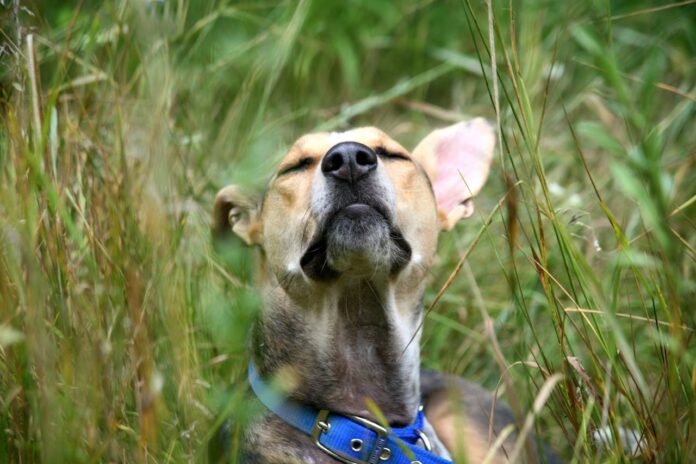
Your dog has ignored three trees, two patches of grass and a perfectly respectable lamppost. Then, for reasons known only to them, one particular spot becomes fascinating. They sniff it carefully, circle around, sniff again and finally urinate exactly where another dog has been.
Smell clearly matters. But this is where many explanations get ahead of the evidence. Dogs are not simply searching for ammonia, urea or some universal chemical that tells them, “pee here.” Where a dog chooses to urinate can be influenced by other dogs’ scent marks, previous experience, the surface under their feet, the surroundings and whether they are actually emptying their bladder or leaving a social signal.
That last distinction matters more than it might seem.
The Scent-Based Communication System
To us, urine is waste. To another dog, it can also be information.
Dogs communicate through scent in ways we are only beginning to understand. Odors can remain in the environment long after the animal that produced them has gone, which means a dog can investigate another individual without ever meeting them face to face. Urine marking is part of that system.
This does not mean that every time a dog urinates they are sending a message. A full bladder still needs emptying. But scent marking is different: dogs may deposit relatively small amounts of urine on particular objects or places even when they do not need to relieve themselves.
That is why the same dog can produce one long urination early in a walk and then somehow find enough urine for several more tiny deposits afterwards.
Other Dogs’ Urine: The Original Social Network
If there is one smell we can confidently say matters, it is the urine of other dogs.
Dogs spend time investigating urine marks, and some respond by leaving a mark of their own. When urine is deposited on top of an existing mark, researchers call it overmarking. When it is deposited nearby, it is generally described as adjacent marking or, more broadly, countermarking.
This is not just an amusing habit invented by dog owners watching lampposts. Controlled studies have found that dogs change both their investigation and marking behavior depending on the urine presented to them. Males and females both participate in countermarking, although sex, reproductive status and social context can influence exactly how they respond.
The evidence becomes much weaker when we try to specify exactly what a dog learns from a single urine mark.
You will often read that urine tells a dog the other animal’s precise age, health, social rank, emotional state, reproductive status and how long ago it passed through. Some of those categories have plausible biological foundations and some have experimental support in particular contexts. But canine urine communication has not been decoded to anything like that level.
Researchers studying the subject still describe the scientific literature on canine urine marking as surprisingly limited.
So the honest version is more interesting than the exaggerated one: dogs clearly obtain socially relevant information from scent, but we do not yet know everything they are learning from it.
That is also a good reason not to rush every sniff on a walk. Your dog may not be reading a detailed neighborhood newspaper, but they are actively investigating information that matters to them.
The Calling Card of Other Animals
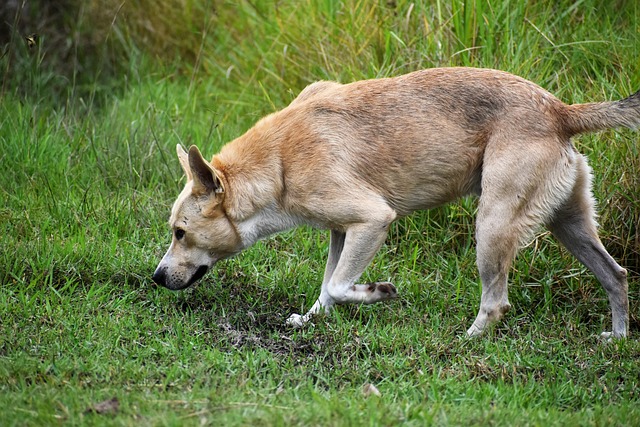
Dogs are naturally interested in animal odors. Cats, rabbits, foxes, rodents and other animals can leave scents that attract prolonged investigation, particularly when those scents are unfamiliar.
But interest in a smell and an urge to urinate are not the same thing.
The evidence is much stronger for dogs responding to the urine of other dogs than for a general rule in which the scent of another species reliably triggers marking. A dog may investigate an unfamiliar animal scent and then mark nearby, but novelty, location, previous scent marks and the dog’s own marking tendencies can all influence what happens next.
The environment matters too. Dogs may mark more when visiting unfamiliar places, particularly where other animals have been. A new house, garden or walking route contains an enormous amount of novel olfactory information.
It is tempting to describe this as territorial behavior: the dog detects an intruder and announces, “this is mine.”
Sometimes territorial or competitive signaling may be part of the picture, but canine marking is not that simple. Marking can occur in social, reproductive and unfamiliar contexts, and dogs do not need to believe they own a lamppost before urinating on it.
Sometimes “I was here” is a better metaphor than “this belongs to me.”
Why Some Dogs Keep Choosing the Same Surfaces
There is another clue hiding underneath your dog’s nose: their feet.
Some dogs strongly prefer grass. Others readily urinate on gravel, soil, mulch or concrete. A puppy accustomed to pee pads may initially struggle when expected to eliminate somewhere completely different.
That tells us something important. Where dogs urinate is not determined by smell alone.
Dogs can develop substrate preferences through experience and learning. If a puppy is repeatedly taken onto grass, urinates there and is rewarded, grass gradually becomes part of the context associated with toileting. Research in dogs has found evidence that the type of surface available can influence elimination behavior.
It is easy to assume that grass and soil attract dogs primarily because they absorb urine and preserve scent better than hard surfaces. Odor retention may influence investigation, but it does not fully explain why individual dogs develop strong preferences for particular substrates.
Learning provides a simpler explanation for at least part of what happens.
It also explains why housetraining can become confusing. A puppy does not understand the abstract human rule that “urination belongs outdoors.” What they actually learn is a combination of place, surface, routine, opportunity and consequence.
That is a rather different lesson.
Why Old Urine Spots Attract Dogs Back
There is one scent effect that matters enormously indoors: a previously soiled area can become a repeat destination.
Dogs can detect residual urine that humans may no longer notice. If that odor remains in carpet, furniture or another surface, the location can continue to be relevant to the dog.
This is where enzymatic cleaners become useful. The goal is not to cover the urine with a more pleasant smell. It is to remove as much of the biological residue as possible.
A common explanation is that ammonia or urea themselves act as powerful urine attractants. The logic sounds convincing: urea is present in urine, old urine can develop an ammonia smell, therefore dogs must detect those chemicals and interpret them as a signal to urinate.
The missing step is evidence.
Urine is chemically complex, and dogs are extraordinarily good at distinguishing complex odors. The presence of a particular compound in urine does not mean that the compound alone is responsible for triggering marking or elimination.
The same caution applies to the familiar claim that an ammonia-based cleaner will necessarily make a dog believe another dog has urinated there. Avoiding irritating cleaning products around animals can make sense for other reasons, but the idea that ammonia automatically acts as a canine “pee here” signal is much more certain than the evidence allows.
The practical rule is much simpler: clean previous accidents thoroughly rather than trying to overpower them with another fragrance.
Scents That Repel Dogs Are Less Reliable Than They Sound
Turn the question around and the internet becomes even more confident.
Citrus keeps dogs away. Vinegar stops marking. Cayenne pepper creates a natural boundary. Strong perfume discourages urination.
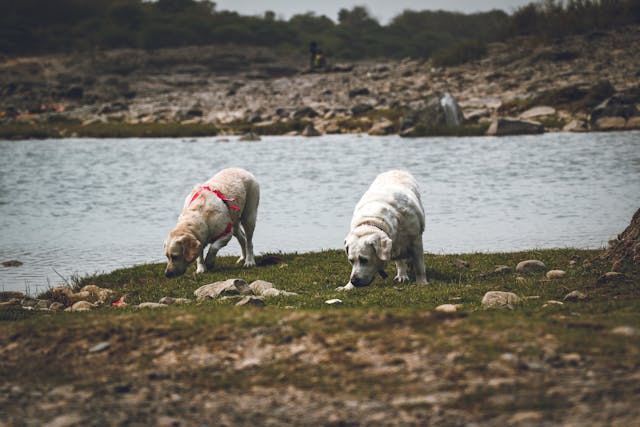
Dogs certainly can dislike strong odors, but individual reactions vary, and there is no dependable household scent that teaches a dog where not to urinate.
One dog may avoid a strong citrus or vinegar smell. Another may investigate it. A third may avoid the location temporarily and return as soon as the odor fades.
That is not training.
Chili powder, cayenne, concentrated essential oils and other deliberately irritating substances are particularly poor choices. A dog’s sensitive nose is not a reason to exploit that sensitivity by making an area uncomfortable.
More importantly, repellents address only half of the problem.
If a dog is urinating behind the sofa, making the sofa smell unpleasant does not teach them that the correct place is the patch of grass outside. It merely makes one location less attractive without establishing the behavior that is actually wanted.
Removing residual odor, supervising the dog, providing regular opportunities to eliminate in the correct place and reinforcing successful elimination gives the animal much clearer information.
Working With What Your Dog Is Actually Learning
Once the search for a magical smell is removed from the equation, housetraining becomes much easier to understand.
Take the dog to an appropriate place. Give them enough time. Use a reasonably consistent surface and location while the behavior is being established. When they urinate there, reinforce it immediately.
Over repeated experiences, the dog learns a pattern.
Scent can contribute to that pattern because previously used toilet areas already contain relevant odors. But deliberately collecting another dog’s urine and placing it in the chosen toilet area is unnecessary. Even if the smell attracts investigation, consistent housetraining provides a clearer and more controllable learning process.
Indoor accidents deserve the opposite treatment. Clean them thoroughly, reduce opportunities for repetition and make successful outdoor elimination easy and worthwhile.
Marking requires slightly different thinking because it is not necessarily a housetraining failure.
A dog that empties a full bladder on the kitchen floor and a dog that leaves a small amount of urine against the leg of a chair may be performing superficially similar acts for very different reasons. Marking often occurs around vertical objects, unfamiliar environments or socially interesting scents, including previous marks from other animals.
A previously house-trained dog that suddenly begins urinating indoors deserves particular attention. Increased urine production, urinary disease, pain and other medical problems can all alter elimination behavior, so a sudden change should not automatically be interpreted as dominance, territoriality or poor training.
A sudden change deserves attention, not a bottle of citrus spray.
Respecting Your Dog’s Scent World
There is a funny asymmetry to walking a dog.
You know exactly where you are going. Your dog knows far more about who has been there.
That is why a patch of grass you have passed a hundred times can suddenly require thirty seconds of investigation. Another dog may have marked it. A new animal may have crossed the path. The odor may simply be novel enough to deserve attention.
Sometimes your dog will investigate and walk away. Sometimes they will urinate nearby. Sometimes they will carefully place their own mark directly over another one.
Scientists have demonstrated enough about canine scent communication to know that these behaviors are meaningful. They have not demonstrated enough for us to translate every sniff into a neat sentence.
And perhaps that distinction is worth preserving.
The interesting thing about your dog’s olfactory world is not that every message has already been decoded. It is that an apparently trivial decision — why this tree rather than the previous one? — sits at the intersection of communication, learning, reproductive biology, individual experience and an extraordinary sensory system.
So what smells attract dogs to urinate?
The strongest answer is not ammonia, vinegar, grass or any other single odor. The scent marks of other dogs matter, particularly for marking behavior. Previous elimination sites matter. Learned preferences and context matter too.
Your dog is not following one smell.
They are making a decision from a world of information that humans can only partly detect.
Sources & Further Reading
- Siniscalchi, M., D’Ingeo, S., Minunno, M., & Quaranta, A. (2018). Communication in dogs. Animals, 8(8), 131.
- Lisberg, A. E., & Snowdon, C. T. (2011). Effects of sex, social status and gonadectomy on countermarking by domestic dogs, Canis familiaris. Animal Behaviour, 81(4), 757–764.
Featured Image Brenda Timmermans

