
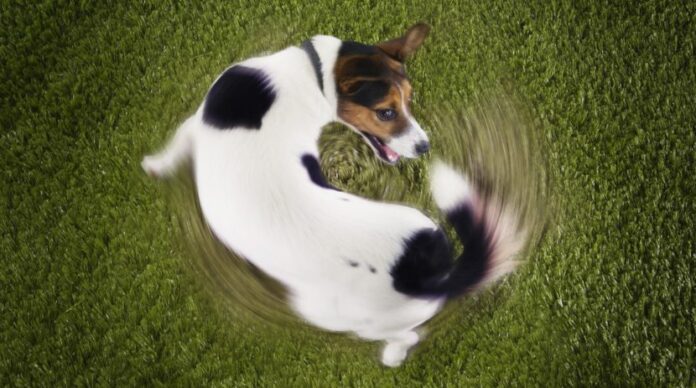
Your dog suddenly notices something moving behind them. They turn to investigate, but the mysterious object moves too. Another turn, another escape, and before you know it, your dog is spinning in circles, apparently determined to catch the one thing that keeps following them everywhere.
Their own tail.
It’s easy to laugh. Watching a puppy discover this endlessly available moving target can be wonderfully entertaining, and a brief tail-chasing session is often just part of play.
But what if your dog starts doing it every day? What if the spinning becomes more intense, lasts longer, or seems impossible to interrupt even when something else would normally catch their attention?
The same behavior that looks amusing in one situation can mean something quite different in another. Understanding why dogs chase their tails means looking beyond the spinning itself, because sometimes it’s a game, sometimes something is bothering them, and sometimes the behavior can become a problem in its own right.
Sometimes, a Tail Is Just an Interesting Toy
Puppies are busy discovering the world, including the strange business of having a body. Paws move, ears twitch, and somewhere behind them is a furry appendage that seems to have a mind of its own.
For a playful puppy, that moving tail can become something worth investigating. It’s a little like watching a baby discover their hands and feet: an ordinary part of the body suddenly becomes interesting. The comparison is a useful way to imagine a puppy’s curiosity, although it doesn’t establish exactly why tail chasing begins.
Adult dogs may occasionally chase their tails too, particularly during moments of excitement or energetic play.
A dog might spin a few times, abandon the chase, and immediately move on to something else. Perhaps a toy catches their eye, someone calls them over, or they simply decide they’ve had enough.
That ability to move on is worth noticing. A brief, occasional spin in an otherwise comfortable, healthy dog is very different from a dog who repeatedly chases their tail for long periods or seems unable to stop.
And there’s no reason to assume every dog experiences the behavior in the same way. One may be playing, another may be reacting to an uncomfortable sensation, and a third may have developed a repetitive behavior that is becoming difficult to control.
The movement may look identical from the outside, but the circumstances surrounding it can tell a very different story.

When Does Tail Chasing Stop Looking Like Play?
Imagine two dogs.
The first chases their tail for a few seconds after an exciting game. Then someone picks up a ball, and the dog immediately runs off to investigate. A little later, they’re lying comfortably on the floor, apparently having forgotten all about the chase.
The second starts spinning in the living room. Their owner calls their name and offers a favorite toy, but the dog continues circling. Eventually the episode ends, only for the same thing to happen again a short while later.
Both dogs are chasing their tails, but the patterns are different.
The most useful clues are how often the behavior happens, how intense it becomes, whether your dog can comfortably stop, and whether it interferes with ordinary life.
Perhaps your dog used to chase their tail occasionally but now does it several times a day. The episodes may be lasting longer, or the dog may seem unusually focused on the movement even when something else is happening nearby.
In more serious cases, dogs can bite or injure their own tails. Repeated chasing may also interfere with activities such as eating, sleeping, playing, or relaxing.
There isn’t a universal number of spins or minutes that separates normal play from a behavioral problem. Dogs differ in their activity levels and habits, and a single episode rarely tells us enough to understand what is happening.
A more useful starting point is knowing what is typical for your own dog and paying attention when that pattern changes.
Could Something Be Itching or Hurting?
Before assuming that persistent tail chasing is a behavioral problem, it’s important to consider a physical explanation.
Something around your dog’s tail or hindquarters may be uncomfortable.
A dog can’t tell you that the skin near the base of their tail is itchy or that something hurts around their rear end. Instead, they may turn toward the area, lick, chew, bite, or repeatedly try to reach it.
One possible culprit is flea allergy dermatitis.
Some dogs are particularly sensitive to flea saliva, and even a relatively small number of bites can produce considerable itching. The lower back and base of the tail are common areas for irritation, so an affected dog may spend a lot of time trying to reach or bite the skin.
You might notice redness, hair loss, scabs, or repeated licking and chewing. However, not every dog who turns toward their tail has fleas, and itching alone doesn’t identify the cause of a skin problem.
Another possibility involves the anal sacs, two small structures located beside a dog’s anus.
These sacs normally release secretions, but they can sometimes become impacted, inflamed, or infected. When that happens, a dog may feel uncomfortable around the rear end and respond by scooting along the floor, licking or biting near the anus, or behaving unusually when sitting or passing stools.
Anal-sac problems can make a dog pay more attention to the area, although tail chasing by itself doesn’t establish that the sacs are responsible.
Pain is another consideration. Problems involving the tail, lower back, or surrounding structures can sometimes produce unusual movements or repeated attempts to reach the affected area. In certain cases, neurological conditions may also need to be investigated.
These possibilities explain why a dog who suddenly becomes unusually focused on their tail may need a veterinary examination rather than simply another toy.
Look for other changes alongside the chasing. Does your dog lick or bite the same area? Is the skin irritated? Do they seem sensitive when touched, uncomfortable when sitting, or different in the way they move?
Those observations can help your vet work out where to begin. But the cause cannot reliably be identified from the spinning alone, and attempting to treat an assumed anal-sac or skin problem without knowing what’s wrong may make matters worse.
When Tail Chasing Becomes Compulsive
Sometimes there is no obvious itch, injury, or other physical problem that explains the behavior.
In some dogs, tail chasing can develop into a compulsive behavior.
This is different from an occasional game. A compulsive behavior is repetitive and excessive, may appear in situations where it serves no obvious purpose, and can become difficult for the dog to interrupt.
It may also interfere with other activities that would normally occupy the animal’s attention.
Imagine a dog who initially spins when especially excited or frustrated. Over time, the chasing becomes more frequent and starts appearing in situations that have little connection with the original excitement.
Eventually, the dog may continue spinning even when opportunities to play, rest, or interact with the family are available.
That doesn’t mean every dog who enjoys chasing their tail is developing a compulsive disorder. Repetitive behavior exists on a spectrum, and a dog may spin because of temporary excitement, frustration, or other circumstances without having a clinical condition.
But when the behavior becomes persistent, excessive, or difficult to interrupt, it deserves to be taken seriously.
Veterinarians consider several possibilities before diagnosing a compulsive disorder, including medical problems that can produce similar behavior. The diagnosis depends on the wider pattern, the dog’s history, and the results of an appropriate evaluation, not simply on how many circles the dog completes.
What Researchers Found in Tail-Chasing Dogs
In 2012, researchers published a study in PLOS ONE examining tail chasing in 368 dogs from four breed groups: Standard Bull Terriers, Miniature Bull Terriers, Staffordshire Bull Terriers, and German Shepherd Dogs.
Using questionnaires completed by owners, the researchers investigated when the behavior began, how frequently it occurred, how easily it could be interrupted, and which circumstances appeared to be associated with it.
One interesting finding concerned the age at which tail chasing began.
In Standard Bull Terriers and German Shepherd Dogs, the reported onset was commonly around three to six months of age. In Miniature Bull Terriers and Staffordshire Bull Terriers, it was typically later, between six and 24 months.
The study also found considerable variation in severity. Some dogs had experienced only a few episodes during their lives, while others chased their tails several times a day.
The differences weren’t limited to how frequently the dogs spun.
Around 48% of the tail-chasing dogs were reported to show reduced responsiveness during episodes. In other words, their owners found that the dogs responded less normally to being called or given familiar cues while they were chasing their tails.
The researchers also found that dogs with more severe tail chasing tended to be harder to interrupt.
That’s an important observation because it illustrates why the behavior’s intensity and the dog’s ability to disengage can be more informative than the movement itself.
The study found that tail-chasing dogs also displayed certain other repetitive behaviors more often than dogs that didn’t chase their tails, including repeated pacing, licking, and chasing lights or apparently invisible objects.
These findings helped researchers examine tail chasing as part of a wider range of repetitive behaviors in dogs.
There are limits to what the results tell us, however. The information came largely from owner questionnaires involving selected breeds, and the study was observational. It could identify associations and patterns, but it couldn’t establish the cause of tail chasing in every dog.
Still, the findings show why persistent chasing deserves more attention than simply describing a dog as playful or easily amused.
Is Boredom Really the Explanation?
You may have heard that dogs chase their tails because they’re bored.
It’s an appealing explanation. If a dog has little to do, perhaps they invent their own entertainment, and their tail becomes an easy target.
Sometimes a lack of engaging activities may be part of the picture, but the research suggests the relationship isn’t that simple.
In the 2012 study, some owners associated their dogs’ tail chasing with boredom or a lack of activities. Others reported episodes following stressful events, while some connected the behavior with excitement, frustration, or other circumstances.
Those observations provide useful clues about the situations in which the behavior appeared, but they don’t establish what the dogs were feeling or what caused the episodes.
The researchers also found no clear association between tail-chasing frequency and the amount of daily exercise or activities reported by owners.
That matters because it challenges the idea that a dog who repeatedly chases their tail must simply need more exercise.
An under-stimulated dog may benefit from additional opportunities to explore, play, and engage with its environment. But adding another walk or buying a new toy isn’t a reliable treatment for every case of persistent tail chasing.
Stress and frustration may also be relevant, particularly when the behavior appears repeatedly in certain situations. Yet even when an episode follows an upsetting event, we cannot automatically conclude that spinning relieves distress or serves a particular emotional purpose.
Individual differences matter as well. Some dogs may be more susceptible to repetitive behaviors because of inherited traits or other factors in their development.
Research has identified particular concerns involving tail chasing in breeds such as Bull Terriers and German Shepherd Dogs, although this doesn’t mean every dog from those breeds will develop a problem. Dogs of other breeds and mixed backgrounds can also display compulsive behavior.
The important point is that the same visible behavior can arise for different reasons.
A dog who continues chasing their tail despite having an active, engaging daily life shouldn’t be dismissed as simply needing more entertainment. And a dog whose routine has recently become less stimulating still deserves a medical assessment if the chasing is persistent, intense, or causing harm.

Could Our Reactions Make Tail Chasing More Frequent?
Picture a puppy spinning after their tail.
Everyone laughs. Somebody calls another family member into the room, and perhaps a phone comes out to capture the moment. The puppy has certainly attracted attention.
Dogs learn from the consequences of their behavior, and human reactions can influence what they do in future interactions.
If spinning repeatedly produces attention, excitement, or an invitation to play, it’s possible that some dogs may become more likely to repeat the behavior in similar circumstances.
But that possibility doesn’t explain every case of tail chasing.
An initially playful action might become more frequent partly because it receives attention, while another dog’s repetitive spinning could be connected to discomfort, anxiety, or a compulsive disorder.
Those situations require different responses.
It’s particularly important not to assume that a dog who seems unable to stop is simply performing for attention or refusing to listen.
If the behavior has become compulsive, shouting, frightening the dog, or physically forcing them to stop is unlikely to address the underlying problem. Punishment may increase fear or stress and can make behavioral difficulties harder to manage.
Instead, try to understand the circumstances in which the chasing happens.
Does it begin during particularly exciting interactions? Do people tend to laugh or encourage it? Does the dog readily move on when the situation changes, or does the behavior continue despite a calm invitation to do something else?
These observations are much more useful than deciding the dog is being silly, stubborn, or deliberately misbehaving.
What Should You Do if Your Dog Keeps Chasing Their Tail?
If your dog’s tail chasing is new, increasingly frequent, intense, difficult to interrupt, or interfering with daily activities, arrange a veterinary appointment.
The first step is to establish whether something physical could be contributing to the behavior.
Your vet can examine your dog’s skin, tail, hindquarters, and general health, and decide whether additional checks are appropriate. If the chasing appears repetitive or unusually difficult to control, a behavioral evaluation may also be needed.
Before the appointment, it can help to pay attention to a few details.
- When it happens: Does your dog start chasing after play, when visitors arrive, during quiet periods, or at a particular time of day?
- How it changes: Are the episodes becoming more frequent, lasting longer, or increasing in intensity?
- Whether your dog can stop: Do they readily respond to a familiar cue or another activity, or do they appear unusually absorbed in the spinning?
- Other physical signs: Have you noticed licking, biting, skin irritation, hair loss, pain, or changes in movement?
- What happens afterward: Does your dog settle normally, return to another activity, or quickly begin chasing again?
These details can help your veterinarian understand the pattern rather than relying on a description of the behavior alone.
If possible, record a short video of a naturally occurring episode without encouraging or prolonging it. Your dog may not display the behavior during the appointment, and seeing it can help the clinician assess what you’re describing.
A new or persistent pattern is worth discussing even when your dog seems otherwise well.
If the chasing is causing bleeding, significant self-inflicted injury, or marked pain, contact your vet urgently. Sudden neurological signs, such as a seizure or an inability to move normally, also require urgent veterinary help.
Give Your Dog Other Ways to Use Their Energy
Whatever the underlying explanation, a comfortable and engaging daily routine matters.
Dogs benefit from opportunities to move, sniff, explore, play, chew suitable objects, learn, and rest. The ideal balance will differ depending on the dog’s age, health, temperament, and everyday circumstances.
For example, a walk that allows plenty of sniffing can offer a different kind of experience from one focused entirely on covering distance. Food puzzles, suitable chew toys, gentle training games, and interactive play can provide additional opportunities for mental and physical activity.
Variety can be valuable, but more excitement isn’t always better.
A dog who becomes easily overwhelmed may benefit from predictable routines and quiet opportunities to settle, rather than an endless succession of stimulating activities.
If your veterinarian suspects a compulsive disorder, the treatment plan may involve changes to the environment, behavior modification, and sometimes prescribed medication. A veterinary behaviorist can be particularly helpful when the behavior is persistent, severe, or causing injury.
The aim is to address the dog’s needs and the factors contributing to the behavior, not simply to suppress an inconvenient movement.
And although an engaging routine is part of good everyday care, it isn’t a guaranteed treatment for compulsive tail chasing or a substitute for investigating a possible medical problem.
There’s More to the Spin Than Meets the Eye
Watching a dog chase their tail can be funny, and sometimes that’s all there is to it.
A moving tail catches a dog’s attention, a little chase begins, and a few seconds later the game is forgotten. The dog moves on with their day, leaving us with an amusing memory or perhaps a photograph.
But when the spinning becomes frequent, intense, or difficult to interrupt, the picture changes.
Itching, pain, stressful circumstances, or a developing compulsive behavior may all deserve consideration. What matters isn’t simply that a dog is turning in circles, but how the behavior fits into the rest of their life.
Does your dog seem comfortable? Can they move on to other activities? Have the episodes changed, or is something else happening alongside them?
Those questions help distinguish an occasional playful moment from a pattern that deserves a closer look.
A few circles may be nothing more than play. But when a dog seems unable to leave the chase behind, the important thing is to find out why.
Sources & Further Reading
- American Animal Hospital Association. (2026). Why Do Dogs Chase Their Tails?. AAHA.
- Tiira, K., Hakosalo, O., Kareinen, L., Thomas, A., Hielm-Björkman, A., Escriou, C., Arnold, P., & Lohi, H. (2012). Environmental Effects on Compulsive Tail Chasing in Dogs. PLOS ONE, 7(7), e41684.
- Merck Veterinary Manual. (n.d.). Behavior Problems of Dogs. Merck Veterinary Manual.
- Merck Veterinary Manual. (n.d.). Diagnosis of Behavior Problems in Animals. Merck Veterinary Manual.
- Merck Veterinary Manual. (n.d.). Anal Sac Disease in Dogs and Cats. Merck Veterinary Manual.
- Merck Veterinary Manual. (2026). Flea Allergy Dermatitis in Dogs and Cats. Merck Veterinary Manual.
- Horwitz, D. F., Ciribassi, J., & Dale, S. (Eds.). (2014). Decoding Your Dog. Houghton Mifflin Harcourt.
- Bender, A., & Strong, E. (2019). Canine Enrichment for the Real World. Dogwise Publishing.

