
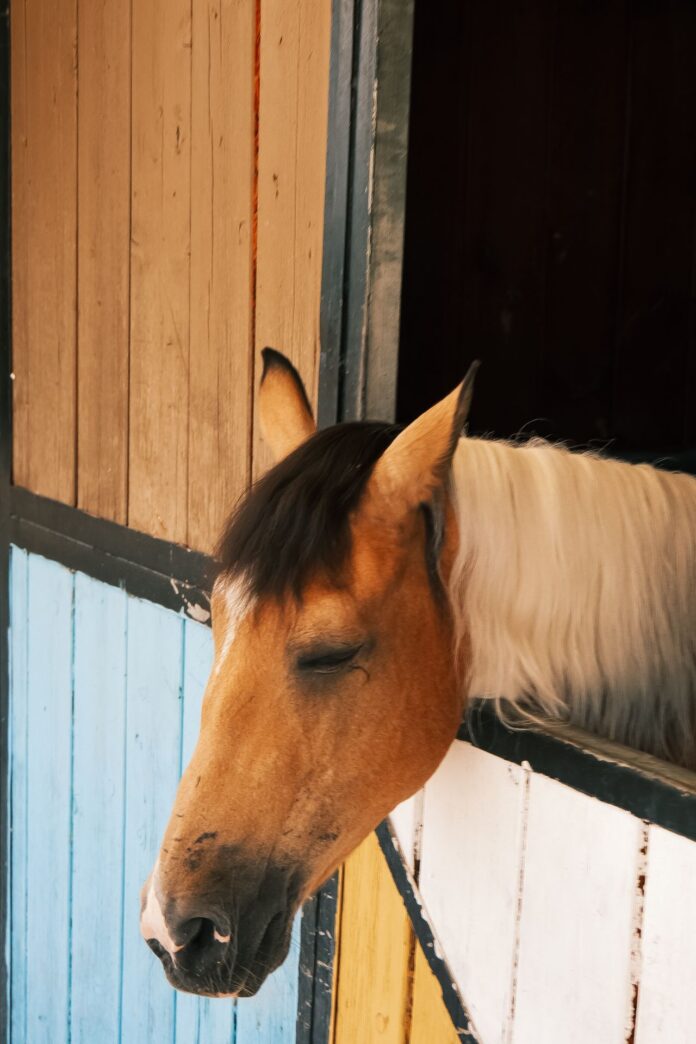
Walk past a field of horses on a quiet afternoon, and you might notice one standing almost motionless, its eyes half closed and a hind leg resting lightly on the ground. It looks perfectly relaxed, perhaps even asleep.
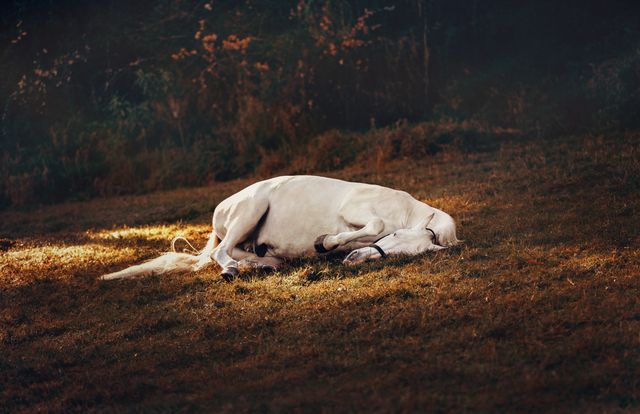
A little farther away, another horse is stretched out on its side, legs extended across the grass. To someone unfamiliar with horses, the second animal might seem more unusual than the first. After all, aren’t horses supposed to sleep standing up?
They certainly can, but that’s only part of the story.
Horses can get genuine sleep while standing, yet they also need opportunities to lie down. The difference has to do with how their bodies support their weight, what happens during different stages of sleep, and whether their surroundings allow them to rest comfortably.
Understanding that distinction reveals something important about equine welfare. A horse that appears to be resting peacefully on its feet may still need a very different kind of sleep.
How Can Horses Sleep Without Falling Over?
For most of us, sleeping while standing would be difficult. As our muscles relaxed, we would struggle to maintain balance. Horses, however, have an anatomical adaptation that makes upright rest much easier.
Their limbs contain a specialized arrangement of tendons, ligaments, and other supporting structures known as the stay apparatus. Working together with the horse’s skeletal anatomy, these structures help stabilize the limbs and allow the animal to remain standing with relatively little muscular effort.
One visible example is the way a resting horse often shifts its weight onto one hind leg while relaxing the other. The supported limb helps maintain stability, allowing the horse to stand quietly without continually engaging its muscles as intensely as we might expect.
This is why a horse can appear almost motionless, with its head lowered and eyes partly closed, while remaining comfortably upright.
And that horse may genuinely be asleep.
Horses can enter non-REM sleep, including slow-wave sleep, while standing. During this stage, brain activity changes in ways associated with sleep, even though the animal remains sufficiently supported to stay on its feet.
The ability is particularly useful for an animal that evolved as a prey species. Resting upright allows a horse to avoid having to lie down every time it needs some sleep, while remaining in a position from which it can move relatively quickly.
But this adaptation has an important limitation. It cannot reliably support a horse through every stage of sleep.
Why Horses Need to Lie Down for REM Sleep
Like humans and many other mammals, horses experience different stages of sleep. One of these is REM sleep, short for rapid eye movement sleep.
During REM sleep, brain activity changes and most skeletal muscles temporarily lose much of their normal tone. This reduction in muscular activity is called muscle atonia.
For a horse weighing several hundred kilograms, that loss of support has obvious consequences.
The stay apparatus helps a horse maintain an upright posture during quieter stages of sleep, but it cannot reliably prevent the body from losing stability when muscle tone decreases during REM sleep.
Horses therefore normally need to lie down to maintain REM sleep safely.
They may rest fully stretched out on their sides, a position known as lateral recumbency, or lie on their chests with the head and neck supported against the ground.
The important factor is that the body no longer depends on the legs to remain upright. With sufficient support, the horse can enter a stage of sleep that would otherwise make standing difficult.
This also explains why standing rest and lying down are not interchangeable. A horse may spend time dozing on its feet and obtain genuine non-REM sleep, but that doesn’t establish that it has received adequate REM sleep.
Can a Horse Ever Enter REM Sleep While Standing?
There is an interesting exception to the usual explanation.
In a small study involving five horses, researchers recorded brain activity alongside video observations and documented brief episodes of REM sleep while standing in one animal.
These weren’t examples of a horse remaining comfortably asleep on its feet. The standing REM episodes were associated with repeated partial collapses, as the animal temporarily lost the muscular support needed to maintain its posture.
A horse experiencing such an episode may suddenly lower its head or begin to buckle at the knees.
These observations help explain why recumbency matters, rather than demonstrating that standing REM is a normal alternative. A horse may briefly enter that sleep stage while upright, but maintaining the position becomes unreliable when muscle tone decreases.
The practical implication is straightforward: being able to sleep standing up doesn’t eliminate a horse’s need for a suitable place to lie down.
Why Some Horses Don’t Lie Down Enough
Lying down may seem like the simplest part of sleeping, but for a horse it involves a substantial physical movement.
The animal must lower its large body to the ground, settle into a comfortable position, and eventually rise again. Both movements require adequate space, suitable footing, and sufficient physical comfort.
A horse also needs an environment in which it can relax without frequent disturbance. A resting area that seems adequate to a person may not always offer the conditions an individual horse needs.
Why Comfortable Bedding Matters
Consider a horse living in a stable with hard or uneven flooring and only a thin layer of bedding. It might be perfectly capable of standing there for hours while being less willing to lower its body onto the surface.
Bedding provides cushioning and can make lying down more comfortable. Researchers have investigated whether differences in bedding conditions influence how much time horses actually spend resting on the ground.
In a study published in 2026, scientists examined 16 individually stabled horses, comparing two depths of peat bedding: 5 cm and 15 cm.
The results showed a substantial difference in lying behavior. With 15 cm of bedding, the horses spent approximately 71 minutes lying down overnight, compared with around 36 minutes when the bedding was only 5 cm deep.
They also lay down more frequently when the bedding was deeper.
That doesn’t mean every horse needs exactly 15 cm of peat or that doubling the time spent lying down necessarily doubles REM sleep. The study measured resting behavior through video observations, and the increase was mainly associated with resting on the chest rather than lying fully on the side.
Nevertheless, the finding is valuable. It shows that a relatively ordinary feature of stable management can influence whether horses make use of their opportunities to rest.
Space is another important consideration. A horse needs enough room to lower itself, adopt a comfortable position, and rise without becoming trapped or injured. Clean, dry bedding and secure footing can also make the resting area more suitable.
There is no single arrangement that guarantees adequate sleep for every horse, but providing a comfortable place to lie down is an essential starting point.
Feeling Safe Enough to Rest
Physical comfort is only part of the picture. Horses are social animals, and their relationships with other horses can influence how they behave in shared spaces.
Familiar companions may contribute to a secure environment, but overcrowding, conflict, or repeated disturbance can make resting more difficult. A horse that is frequently approached or displaced may have fewer opportunities to settle undisturbed.
Changes in housing can also affect resting behavior. Moving to an unfamiliar stable, adjusting to a new group, or encountering a different daily routine may temporarily alter when and how long a horse lies down.
A 2026 study at the University of Veterinary Medicine Vienna examined sleep in ten horses across different housing conditions. Researchers used non-invasive electroencephalography (EEG), which records electrical activity in the brain, alongside video monitoring over four consecutive nights.
They found differences in sleep stages and lying behavior between a shared housing arrangement and individual stalls. The horses also showed changes over successive nights, suggesting that adaptation to the environment influenced their resting patterns.
Age was another factor. In this small sample, younger adult horses generally showed more REM sleep and less fragmented sleep patterns than older horses.
The study cannot establish one ideal housing arrangement for every horse, particularly given its limited sample size. But it provides an important reminder that sleep is influenced by the environment, social circumstances, and characteristics of the individual animal.
A horse’s resting behavior therefore needs to be considered in the context of where and how it lives, rather than judged from a single observation.
Pain Can Make Lying Down Difficult
Sometimes the obstacle isn’t the resting area but the horse’s own physical condition.
Imagine an older horse with painful joints. Standing quietly may be relatively comfortable, while lowering several hundred kilograms to the ground requires bending those joints and shifting weight in ways that cause discomfort.
Getting back up can be equally demanding.
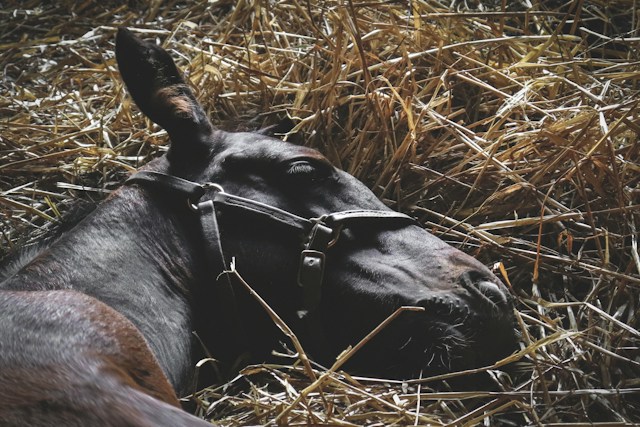
A horse with arthritis, stiffness, an injury, or another painful condition may become reluctant to lie down because the movement is uncomfortable. Depending on the problem, the horse may also have difficulty rising once it is on the ground.
This is why a change in resting behavior can sometimes provide a clue about physical health.
A horse that previously lay down regularly but now appears hesitant, particularly if it also shows lameness, stiffness, or changes in movement, may need veterinary assessment rather than simply a more comfortable bed.
There is an important difference, however, between a horse that hasn’t been observed lying down and one that is visibly struggling to do so. The first situation may have an ordinary explanation; the second deserves closer attention.
Resting behavior alone cannot identify the cause, but changes in that behavior can help indicate when something needs investigating.
What Happens if a Horse Doesn’t Get Enough REM Sleep?
Horses don’t usually sleep in one long, uninterrupted period. Instead, they are polyphasic sleepers, meaning they sleep in several bouts throughout the day and night.
Much of their sleep occurs overnight, although the timing and duration vary between individuals and environments. Standing sleep forms part of this pattern, while lying down provides the usual opportunity for REM sleep.
If a horse repeatedly misses those opportunities, the consequences may become noticeable.
Veterinarians and researchers have described horses showing excessive daytime drowsiness and episodes in which the head suddenly drops or the legs begin to buckle. Some animals appear to start falling asleep while standing, then briefly lose enough muscular support that they partially collapse.
Repeated episodes can cause injuries, particularly around the knees, fetlocks, or face.
One possible explanation is insufficient REM sleep because the horse has been unable or unwilling to lie down adequately. However, buckling or collapse doesn’t prove sleep deprivation. Other medical and neurological conditions can produce similar signs.
Recognizing that distinction is essential, because an animal that repeatedly loses stability needs proper assessment rather than an assumed diagnosis.
Is That the Same as Narcolepsy?
Not necessarily.
Narcolepsy is a neurological sleep disorder associated with excessive sleepiness and episodes of abnormal sleep regulation. Affected horses may experience sudden loss of muscle tone, sometimes triggered by events or changes in their surroundings.
But genuine narcolepsy appears to be uncommon in horses.
The University of California, Davis, notes that episodes resembling narcolepsy may instead be associated with insufficient sleep, including situations in which discomfort or environmental conditions prevent normal rest.
The outward signs can look similar, which makes it difficult to identify the underlying problem through observation alone.
Repeated buckling, sudden episodes of apparent sleep, or partial collapse warrant prompt veterinary investigation, even if a horse otherwise seems healthy.
And if a horse goes down and cannot get back up, urgent veterinary assistance is needed.

How Can You Tell Whether Your Horse Is Resting Well?
One of the most useful things to remember is that not seeing your horse lie down doesn’t necessarily mean it never does.
Horses may choose to rest during the night, early in the morning, or at times when their caregivers aren’t present. Some also prefer particular areas of a stable or field.
If you only visit your horse for an hour each afternoon, you may simply be missing much of its normal resting behavior.
Observing over several days can provide a clearer picture. Where practical, an overnight camera may help reveal patterns that would otherwise go unnoticed.
Pay attention to whether your horse lies down, how comfortably it moves into and out of that position, and whether anything has changed from its usual behavior. A horse that occasionally rests on the ground and rises without difficulty presents a different picture from one that appears reluctant, uncomfortable, or unusually drowsy.
It is also useful to consider the surroundings.
- Is there enough clean, dry space for the horse to lie down and rise safely?
- Is the bedding comfortable and the footing secure?
- Can the horse rest without being repeatedly disturbed by people or other horses?
- Have changes in housing, routine, or social grouping coincided with changes in resting behavior?
- Does the horse show signs of pain, stiffness, or difficulty moving?
These observations won’t tell you exactly how much REM sleep a horse has obtained. Identifying sleep stages reliably requires more specialized methods than watching posture or behavior.
Nevertheless, they can help identify practical obstacles to comfortable rest and provide useful information if veterinary advice becomes necessary.
Sometimes a change in bedding, available space, or the way horses are grouped may improve resting opportunities. But adjustments should respond to an identified problem rather than being treated as a guaranteed solution.
If a horse continues to show unusual behavior despite a suitable environment, pain, illness, or another underlying condition may need to be investigated.
When Should You Call a Veterinarian?
An occasional quiet doze while standing is normal, and finding a horse stretched out on the ground isn’t automatically a cause for concern.
What matters is whether its resting behavior has changed or whether it shows signs of difficulty.
Arrange veterinary advice if you notice a new reluctance to lie down, difficulty lowering the body or rising, signs of pain, or persistent unusual daytime drowsiness.
Repeated buckling or collapse-like episodes require prompt veterinary assessment, because they may have several possible causes and can lead to injury.
A horse that suddenly cannot rise needs urgent veterinary help. Avoid assuming that the problem is simply tiredness or attempting to force the animal to its feet without professional guidance.
The aim isn’t to worry about every resting posture, but to recognize when an otherwise ordinary behavior has changed in a way that may indicate a welfare or medical problem.
A Horse’s Sleep Tells Us More Than We Might Expect
There is something remarkable about a horse dozing peacefully on its feet. Beneath that familiar posture is an anatomical system that allows a large animal to rest while remaining upright.
Yet the sight of a horse lying comfortably on the ground is just as important.
That apparently simple behavior depends on several things coming together: adequate space, suitable footing, physical comfort, and surroundings in which the animal can settle without unnecessary disturbance.
A horse stretched out on its side isn’t necessarily doing anything unusual. It may simply be getting an important kind of sleep that standing rest cannot reliably provide.
For the people responsible for horses, understanding both forms of rest offers a more complete picture of their needs.
The remarkable thing isn’t only that horses can sleep standing up. It’s that good welfare also means giving them the opportunity to lie down.
Sources & Further Reading
- Greening, L., & McBride, S. (2022). A Review of Equine Sleep: Implications for Equine Welfare. Frontiers in Veterinary Science, 9, 916737.
- University of California, Davis. (n.d.). Equine Sleep and Sleep Disorders. Equine and Comparative Neurology Research Group.
- Young, A., & Finno, C. (2021). Narcolepsy. UC Davis Center for Equine Health.
- Zimmer, L., et al. (2026). Sleep Architecture and Lying Behavior in Horses Across Age Groups and Two Housing Systems: An Overnight Non-invasive EEG Study. Frontiers in Veterinary Science, 13, 1898580.
- Suomala, H. M., Hänninen, L., Lüscher, M., Ternman, E., & Mykkänen, A. (2026). Greater Bedding Depth Increases Lying and Sleep-Related Behaviour in Stabled Horses. Applied Animal Behaviour Science, 305, 107194.
- University of California, Davis. (n.d.). The Passive Stay Apparatus. Center for Equine Health.
Featured image by Ebahir

