
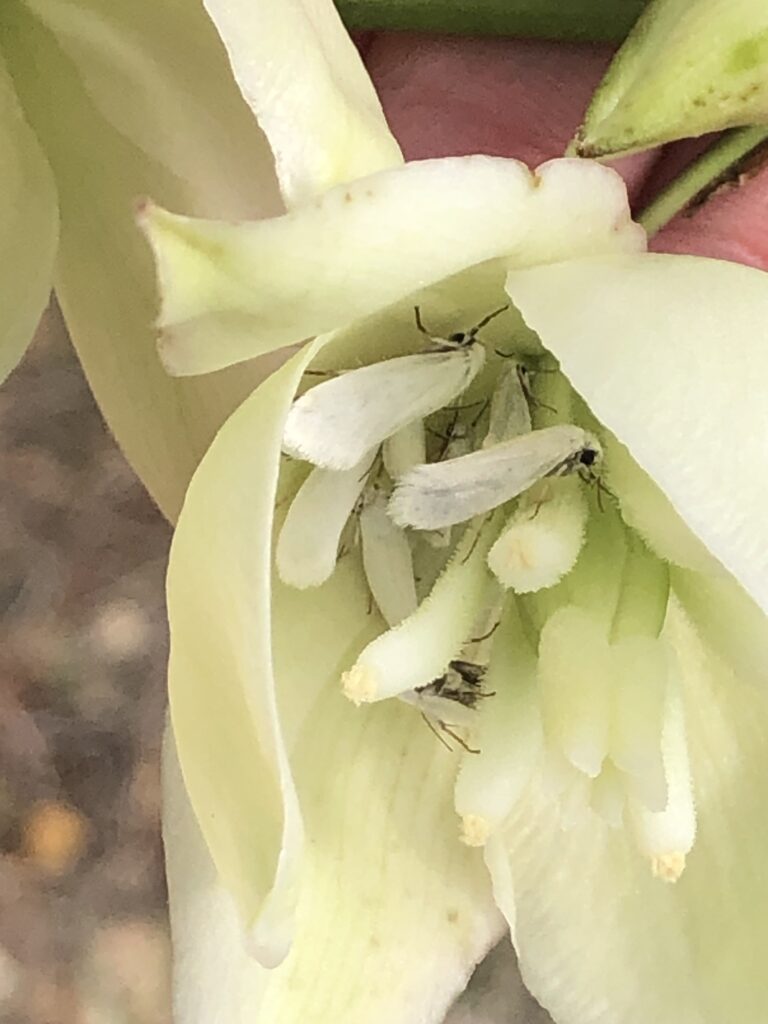
In a North American desert, a tiny moth climbs into a yucca flower carrying something unusual: a carefully collected bundle of pollen.
She hasn’t picked it up by accident. She gathered it from another flower and will deliberately place it where the yucca needs it. During her visit, she also lays her eggs, and the seeds that develop after successful pollination will provide food for her future caterpillars.
It’s an extraordinary relationship between an insect and a plant. And it has nothing to do with bees.
When we think about pollination, bees usually get most of the attention. We picture them moving between flowers, their bodies dusted with pollen as they search for nectar. But the natural world has developed many other ways to accomplish the same essential task.
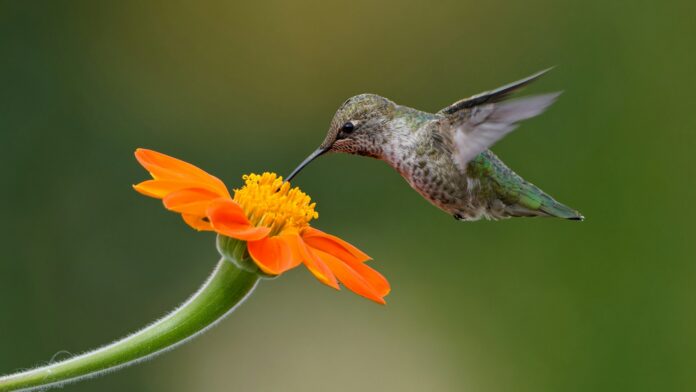
Tiny flies help pollinate cacao flowers. Beetles crawl through magnolias. Hummingbirds carry pollen on their bills and feathers, while bats visit desert flowers under cover of darkness. Some plants even rely on tiny wasps that develop inside structures most of us would mistake for ordinary fruit.
And in certain ecosystems, the list becomes stranger still: lizards, rodents, and small marsupials can also help plants reproduce.
Bees are remarkable pollinators, but they are only part of a much larger story. To understand the others, we need to look at what actually happens when an animal visits a flower.
What Makes an Animal a Pollinator?
A flower may offer nectar, pollen, or other resources to attract visitors. In return, some of those visitors help move pollen from a flower’s pollen-producing structures to a receptive stigma, either within the same flower or on another flower.
The stigma is the surface where pollen is received. When compatible pollen reaches it, the process can lead to fertilization and, eventually, the production of seeds.
The animal doesn’t usually intend to help. It may simply be trying to reach a drop of nectar or collect something to eat. Pollen clings to its fur, feathers, or body as it moves around the flower, and some of that pollen may reach a receptive stigma during the same visit or a later one.
This creates an ecological relationship between organisms pursuing different goals. A plant needs to reproduce, an animal needs food, and their interests can bring them together.
Not every flower visitor is an effective pollinator, however. A butterfly might reach nectar without touching the reproductive parts of a flower, while a beetle or fly may transfer considerable amounts of pollen simply by crawling through it. The outcome depends on the animal, the flower, and how they interact.
Sometimes the relationship is relatively flexible, with several different animals able to help a plant reproduce. In other cases, the connection becomes astonishingly specialized.
Some of the best examples involve insects we rarely notice.
Flies: The Tiny Pollinators Behind Chocolate
The next time you eat a piece of chocolate, consider the tiny flies that may have helped make it possible.
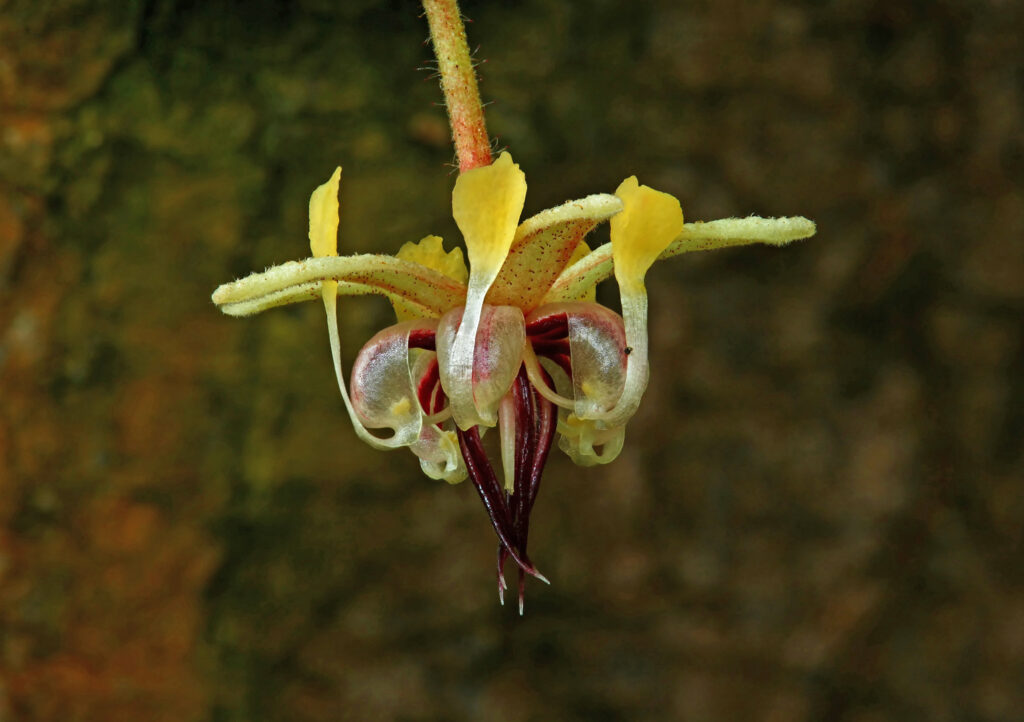
Cacao trees, which produce the beans used to make chocolate, grow small flowers directly from their trunks and older branches. The flowers are intricate and surprisingly small compared with the large pods they can eventually produce.
Their structure makes pollination a challenge for many larger insects. But certain tiny flies, particularly biting midges, are small enough to move among the floral structures and come into contact with pollen.
The Royal Botanic Gardens, Kew, identifies these midges as important pollinators of cacao in the wild. At Kew’s own glasshouses, horticulturists sometimes pollinate cacao flowers by hand using a paintbrush.
A cacao flower doesn’t necessarily need a large, conspicuous visitor. Some of the insects best suited to reaching its reproductive structures are almost too small to notice.
What Researchers Discovered in 2026
A study published in Basic and Applied Ecology in August 2026 took a closer look at which insects visiting cacao flowers were most likely to transfer pollen.
The researchers examined how different insects behaved on the flowers, whether they contacted the reproductive structures, and whether cacao pollen adhered to their bodies. This allowed them to distinguish visitors with traits compatible with pollination from insects that happened to be present without showing convincing evidence of that role.
Biting midges belonging to the genus Forcipomyia emerged as particularly strong candidates for effective pollination. They were active around the flowers, frequently contacted the relevant structures, and carried pollen more consistently than several other groups of visiting insects.
The researchers also found that some insects previously suggested as cacao pollinators showed little evidence of performing the necessary movements or transporting pollen.
There was an important limitation: the study did not directly measure how many fruits resulted from verified visits by individual insects. Carrying pollen is strong evidence of pollination potential, but it does not establish exactly how much each species contributes to fruit production.
Even with that limitation, the findings strengthened the case for tiny biting midges as important cacao pollinators and showed why counting every insect on a flower can give a misleading picture of its reproductive ecology.
Cacao is far from the only plant visited by flies.
Hoverflies, which often resemble small bees or wasps, are familiar visitors to garden flowers. Many feed on nectar and pollen and can transfer pollen as they travel between blossoms.
Other flies are attracted by scents that are less appealing to us. Some plants imitate the odors of decaying material, drawing insects that normally search for places to feed or lay their eggs.
For a fly, a flower may resemble food, shelter, or something entirely different from the sweet blossoms we associate with gardens. Whether that attraction benefits the plant depends on what happens once the insect arrives.
Beetles: The Ancient Pollinators That Make a Mess
Watch a beetle exploring a large flower, and you may notice that it doesn’t behave much like a delicate butterfly.
It crawls over the petals, burrows between floral structures, and sometimes chews on pollen or parts of the flower itself. Yet beetles have been involved in relationships with flowering plants for an extraordinarily long time.
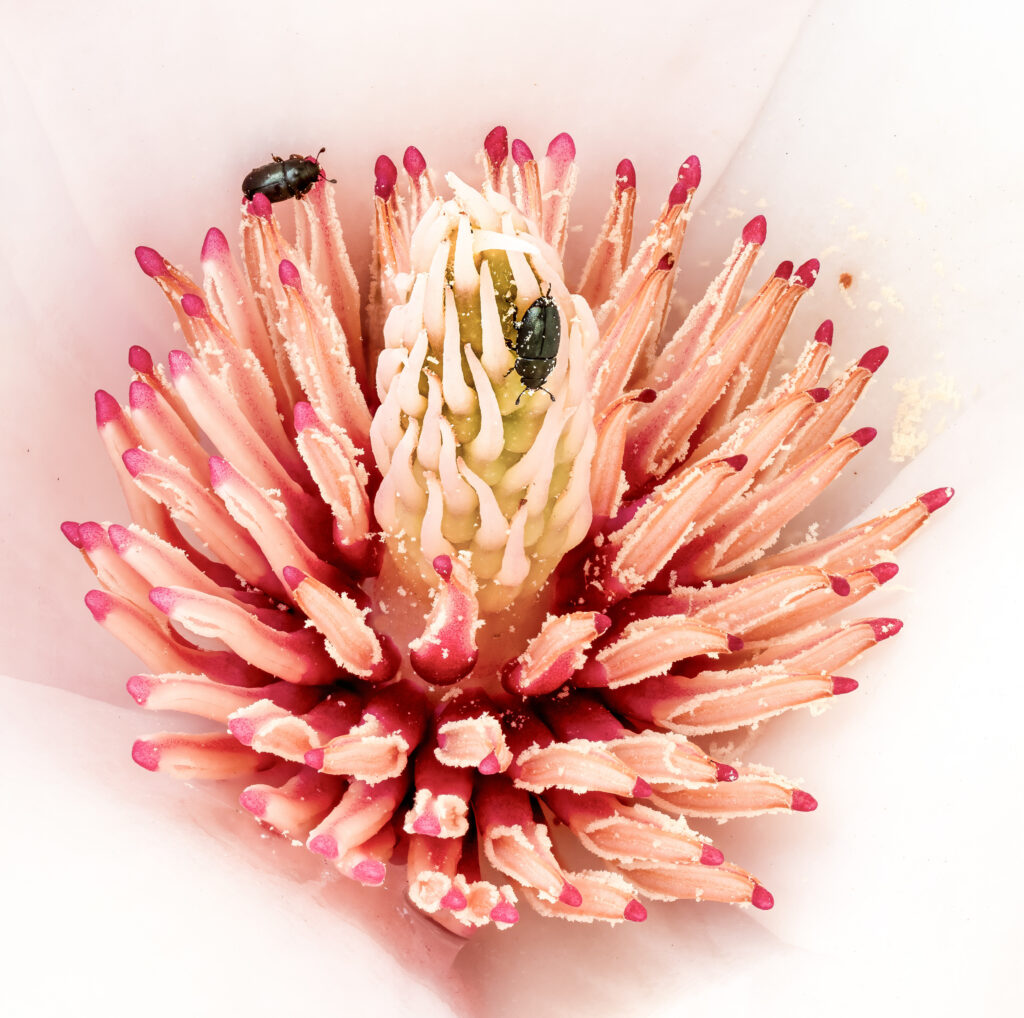
One of the most familiar examples is the magnolia.
Why Magnolias Welcome Beetles
Magnolias belong to an ancient lineage of flowering plants, and many species have long-standing relationships with beetle pollinators.
Their large flowers provide accessible structures where beetles can feed and move around. Some magnolias also have relatively tough reproductive tissues that can withstand the insects’ chewing and crawling.
As a beetle explores a flower, pollen can adhere to its body. When it visits another receptive flower, some of that pollen may be transferred.
Smithsonian Gardens describes magnolia flowers as having evolved features that help accommodate beetle visitors, including structures that tolerate their feeding behavior.
A beetle doesn’t need to hover in front of a flower or reach nectar with a long feeding tube. It can transfer pollen while clambering through floral parts and occasionally eating some of what it encounters.
That may seem a rather untidy arrangement, but flowers and their visitors have evolved together in many different ways. There is no single ideal pollinator. What matters is how effectively a particular animal interacts with a particular plant.
Moths: The Pollinators Working After Dark
As daylight fades, many familiar flower visitors become less active. Pollination, however, doesn’t stop at sunset.
Some moths begin searching for nectar in the evening or during the night, visiting flowers that may be particularly fragrant or accessible after dark.
Their long feeding tubes, called proboscises, allow many species to reach nectar inside flowers. As a moth feeds, pollen may brush against its head or body and travel with it to the next blossom.
Some hawk moths can even hover in front of flowers while feeding, much like hummingbirds.
But one of the most extraordinary moth pollination relationships involves the little insect from the beginning of this article.
The Yucca Moth That Deliberately Pollinates a Flower
Most animal pollinators transfer pollen incidentally while looking for food. Pollinating yucca moths do something different.
In certain specialized relationships with yucca plants, female moths actively collect pollen and deliberately deposit it on a flower’s receptive surface.
They possess unusual tentacle-like structures around their mouthparts that help them gather and manipulate pollen.
A female scrapes pollen from the anthers of a yucca flower, compacts it into a bundle, and carries it to another suitable blossom. There, she lays her eggs in or near the flower’s reproductive structures and uses her specialized mouthparts to deposit pollen.
In well-studied species, including Tegeticula maculata, females pollinate after laying the first egg in a flower. Observations of other pollinating yucca moths have also documented pollen deposition following oviposition, although the details of the behavior vary among species.
Why does the moth invest so much effort in moving pollen?
Because the flower is also where her offspring will develop.
If pollination succeeds, seeds begin to form. When the moth’s larvae hatch, they feed on some of those developing seeds, while others remain available for the plant’s reproduction.
The plant gains a means of producing seeds, and the moth gains a nursery and a food supply for her offspring.
Neither partner gets everything. The larvae consume some of the plant’s investment in reproduction, and yucca plants can sometimes abort flowers or developing fruits that would impose excessive costs. Nevertheless, the relationship persists because both organisms can benefit.
This is an example of mutualism, a biological relationship in which two different organisms benefit from their interaction.
The specialized mouthparts of pollinating yucca moths are particularly remarkable. Research by Olle Pellmyr and Harald Krenn showed how these structures are associated with the moths’ ability to collect and deliberately transfer pollen, an unusual behavioral adaptation among flower-visiting insects.
The relationship between yuccas and their pollinating moths is so close that the reproductive success of each can depend heavily on the other.
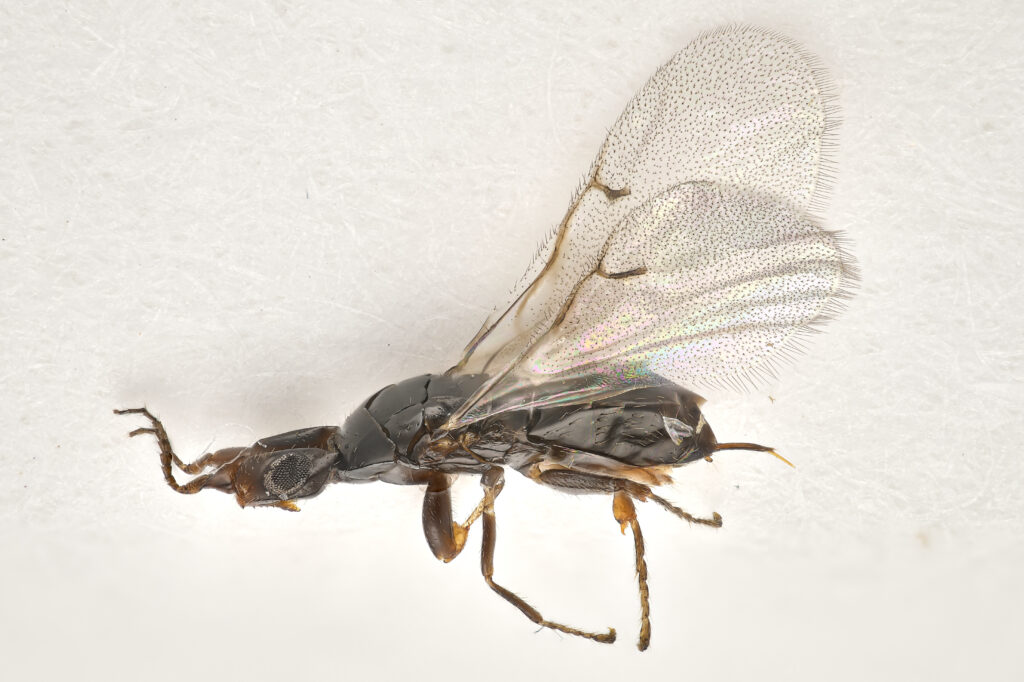
Wasps: The Hidden World Inside a Fig
If the yucca moth’s behavior seems remarkable, consider what happens inside a fig.
Most of us think of a fig as a fruit. Botanically, however, a fig begins as a specialized enclosed structure, called a syconium, with numerous tiny flowers lining its inner surface.
Those flowers aren’t exposed to the outside world like the petals of a daisy or a rose.
In many wild fig species, pollen reaches them through the work of tiny wasps.
A Journey Through a Very Small Opening
A female pollinating fig wasp develops inside a fig, where the next generation of wasps emerges and mates. The fertilized female then leaves, carrying pollen from the flowers inside her birthplace.
She must find another receptive fig, often on a different tree, to complete her reproductive cycle.
Chemical signals released by fig trees help guide females toward suitable hosts. When a wasp finds a receptive fig, she squeezes through a tiny opening called the ostiole.
The entrance can be so narrow that the wasp may lose parts of her wings or antennae as she passes through.
Once inside, she encounters the hidden flowers.
Depending on the fig and wasp species, pollen may be transferred passively from her body or deliberately deposited on receptive flowers. She may also lay eggs in suitable flowers, where her offspring will develop.
Some flowers produce seeds, while others provide the developing wasps with the resources they need.
Later, the next generation emerges. In many species, the males are wingless and spend their entire lives inside the fig, mating with females before dying. The females collect or acquire pollen, leave their birthplace, and search for another receptive fig.
The relationship is often highly specialized. Many fig species have close associations with particular pollinating wasps, although the system is more varied than a simple rule of one wasp species per tree.
The consequences extend well beyond the wasps and the fig trees themselves.
Figs provide food for many birds, bats, monkeys, and other fruit-eating animals. In some tropical ecosystems, fig trees are especially valuable because they produce food when other fruits are scarce.
A pollination relationship taking place inside a structure only a few centimeters across can therefore help support an entire community of animals.
One clarification is worth making: this doesn’t mean every edible fig from the supermarket has contained a wasp.
Many cultivated varieties of the common fig, Ficus carica, can develop edible figs without pollination. These varieties are parthenocarpic, meaning that the structure develops without fertilization.
Other varieties do require pollination. The extraordinary fig–wasp partnership is real, but its details depend on the fig species and variety.
Butterflies and Birds: Following the Nectar
Not every pollination relationship involves such elaborate specialization.
A butterfly settles on a flower, uncoils its proboscis, and reaches for nectar. If the flower’s anthers and stigma are positioned along the butterfly’s feeding route, pollen may be picked up and deposited during later visits.
Butterflies are familiar daytime visitors, especially around flowers offering accessible nectar. Their contribution varies among plant species, but they form part of the broader network of insects moving pollen through an ecosystem.
Birds can perform a similar task on a much larger scale.
Hummingbirds and Their Flower Partners
In the Americas, hummingbirds visit flowers using their long bills and specialized tongues to reach nectar.
As a bird feeds, pollen can collect on its bill, forehead, throat, or feathers. A subsequent visit may carry that pollen to another flower.
Some blossoms are shaped so that the bird makes contact with the reproductive structures almost inevitably while reaching for nectar. Others may be visited by several kinds of animals, including insects.
The bird receives a sugary meal, while the plant gains a potential pollen carrier capable of traveling between widely separated flowers.
Hummingbirds aren’t the only birds involved in pollination. Sunbirds in Africa and Asia, honeyeaters in Australia and nearby regions, and other nectar-feeding birds also transfer pollen between flowers.
Their different feeding styles, body sizes, and relationships with plants help shape which flowers they visit and how effectively they move pollen.
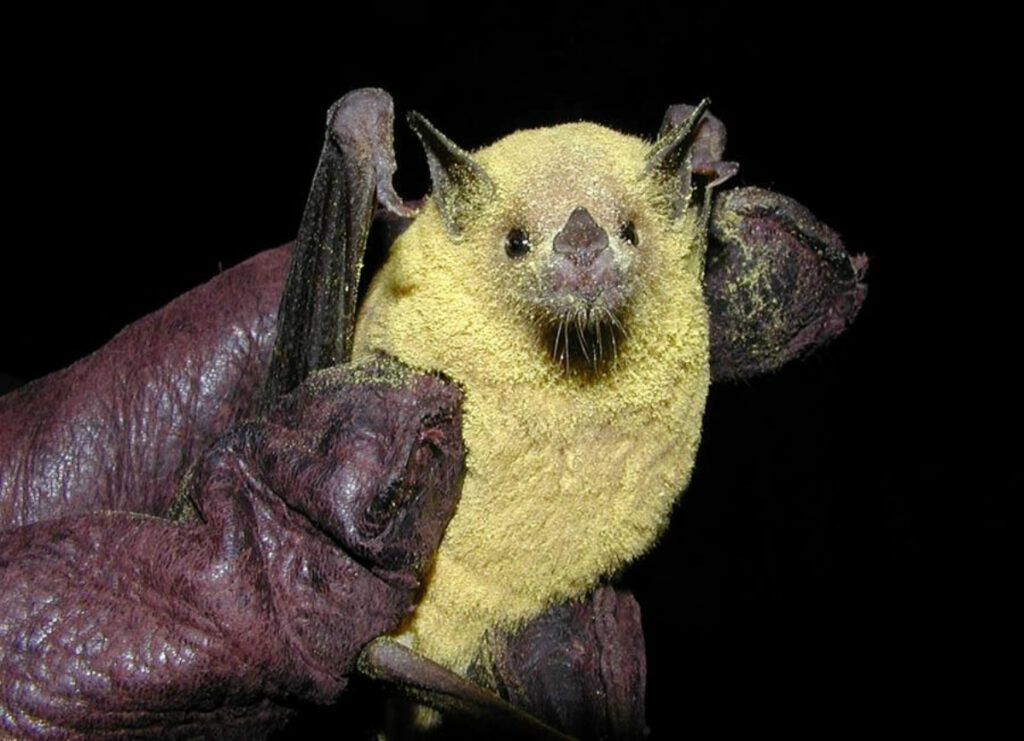
Bats: Keeping Desert Flowers Reproducing at Night
Imagine a flowering agave in a Mexican desert.
Its tall stalk carries clusters of flowers, and as evening arrives, the plant becomes a source of nectar for nocturnal visitors.
A nectar-feeding bat approaches, extends its tongue, and feeds. As it reaches into the flower, pollen may cling to its muzzle and fur.
Then the bat flies away, potentially carrying pollen to another agave.
In some desert plants, these nighttime visits can make a substantial difference to reproduction.
What Happens When Bats Cannot Reach the Flowers?
Researchers studying Agave macroacantha in Mexico investigated how bats and moths contributed to the plant’s reproductive success.
Their work combined observations of nocturnal visitors with experiments designed to separate the contributions of different pollinator groups.
Some flowering stalks were accessible to moths but not bats. Others could be visited by both groups.
The results were striking: stalks accessible to moths but not bats produced approximately 50% fewer fruits than those accessible to both groups.
The researchers also found differences among bat species. Flowers visited by Leptonycteris curasoae produced fruits with more seeds than those in some of the other pollination treatments.
For this agave, nocturnal visitors were crucial, and bats made an especially important contribution.
The finding doesn’t mean every agave depends exclusively on bats, or that bats are equally important for all desert plants. Pollination relationships vary according to the species, region, and animals available.
What makes the experiment valuable is that it goes beyond observing bats at flowers. By restricting access to particular visitors, the researchers could measure how the absence of those animals affected fruit production.
Elsewhere in North American deserts, the lesser long-nosed bat visits the flowers of agaves and cacti, including saguaros and organ pipe cacti.
These animals benefit from the nectar provided by desert plants while also contributing to the reproduction of plants that provide resources for many other species.
Protecting a nectar-feeding bat can therefore matter to an entire network of ecological relationships, not just to the bat itself.
Even Lizards and Small Mammals Can Pollinate Flowers
So far, we’ve encountered flies, beetles, moths, wasps, butterflies, birds, and bats. But some flowering plants receive useful visits from animals that are rarely associated with pollination.
In southwestern Australia, the honey possum is a tiny marsupial with a long snout and a brush-tipped tongue adapted for feeding on nectar and pollen.
It moves among flowering plants, including banksias, collecting food and sometimes carrying pollen between blossoms.
Its importance as a pollinator isn’t simply assumed from the fact that it visits flowers. Researchers have used observations, pollen samples, and experiments that restrict flower access to establish whether small mammals contribute to plant reproduction.
A study published in the Botanical Journal of the Linnean Society in 2025 combined camera traps and selective pollinator-exclusion experiments to examine four Banksia species in Western Australia.
The researchers found that non-flying mammals contributed to pollination in all four species, although the relative importance of mammals, birds, and insects varied.
One particularly surprising result concerned Banksia subulata.
Instead of honey possums, which might seem the obvious candidates, mice were the most frequent mammalian visitors recorded at its flowers. The combined evidence indicated that rodents were the primary pollinators of this species at the study sites.
The researchers also found that honey possums made substantial contributions to fruit production in some other banksias, even where they weren’t frequent visitors.
These findings challenge the idea that the appearance and scent of a flower always reveal which animal is responsible for most of its pollination.
A flower that seems adapted to attract one kind of visitor may receive important reproductive help from another.
The Flower-Visiting Lizards of Island Ecosystems
Some lizards also feed on nectar and can help transport pollen.
These interactions are particularly well documented on islands, where lizards may make greater use of plant resources than their relatives elsewhere. Reduced competition, different food availability, and local ecological conditions can all influence what these animals eat.
A gecko visiting a flower may brush pollen onto its head or body before moving to another blossom.
But finding pollen on a lizard isn’t necessarily enough to prove that it makes an important contribution to the plant’s reproduction.
A global review published in Ecography examined 452 recorded interactions between plants and lizards. Only around 20% included confirmation of pollination effectiveness.
The researchers also found that most documented interactions occurred on islands, although flower-visiting lizards are not restricted to island ecosystems.
The distinction between visiting a flower and successfully pollinating it matters here just as much as it does for cacao midges or butterflies.
Some lizards genuinely contribute to pollination, but many recorded encounters haven’t yet been studied closely enough to establish their effectiveness.
As researchers investigate more of these relationships, the known range of animal pollinators may continue to grow.
Why Protecting Pollinators Means Looking Beyond Bees
The diversity of these relationships matters for conservation.
Some flowers attract a wide assortment of visitors. Others depend heavily on a few specialized partners. Some provide nectar in daylight, while others become especially important after sunset.
If a plant depends strongly on a particular animal, losing that animal may make reproduction more difficult. And when flowering plants decline, the effects can extend to wildlife that relies on their seeds, fruit, foliage, and shelter.
The fig–wasp relationship provides an especially clear example. Pollination by tiny insects can ultimately influence food availability for birds, mammals, and other animals that have no direct involvement in pollinating the tree.
The same principle applies to desert plants and their bat visitors, or to flowering plants that depend on less conspicuous insects.
Protecting pollination therefore means protecting more than a familiar handful of species. It also means considering the habitats and food resources that different animals need throughout their lives.
For gardeners, planting a variety of locally native flowering species can help provide resources for a range of pollinators. Avoiding unnecessary pesticide use and retaining suitable habitat can support insects that visit flowers, including those whose contribution is easily overlooked.
And because some pollinators work at night, reducing unnecessary outdoor lighting is another useful consideration.
Research has found that artificial lighting can alter moth activity and disrupt pollen transport in certain settings. Lights that attract insects away from flowers may interfere with interactions that would otherwise occur in darkness.
A garden that looks quiet after sunset may still be supporting a busy ecological community.
Every Flower Has a Story Beyond the Bee
Consider a flowering landscape over the course of a single day.
In the morning, hoverflies visit blossoms while beetles explore larger flowers. Butterflies feed in the afternoon, and hummingbirds travel between nectar-rich plants.
As darkness arrives, moths begin visiting flowers that may have attracted little attention during daylight. In a desert farther away, bats move among flowering agaves.
Elsewhere, a tiny wasp is entering a fig, while a female yucca moth carries a carefully collected bundle of pollen toward a flower where she will lay her eggs.
These animals aren’t performing the same task in exactly the same way. Each relationship has its own history, adaptations, and consequences for the plants involved.
A flower can be a feeding place, a nursery, or part of a partnership shaped over millions of years. The animals that visit it may be essential to its reproduction, even when their role is difficult to observe.
Bees deserve their reputation as important pollinators. But the next time you notice a fly, beetle, moth, bird, or another unexpected visitor investigating a blossom, consider what might be happening beyond the search for a meal.
The natural world has many ways of keeping flowers—and the life that depends on them—going.
Sources & Further Reading
- U.S. Fish & Wildlife Service. (2026). Nocturnal Pollinators.
- Royal Botanic Gardens, Kew. Cacao Tree (Theobroma cacao).
- Van de Sande et al. (2026). Revisiting Cacao Pollination: New Behavioural and Pollen-Based Evidence for the Key Role of Ceratopogonidae. Basic and Applied Ecology, 94, 24–33.
- Smithsonian Gardens. (2021). The Botany of Magnolias.
- Pellmyr, O., & Krenn, H. W. (2002). Origin of a Complex Key Innovation in an Obligate Insect–Plant Mutualism. Proceedings of the National Academy of Sciences, 99(8), 5498–5502.
- Aker, C. L., & Udovic, D. (1981). Oviposition and Pollination Behavior of the Yucca Moth, Tegeticula maculata, and Its Relation to the Reproductive Biology of Yucca whipplei. Oecologia, 49, 96–101.
- National Wildlife Federation. Yucca Moths.
- FigWeb — Iziko Museums of South Africa. How Do Fig Wasps Pollinate Fig Trees?.
- University of Florida IFAS Extension. The Fig.
- National Park Service. Pollinators: Lesser Long-Nosed Bat.
- Arizaga, S., Ezcurra, E., Peters, E., de Arellano, F. R., & Vega, E. (2000). Pollination Ecology of Agave macroacantha (Agavaceae) in a Mexican Tropical Desert. II. The Role of Pollinators. American Journal of Botany, 87(7), 1011–1017.
- Wawrzyczek, S. K., Davis, R. A., Krauss, S. L., Hoebee, S. E., & Phillips, R. D. (2025). Does Pollination by Non-Flying Mammals Contribute Substantially to Fruit Set of Banksia (Proteaceae)? A Test in Four Species With Contrasting Floral Traits. Botanical Journal of the Linnean Society, 208(2), 125–141.
- Justicia Correcher et al. (2023). Environmental and Morphological Drivers of Mutualistic Plant–Lizard Interactions: A Global Review. Ecography.
- Macgregor, C. J., Evans, D. M., Fox, R., & Pocock, M. J. O. (2017). The Dark Side of Street Lighting: Impacts on Moths and Evidence for the Disruption of Nocturnal Pollen Transport. Global Change Biology, 23(2), 697–707.
- Bernhardt, P. (2026). Unsung Heroes of Pollination: More Than the Birds and the Bees. CSIRO Publishing.
Featured image by Patrick Bigelow

