
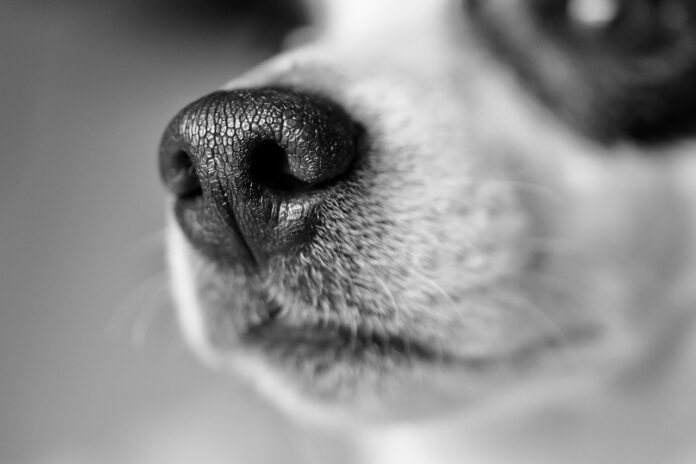

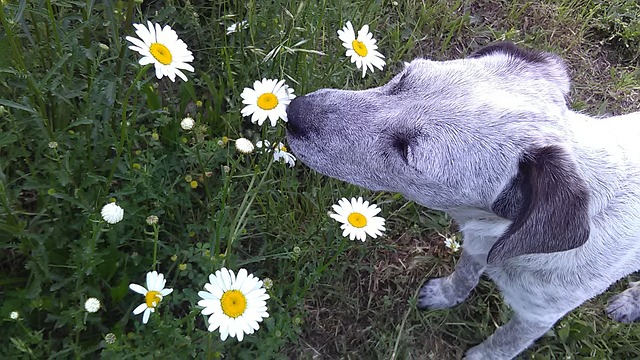
A walk with a dog rarely follows a perfectly straight line. One moment, your dog is moving beside you. The next, their nose is buried in a patch of grass that looks no different from the one you passed a few steps earlier.
To us, there may be nothing particularly interesting about that spot. To a dog, it can contain odors worth investigating even when we notice nothing at all.
Dogs do not experience the world through smell alone, but scent gives them access to information that largely escapes us. Understanding a little about how their noses work helps explain why something as ordinary as a walk can become such a rich sensory experience.
A Nose Built to Notice What We Miss
A faint trace that a person walks past without noticing may still be worth investigating to a dog.
Common estimates suggest that dogs have roughly 200–300 million olfactory sensory cells, compared with around 5–6 million in humans. These are estimates rather than fixed counts for every individual dog, and they refer to sensory cells in the nose—not to hundreds of millions of different kinds of smell receptors.
The numbers are striking, but they are not a simple smell score. Sensitivity varies with the odor, the dog, and the conditions in which the scent is encountered.
That is why dramatic comparisons such as a dog detecting a tiny drop of perfume in an enormous swimming pool should be treated cautiously. They may help us imagine the difference between canine and human smell, but they are not universal demonstrations of what every dog can detect.
The useful point is simpler: a place that seems almost scentless to us may still contain plenty for a dog to investigate.
What Happens When a Dog Sniffs?
A dog’s nose does more than pull air into the body. Its internal structure helps direct some odor-bearing air toward the region responsible for detecting smells.
During a sniff, air carrying odor molecules reaches sensory tissue inside the nasal cavity. Research into canine airflow also suggests that exhaled air leaves through openings along the sides of the nostrils and moves downward rather than being pushed directly forward.
That airflow pattern may help prevent each exhalation from blowing nearby odors away, allowing the dog to sample again with the next sniff.
So there is no separate external tube devoted only to smelling. Instead, the shape of the nose and the way air moves through it create an efficient system for repeatedly sampling odors from the environment.
A Scent Is a Clue, Not a Complete Report
When a dog stops to investigate a patch of ground, they may be checking scent marks left by other dogs, along with other clues about what has been nearby.
You can think of that spot as a small neighborhood newspaper: there may be traces worth examining even though they do not provide a perfect account of who passed by, exactly when they were there, or what they were feeling.
Odors can remain after their original source has moved on, and dogs may detect differences that are no longer apparent to us. But that does not mean a dog can reconstruct every event that happened in that location simply by smelling it.
What matters is that the dog is attending to information we may not even realize is there.
That is one reason stopping to sniff should not automatically be treated as an interruption to the walk. For the dog, investigating those traces can be part of experiencing the environment itself.
What Trained Noses Can Do
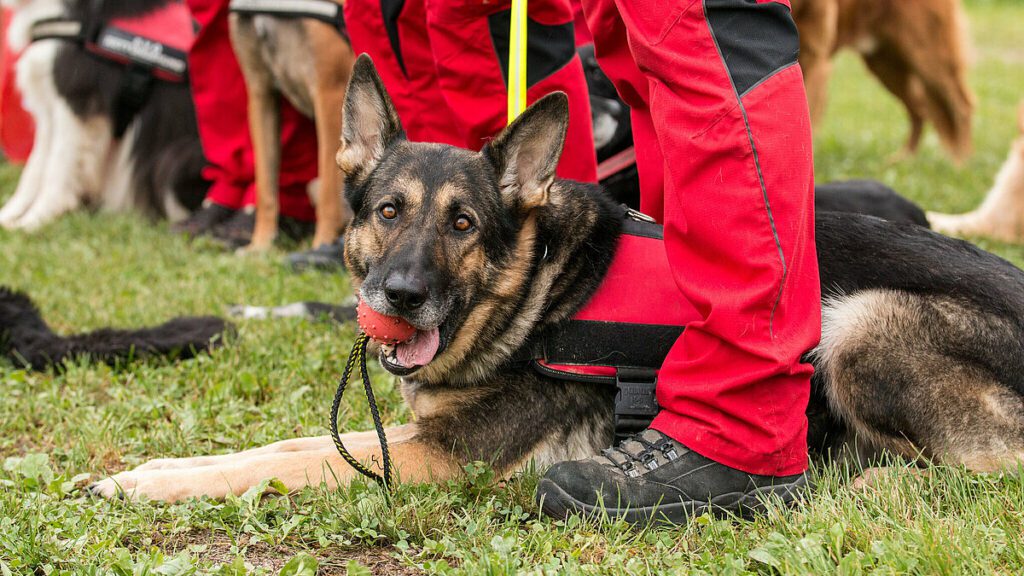
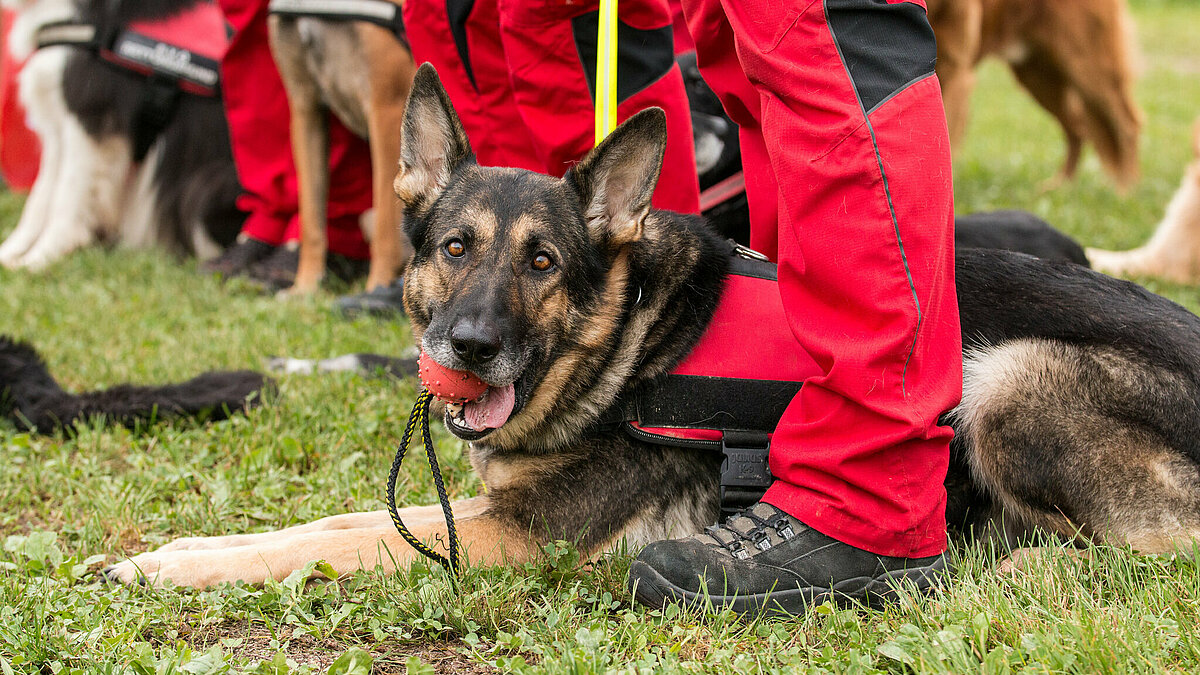
Dogs’ ability to detect and follow odors has uses far beyond everyday walks. Detection dogs can be trained to search for substances such as explosives or drugs, while search-and-rescue dogs learn to locate people in challenging environments.
These abilities depend on more than an excellent nose. Dogs need training to recognize a particular target and respond reliably under the conditions in which they work.
Researchers have explored more unusual applications too. In one South Florida study, trained dogs detected signs associated with laurel wilt in avocado trees, sometimes before visible symptoms appeared. That does not mean dogs can identify every plant disease; it shows what specialized training can achieve with a particular scent target.
Medical scent detection is also being investigated. In one small controlled study, three trained beagles distinguished blood-serum samples from people with non-small-cell lung cancer from healthy controls, with reported sensitivity of 96.7% and specificity of 97.5%. Researchers have also studied canine scent discrimination in ovarian-cancer research.
Those results are intriguing, but they do not make dogs established clinical screening tools. Performance depends on the target, training, study conditions, and individual dog. The same caution applies to dogs trained to alert to glucose-related changes in people with diabetes, where real-world reliability can vary considerably between teams.
A dog’s nose can be extraordinarily useful when trained for a specific task, but success with one scent under particular conditions does not mean dogs can reliably detect anything.
Giving Your Dog Opportunities to Use Their Nose
Your dog does not need a job in search and rescue or medical research to benefit from opportunities to investigate scents.
At home, you can hide a familiar toy, lay a short trail with suitable treats, or introduce a simple scent-search game. Start with something easy enough to find, then let your dog’s interest and abilities guide what comes next. Some dogs may happily keep searching, while others will prefer a shorter activity.
Walks offer opportunities too. When the surroundings are safe, allowing your dog a little time to investigate an interesting patch of grass or follow an odor trail can make the outing more engaging.
Not every walk needs to become a scent-work session, and you do not have to stop at every smell. The point is simply to recognize that exploring odors can be part of what the walk is for.
What looks like an unnecessary pause to us may be a worthwhile moment of investigation for the dog.
Seeing the Walk From Your Dog’s Perspective
The next time your dog stops at an apparently ordinary patch of ground, consider how differently the two of you may be experiencing the same place.
You might notice the path ahead, the people nearby, or the trees around you. Your dog may be paying attention to traces of odor that you cannot perceive at all.
We cannot fully reconstruct that sensory world, and a dog’s nose does not provide a perfect record of everything that has happened nearby. But understanding how important smell is to dogs can change the way we think about those familiar pauses.
Sometimes, giving your dog a little extra time to sniff is simply giving them the chance to explore a part of the world that remains largely invisible to us.
Sources & Further Reading
- Jendrny, P., Twele, F., Meller, S., Osterhaus, A. D. M. E., Schalke, E., & Volk, H. A. (2021). Canine olfactory detection and its relevance to medical detection. BMC Infectious Diseases, 21(1), 838.
- Craven, B. A., Paterson, E. G., & Settles, G. S. (2010). The fluid dynamics of canine olfaction: Unique nasal airflow patterns as an explanation of macrosmia. Journal of the Royal Society Interface, 7(47), 933–943.
- Mendel, J., Burns, C., Kallifatidis, B., Evans, E., Crane, J., Furton, K. G., & Mills, D. (2018). Agri-dogs: Using Canines for Earlier Detection of Laurel Wilt Disease Affecting Avocado Trees in South Florida. HortTechnology, 28(2), 109–116.
- Junqueira, H., Quinn, T. A., Biringer, R., Hussein, M., Smeriglio, C., Barrueto, L., Finizio, J., & Huang, X. Y. M. (2019). Accuracy of Canine Scent Detection of Non-Small Cell Lung Cancer in Blood Serum. The Journal of the American Osteopathic Association, 119(7), 413–418.
- Kane, S. A., Lee, Y. E., Essler, J. L., Mallikarjun, A., Preti, G., Plymouth, V. L., Verta, A., DeAngelo, A., & Otto, C. M. (2022). Canine discrimination of ovarian cancer through volatile organic compounds. Talanta, 250, 123729.
- Gonder-Frederick, L. A., Grabman, J. H., & Shepard, J. A. (2017). Diabetes Alert Dogs (DADs): An Assessment of Accuracy and Implications. Diabetes Research and Clinical Practice, 134, 121–130.
- Horowitz, A. (2016). Being a Dog: Following the Dog Into a World of Smell. Scribner.
Featured image by Jade.