


You look down and spot something small and white on the floor. At first, you can’t quite work out what it is. Then you look over at your puppy, happily chewing on a toy, and realize you’ve found a tiny tooth.
Your puppy is growing up, and their adult teeth are starting to arrive.
Perhaps you’ve noticed other changes, too. Your shoelaces have become unusually interesting, the corner of a rug seems irresistible, and those needle-sharp teeth keep finding their way onto things you would rather they left alone.
Welcome to puppy teething.
It’s a normal part of growing up, but it can be uncomfortable for your puppy and occasionally confusing for the people looking after them. Knowing when teeth should appear, which changes are normal, and how to provide safe things to chew can make the whole stage easier to manage.
Puppies Have Two Sets of Teeth
Just like human children, puppies don’t keep their first set of teeth forever.
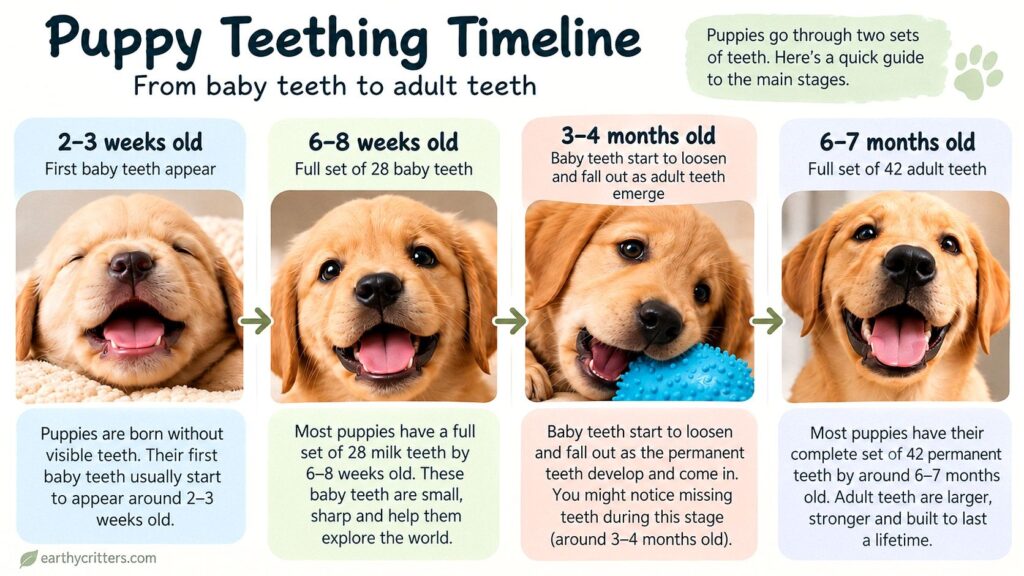
They’re born without visible teeth, and their first teeth usually begin appearing at around 2–3 weeks of age. These are called deciduous teeth, although they’re more commonly known as baby teeth or milk teeth.
If you’ve ever felt one against your finger, you’ll know how surprisingly sharp they can be. Puppies use their mouths to investigate objects, interact with their littermates, and begin exploring the world, so those little teeth quickly become part of everyday life.
By around six to eight weeks of age, most puppies have their full set of 28 baby teeth. But that first set won’t be around for long.
When Do Puppies Start Losing Their Baby Teeth?
At approximately 3–4 months of age, baby teeth begin to loosen and fall out as the permanent teeth develop and emerge.
The process continues over the following months. By around 6–7 months, most puppies have their adult teeth, although the exact timing varies from dog to dog.
And there’s a noticeable difference between the two sets.
A puppy starts with 28 baby teeth, but the complete adult set contains 42 permanent teeth.
That means quite a lot is changing inside a young dog’s mouth over a relatively short period.
You might occasionally discover a discarded baby tooth in your puppy’s bedding, on the floor, or caught in a favorite toy. Sometimes the tooth looks like a tiny hollow shell because its root has gradually been broken down and absorbed as the adult tooth developed.
But don’t be surprised if you never find any.
Puppies often swallow their loose baby teeth while eating or chewing, and this is generally harmless. You could go through the entire teething stage without finding more than one or two.
Why Do Teething Puppies Chew So Much?
Imagine having several new teeth pushing through your gums over the course of a few months. It probably wouldn’t be particularly comfortable.
As permanent teeth emerge, puppies can experience tenderness or irritation in their mouths. Chewing may help them respond to those sensations, which is one reason they can become especially enthusiastic about finding things to bite.
But teething is only part of the explanation.
Puppies chew even when they aren’t teething.
Their mouths are important tools for discovering the world. A young dog may investigate unfamiliar objects by picking them up, chewing them, or feeling their texture with their teeth and tongue.
Puppies also use their mouths during play and social interaction. They may grab a toy, mouth a littermate, or gently bite at a person’s sleeve without experiencing any particular dental discomfort.
That’s why a puppy who starts chewing a table leg isn’t necessarily trying to soothe sore gums. They may simply have discovered an object that feels interesting.
Normal exploration and teething discomfort can happen at the same time, making it difficult to separate one from the other.
And although teething eventually ends, chewing doesn’t. Many adult dogs continue to enjoy appropriate chew toys throughout their lives.

What Does Normal Puppy Teething Look Like?
Every puppy experiences teething a little differently.
Some seem to move through the process with very little noticeable discomfort. Others become more interested in chewing, drool a little more than usual, or seem less enthusiastic about having their mouths touched.
You may also notice a small amount of blood when a baby tooth loosens or falls out.
For example, a chew toy might have a faint reddish mark on it after your puppy has been playing. A tiny, brief trace like this can occur during normal tooth replacement.
But the amount should be very small.
Persistent bleeding, pronounced swelling, or significant pain shouldn’t automatically be explained away as teething. The same applies to a puppy who refuses food or seems unusually uncomfortable when trying to eat.
A puppy may be slightly less enthusiastic about chewing certain foods while their gums are tender, but ongoing difficulty eating deserves veterinary attention.
Teething is normal. Significant pain and persistent mouth problems are not things you should simply expect your puppy to endure.
The most useful approach is to watch how your puppy is behaving overall. A little extra chewing in an otherwise comfortable, active puppy is very different from a dog who seems distressed, stops eating, or has obvious swelling around the mouth.
Help Your Puppy Find Something Better to Chew
Imagine your puppy has discovered the corner of your favorite shoe.
You move the shoe out of reach, only to find them chewing your slipper a few minutes later. Once that’s gone, they begin investigating a table leg.
At this point, it’s clear that simply removing one tempting object after another could become a full-time job.
A better approach is to make sure your puppy has suitable things of their own to chew.
Chewing is a normal behavior. Rather than trying to stop it altogether, the aim is to give your puppy safe, satisfying alternatives while making inappropriate objects less accessible.
Choose Toys That Are Gentle on Growing Teeth
Look for chew toys designed for puppies, with enough flexibility to avoid placing excessive pressure on developing teeth.
Soft but durable rubber toys can be useful, provided they’re an appropriate size and suitable for the way your puppy chews. Some puppies prefer smooth surfaces, while others seem to enjoy different textures.
You may need to experiment to discover what yours actually likes.
A puppy-appropriate chew toy chilled in the refrigerator may feel pleasant against tender gums. There’s no need to freeze it until it becomes extremely hard, though. A chilled toy and a rock-solid frozen object are very different things.
In fact, very hard chewing objects can damage teeth.
Bones, antlers, hooves, ice cubes, and particularly rigid chew toys can cause dental fractures. A puppy’s growing mouth is no place to experiment with something that barely gives under pressure.
Veterinary dentists sometimes recommend a simple test when choosing a chew: if you can’t make even a slight impression in the material with your fingernail, it may be too hard for your dog’s teeth.
It’s a helpful guideline, although passing the test doesn’t guarantee that an object is safe.
Size and durability matter just as much.
A small toy that can be swallowed, or one that breaks apart into large chunks, may create a choking hazard or cause an intestinal blockage. Even a soft toy can become dangerous if your puppy starts tearing pieces off and swallowing them.
Supervise your puppy when introducing a new chew, and remove anything that begins to break apart.
The best choice isn’t necessarily the most expensive toy or the one promising extraordinary teething relief. It’s something your puppy enjoys, can use safely, and is appropriate for their size and chewing habits.
What About Puppies Biting Hands and Feet?
Sometimes the most interesting object in the room is attached to a person.
Your puppy may nip at your fingers during play, grab your sleeve, or chase your feet as you walk across the room. Those tiny teeth can turn an otherwise affectionate interaction into a surprisingly painful experience.
It’s important to remember that mouthing is a normal part of puppy development.
Puppies learn about their surroundings through their mouths, and playful biting is common when they interact with littermates and people. Teething discomfort may contribute, but excitement, exploration, and play can be involved too.
The goal isn’t to punish your puppy for having a mouth. It’s to help them learn what they can appropriately use it on.
Try to avoid using your hands as toys. Instead, offer playthings that create some distance between your fingers and your puppy’s teeth, such as an appropriate tug toy.
If your puppy begins biting your hands or grabbing your clothes during a game, calmly pause the interaction and offer a suitable toy. When they engage with it, play can continue.
Consistency matters because puppies are still learning the rules of interacting with people. If hands are encouraged as playthings one moment and discouraged the next, the message becomes harder to understand.
Sometimes Your Puppy Just Needs a Break
Not every burst of biting means your puppy needs more playtime.
Young dogs can become especially mouthy when they’re tired or overstimulated. A puppy who has been playing enthusiastically for a while may start nipping more intensely, even though what they really need is an opportunity to settle.
In those moments, another exciting game may only make things harder.
A quiet break, a familiar resting place, and a predictable daily routine can help your puppy wind down.
Avoid shouting, hitting, frightening, or physically punishing normal puppy mouthing. These responses can create stress without teaching the puppy what they should do instead.
It takes time for young dogs to learn how to interact gently, and those lessons don’t automatically finish when the last baby tooth falls out.

See Your Home From a Puppy’s Point of View
There’s something revealing about getting down on the floor and looking around at puppy height.
From there, you might notice the loose charging cable behind the sofa, the tassel hanging from a cushion, the edge of a wicker basket, or the shoelaces you left beside the door.
To a curious puppy, all of them may look like perfectly reasonable things to investigate.
Puppy-proofing your home doesn’t mean removing everything interesting. It means reducing access to dangerous objects and giving your puppy safer alternatives.
Electrical cords deserve particular attention, because chewing through them can cause serious injuries. Keep loose cables out of reach or use suitable barriers and protective covers.
Medications, cleaning products, small objects, and anything likely to break into dangerous pieces should also be inaccessible.
Consider using a puppy-safe area or barriers when you can’t supervise closely. This protects both your puppy and your belongings while they’re learning which objects are appropriate to explore.
If your puppy does manage to grab something they shouldn’t have, try not to turn the situation into an exciting chase around the house.
Calmly encouraging them to trade the object for a suitable toy or reward can help you retrieve it without making the experience into a game. If the object is dangerous or you suspect your puppy has swallowed it, contact your vet rather than trying to manage the situation through play.
As your puppy grows, they can gradually learn which objects belong to them. Until then, making good choices easy and dangerous choices difficult is one of the most useful things you can do.
What If Your Puppy Has Two Teeth in the Same Place?
There’s one dental problem worth recognizing because it can be easy to spot once you know what to look for.
Imagine lifting your puppy’s lip and seeing two canine teeth standing close together. One is a smaller baby tooth, while the other is the permanent tooth emerging beside it.
It can look as though your puppy has suddenly grown an extra fang.
This may be a retained deciduous tooth, also called a persistent baby tooth.
Normally, as a permanent tooth develops, the root of the baby tooth gradually breaks down. This allows the baby tooth to loosen and fall out, creating space for its adult replacement.
Sometimes, however, the baby tooth remains in place even after the permanent tooth begins emerging.
The problem is more common in certain small breeds and short-muzzled dogs, although it can happen in other puppies too.
Why Retained Baby Teeth Matter
When a baby tooth remains beside its adult replacement, the two teeth are competing for space.
This can cause crowding or push the permanent tooth into an abnormal position. In some cases, the developing teeth make contact with other teeth or the soft tissues inside the mouth, creating pain or problems with the dog’s bite.
Food and debris can also collect between crowded teeth, encouraging plaque to accumulate and increasing the risk of dental disease later on.
The important point is that a retained baby tooth isn’t always something you should wait to see if it resolves on its own.
If you notice a permanent tooth emerging beside a baby tooth that hasn’t fallen out, arrange a veterinary dental examination promptly.
Your vet can assess whether the baby tooth needs to be removed to allow the permanent tooth to develop in a healthier position. Early treatment may prevent problems that become much harder to correct once the adult tooth has settled into place.
Don’t attempt to pull out a retained tooth yourself.
It’s also useful to check your puppy’s mouth regularly as their adult teeth come in. You don’t need a complicated inspection routine; gently lifting a lip when your puppy is comfortable can help you notice obvious changes.
When Should You Call the Vet About Puppy Teething?
Finding a tiny tooth on the floor or a faint red mark on a chew toy usually isn’t a reason to worry.
But normal teething shouldn’t become an explanation for every problem involving your puppy’s mouth.
Arrange a veterinary check if you notice a permanent tooth growing beside a retained baby tooth, a broken or damaged tooth, persistent unpleasant breath, marked gum redness or swelling, unusual drooling, or difficulty chewing.
A puppy who seems reluctant to eat because their mouth hurts also deserves veterinary advice. While mild tenderness can occur during tooth replacement, significant discomfort should be assessed rather than simply tolerated.
Seek prompt veterinary advice if your puppy refuses food, appears markedly painful, or continues bleeding beyond a tiny, short-lived trace associated with a loose tooth.
Heavy or uncontrolled bleeding, severe swelling, difficulty breathing, or signs of serious distress require urgent veterinary care.
Your vet can examine the mouth and determine whether what you’re seeing is part of normal development or a problem that needs treatment.
You don’t need to become an expert in canine dentistry. The important thing is to recognize changes that don’t fit the usual pattern and ask for help when your puppy needs it.
A Good Time to Introduce Dental Care
Your puppy’s baby teeth are temporary, but the permanent teeth replacing them are meant to last throughout adulthood.
That makes puppyhood a useful time to begin building comfortable habits around oral care.
You don’t have to start with a toothbrush straight away. In fact, trying to brush sore gums while teeth are actively coming loose may make the experience unpleasant.
Begin with simple, gentle handling when your puppy is relaxed.
You might briefly touch their muzzle, lift a lip, or look at their teeth, rewarding them for remaining comfortable. Over time, these small interactions can help them become familiar with having their mouth examined.
Once your puppy is comfortable and their mouth is ready, you can gradually introduce a soft toothbrush and toothpaste formulated specifically for dogs.
Never use ordinary human toothpaste. Some ingredients used in products for people are unsuitable or potentially dangerous for dogs.
Your veterinarian can help you decide when to begin brushing and which products are appropriate for your puppy.
Regular toothbrushing is one of the most useful habits for reducing plaque buildup, but the process should be introduced patiently. A few comfortable seconds of handling are a better starting point than forcing a frightened or uncomfortable puppy through a full brushing session.
As your dog grows, it’s also useful to understand how professional dental cleaning differs from daily brushing and when a veterinary dental assessment may be needed.
The aim isn’t to achieve perfect dental care on the first attempt. It’s to make looking after your dog’s mouth a familiar, manageable part of life.
And that becomes particularly valuable after teething ends, when caring for those permanent teeth is just beginning.
One Day, the Tiny Teeth Will Be Gone
Puppy teething can feel surprisingly eventful. There are sharp little teeth, chew toys scattered around the house, the occasional mysterious object on the floor, and moments when your puppy seems convinced that everything deserves to be investigated with their mouth.
But the actual process of replacing baby teeth is relatively brief.
Within a few months, most puppies have exchanged their first 28 teeth for a complete adult set of 42. They may still enjoy chewing, of course. Having adult teeth doesn’t automatically turn a curious young dog into a perfectly behaved companion.
What does change is your understanding of what they need.
You can provide safe toys, protect them from dangerous objects, recognize when a dental problem requires attention, and help them develop better habits around chewing and play.
And somewhere along the way, the shoelaces may finally become a little less interesting.
The teeth change quickly. The habits your puppy learns around chewing, play, and gentle handling can last much longer.
Sources & Further Reading
- Barnes, C., Williams, K., & Lerner, R. (n.d.). Teeth, Teething and Chewing in Puppies. VCA Animal Hospitals.
- American Kennel Club. (n.d.). Puppy Teething Timeline: When Do Puppies Get Teeth?. AKC.
- Hunter, T., Hiscox, L., & Bellows, J. (n.d.). Persistent Deciduous Teeth (Baby Teeth) in Dogs. VCA Animal Hospitals.
- Cornell University College of Veterinary Medicine. (n.d.). Risks From a Fractured Tooth. Cornell University.
- American Animal Hospital Association. (2019). 2019 AAHA Dental Care Guidelines for Dogs and Cats. AAHA.
- American Animal Hospital Association. (2026). Dog & Cat Dental Disease: Signs, Professional Cleanings, Anesthesia, and Home Care. AAHA.
- Gibeault, S. (n.d.). How to Stop Puppy Mouthing and Teach Better Bite Habits. American Kennel Club.
- Capuzzi, J. (2024). Puppy Care: A Complete Guide to Raising a Happy Puppy in a Positive Environment. Lyons Press.
Featured image by Sean Brannon