
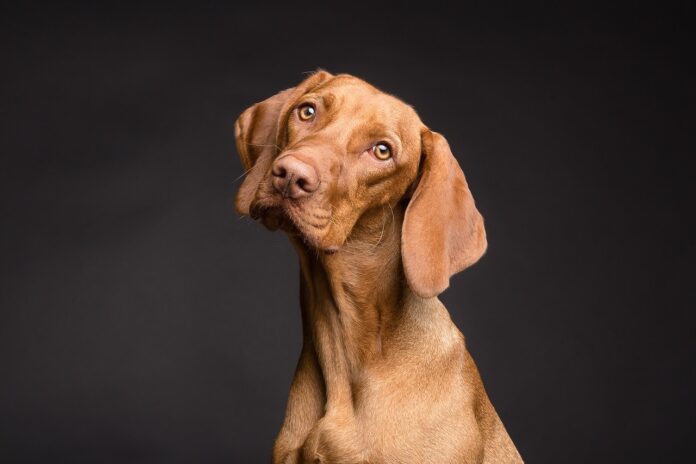
You come home to find a cushion on the floor, its stuffing scattered across the living room. Your dog is sitting nearby, ears back, looking up at you with unusually wide eyes.
It’s the kind of face that seems to say, I know. I’ve done something terrible.
But does your dog actually feel guilty? Or are you reading a very human story into an expression that means something else?
Dogs have an extraordinary ability to make us see familiar emotions in their faces. A lifted eyebrow can look like sadness, a relaxed mouth resembles a smile, and a sideways glance might seem worried or suspicious.
Those expressions can tell us something useful, but they aren’t word-for-word translations of what a dog feels. Understanding them means looking beyond the face to the dog’s body, surroundings, and behavior.
And as scientists have discovered, there’s more going on behind those memorable looks than you might expect.
Why Do Dogs Make Puppy-Dog Eyes?
You probably know the expression: a dog raises the inner corners of its eyebrows, making its eyes look larger and giving its face an almost pleading appearance.
It’s hard not to respond to that look. And there’s an intriguing anatomical reason dogs can make it so noticeably.
In 2019, researchers compared the facial muscles of six domestic dogs and four gray wolves. They found differences around the eyes, particularly involving a muscle called the levator anguli oculi medialis, or LAOM, which helps raise the inner eyebrow.
The researchers also observed dogs and wolves interacting with people. In those observations, the dogs raised their inner eyebrows more frequently and more intensely than the wolves.
The scientists proposed that humans may have favored dogs with more expressive eyebrows over generations of domestication. Raising the inner brow makes the eyes appear larger and more infant-like, a feature that can attract human attention.
It’s a fascinating possibility, but the anatomical sample was small, and the study didn’t prove that human preferences caused those differences to evolve.
Do Dogs Change Their Expressions When We’re Watching?
Another study, published in 2017, revealed something equally interesting.
Researchers observed dogs while a person either faced them or turned away. Sometimes the person also held food.
The dogs made more facial movements when the person was paying attention to them. Simply showing food didn’t produce the same effect in that experiment.
Raising the inner eyebrows and showing the tongue were among the movements influenced by human attention.
This suggests that canine facial expressions aren’t always just automatic reactions to an internal feeling. They can also change with the social situation.
More recent research has found changes in dogs’ facial movements when they encounter rewarding experiences, including preferred foods and other enjoyable stimuli.
None of this means every lifted eyebrow is a deliberate attempt to charm you. It does suggest that dogs’ expressions are flexible, influenced by their experiences and by what’s happening around them.
Why We Sometimes Misread a Dog’s Face
Return to that destroyed cushion.
Your dog is looking up with their ears back and head lowered. You recognize the expression immediately: guilt.
But there’s a problem with that interpretation. You’re looking at the dog’s face while also thinking about what happened to the cushion.
And the story in your head may be influencing what you believe the expression means.
In a 2025 study, researchers showed people videos of dogs in different situations. Sometimes the surrounding context was visible; sometimes it was removed or altered.
Participants’ judgments about the dogs’ emotions changed depending on the context they saw, even when that context was misleading.
In other words, we don’t interpret a dog’s expression in isolation. We also interpret the story surrounding it.
That isn’t necessarily a bad thing. Context is essential when understanding animals. But it can lead us astray if the story we’ve imagined isn’t accurate.
The Famous Guilty Look
Animal cognition researcher Alexandra Horowitz explored this problem in a 2009 experiment.
Dogs were told not to eat a treat while their owners were out of the room. The researchers varied whether the dogs had disobeyed and how their owners reacted afterward.
The results challenged a familiar assumption.
Dogs displayed more behaviors associated with the so-called guilty look when their owners scolded them, regardless of whether they had actually eaten the forbidden treat. The effect of scolding was particularly noticeable when the dogs had obeyed.
That doesn’t prove dogs never experience guilt. But it does show that the familiar guilty-looking expression isn’t reliable evidence that a dog knows they’ve done something wrong.
Your dog may be responding to your voice, posture, or behavior rather than confessing to a crime involving the sofa cushions.
It’s a useful reminder that what we think a dog’s face means and what the dog is responding to aren’t always the same thing.
What Your Dog’s Eyes and Mouth May Be Saying
Although we can’t translate every expression precisely, certain facial movements can help us recognize when a dog seems comfortable or may be experiencing tension.
The trick is to treat them as clues, not definitive labels.
Soft Eyes and Whale Eye
Picture your dog resting beside you after a walk. Their body is loose, their eyelids are relaxed, and their face looks soft rather than tense.
That combination fits with a dog who appears comfortable and at ease.
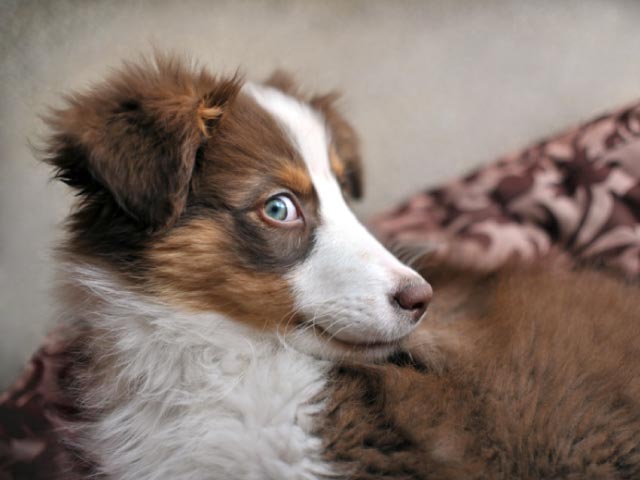
Now imagine someone leaning over a dog who’s resting on the sofa. The dog turns their head away but keeps watching the person from the corner of their eye, revealing more of the white part of the eye.
This is often called whale eye.
It can occur when a dog feels uncomfortable or wants to keep track of something concerning. However, the amount of visible white varies between individual dogs, so whale eye isn’t proof of fear by itself.
Look at what else is happening. If the dog has become stiff, is turning away, or appears unable to escape an unwanted interaction, giving them space is the sensible response.
You don’t need to wait for growling or snapping before respecting a dog’s discomfort.
Is That Really a Smile?
Few things are more appealing than a dog looking up at you with an open mouth and a relaxed face. To us, it can look exactly like a smile.
Sometimes that appearance accompanies a comfortable, contented moment. But dogs also open their mouths to pant, cool themselves, or breathe more heavily after exercise.
A gently open mouth on a relaxed dog is quite different from heavy panting accompanied by tension, restlessness, or attempts to move away.
Some dogs also display what people call an appeasement grin, pulling their lips back and exposing their front teeth. It may resemble a friendly human smile, but it can occur during interactions involving uncertainty or an attempt to reduce conflict.
The face alone doesn’t settle the question. A loose, wiggly body gives a different impression from a dog who’s stiff, retreating, or freezing in place.
Lip Licking, Yawning, and Other Small Clues
Imagine someone trying to hug a dog who doesn’t enjoy being hugged.
The dog turns their head away, quickly licks their nose, and yawns. They’re quiet, so the person keeps hugging them.
Those movements are easy to overlook, but they can appear during uncomfortable interactions.
Of course, a dog may lick their lips after eating or yawn because they’re tired. Neither behavior means I’m stressed every time it happens.
What matters is the combination. If lip licking, yawning, looking away, and body tension appear together while someone is touching or approaching a dog, it’s worth pausing and letting the dog move away.
Responding to subtle signs of discomfort is often more helpful than waiting for a much clearer warning.
Why the Rest of the Body Matters
A dog’s face is only one part of the picture.
Imagine meeting a dog who’s wagging their tail. At first, the movement seems reassuring. But then you notice the dog is stiff, holding its mouth tightly closed, and isn’t approaching you.
Suddenly, that wag doesn’t seem quite so friendly.
A wagging tail can accompany excitement, anticipation, uncertainty, or other states. It doesn’t automatically mean a dog is happy or wants to be touched.
Research supports the importance of looking beyond the face. In a 2024 study involving 447 human participants, researchers examined how people categorized dogs’ expressions when they could see facial information alone or both the face and body.
Body information often improved people’s ability to identify the emotional categories being studied, although the effect varied depending on the expression.
The practical lesson is straightforward: look at the whole dog.
Notice whether their posture is loose or stiff, whether they’re approaching or retreating, and whether they seem comfortable with the interaction. Their ears, tail, movements, and surroundings all contribute.
The same applies to head tilting, a familiar gesture that researchers have linked to human communication without establishing a single meaning.
Every Dog Has a Different Face
There’s another complication: dogs don’t all look alike.
A Greyhound, a Pug, and a Bloodhound have very different facial proportions, ear shapes, and skin folds. Those physical differences can affect how easily people recognize certain movements.
A 2024 study comparing facial expressions in sampled dogs and wolves suggested that changes associated with domestication and selective breeding may make some expressions harder to distinguish in dogs.
That doesn’t mean dogs are poor communicators. It means there isn’t one universal canine face, and a movement that’s obvious in one dog may be difficult to notice in another.
Getting to know an individual dog’s normal appearance and behavior is therefore especially valuable.

How to Get Better at Reading Your Dog
You don’t need to memorize a dictionary of canine expressions. A better starting point is to become familiar with what your own dog looks like when they’re relaxed.
Notice their eyes, ears, mouth, and posture during ordinary moments. Watch how those features change when something catches their attention or when an interaction becomes uncomfortable.
Then consider the circumstances rather than immediately assigning an emotion.
If your dog turns away when someone approaches, allow them space. If they become tense while being touched, stop the interaction. If they’re relaxed and choose to approach, let them do so at their own pace.
These responses don’t require you to know exactly what your dog is feeling. They simply respect what the dog is showing you.
It’s also important to recognize changes that may have a medical cause.
A dog who suddenly squints, develops facial swelling or asymmetry, seems painful around the head, or begins behaving unusually may need veterinary attention. Persistent signs of fear or distress are also worth discussing with a veterinarian or a qualified behavior professional.
The aim isn’t to interpret every expression perfectly. It’s to notice patterns, respond thoughtfully, and keep learning about the dog in front of you.
The Face You Know Best
A lifted eyebrow, a relaxed gaze, or a quick look away may seem like a tiny detail. Yet each belongs to a complex system of communication that scientists are still working to understand.
We know dogs’ facial anatomy differs from that of wolves in some important ways. We know their expressions can change with human attention and rewarding experiences. And we know people sometimes misread those expressions because of the stories they attach to them.
None of that makes a dog’s face less fascinating.
The next time your dog gives you that memorable look, enjoy it. But notice the ears, the posture, the situation, and what happens next, too.
Understanding your dog isn’t about finding a human word for every expression. It’s about learning to see the animal behind the face you love.
Sources & Further Reading
- Kaminski, J., Waller, B. M., Diogo, R., Hartstone-Rose, A., & Burrows, A. M. (2019). Evolution of Facial Muscle Anatomy in Dogs. Proceedings of the National Academy of Sciences, 116(29), 14677–14681.
- Kaminski, J., Hynds, J., Morris, P., & Waller, B. M. (2017). Human Attention Affects Facial Expressions in Domestic Dogs. Scientific Reports, 7, 12914.
- Horowitz, A. (2009). Disambiguating the “Guilty Look”: Salient Prompts to a Familiar Dog Behaviour. Behavioural Processes, 81(3), 447–452.
- Molinaro, H. G., & Wynne, C. D. L. (2025). Barking Up the Wrong Tree: Human Perception of Dog Emotions Is Influenced by Extraneous Factors. Anthrozoös, 38(2), 349–370.
- Guo, K., Correia-Caeiro, C., & Mills, D. S. (2024). Category-Dependent Contribution of Dog Facial and Bodily Cues in Human Perception of Dog Emotions. Applied Animal Behaviour Science, 280, 106427.
- Hobkirk, E. R., & Twiss, S. D. (2024). Domestication Constrains the Ability of Dogs to Convey Emotions via Facial Expressions in Comparison to Their Wolf Ancestors. Scientific Reports, 14, 10491.
- Kiyokawa, Y., et al. (2026). Identification of Facial Expressions in Response to Rewarding Stimuli in Dogs. Applied Animal Behaviour Science, 297, 106921.
- Dogs Trust. (n.d.). How to Understand Your Dog’s Body Language. Dogs Trust.
- Horowitz, A. (2025 revised edition). Inside of a Dog: What Dogs See, Smell, and Know. Scribner.
Featured image by Péter Göblyös

