

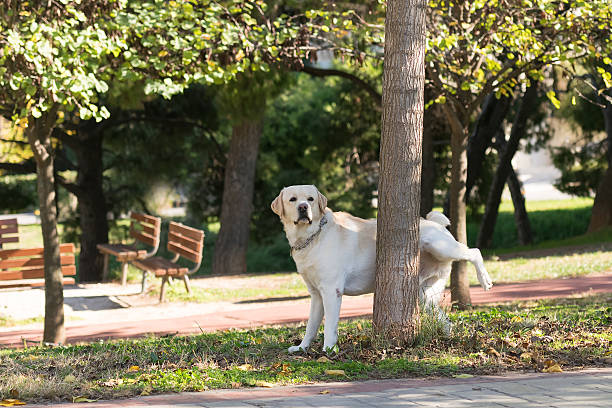
You are out for a walk with your dog, making good progress, when they suddenly stop beside a tree. They sniff carefully, lift a leg or squat, leave a little urine, and move on.
A few steps later, they do it again at a lamppost.
From your end of the leash, it can seem as though your dog is determined to turn a short walk into a very long one. But those little stops can be about more than emptying a bladder.
Dogs experience much of the world through smell, and urine marking is one way they leave scent behind for other dogs to investigate later.
So why do dogs mark particular places, and when does the behavior deserve a closer look?
Marking Is Not the Same as Every Pee
When a dog needs to empty their bladder, they usually release a larger amount of urine. Marking often looks different.
A dog may stop at a particular tree, post, wall, or patch of ground, sniff for a moment, and leave a small amount of urine before moving on. The same thing may happen several times during one walk, even after the dog has already had a proper bathroom break.
The difference is not always obvious. Amount, location, and what the dog does before and after urinating can give you clues, but there is no single test you can use just by watching.
Both male and female dogs can mark. Lifting a leg is common, especially among males, but posture alone does not tell you whether a dog is marking or simply urinating.
What makes marking especially interesting is the role scent plays in the way dogs explore shared spaces.
What Does Another Dog Find in a Scent Mark?
Imagine a lamppost on a street where several people regularly walk their dogs.
Throughout the day, different dogs stop there, sniff, and leave small amounts of urine. They may never meet one another, yet each dog can still encounter traces left by animals that came before.
A dog’s nose can detect chemical information in urine that we cannot pick up in anything like the same way. When a dog spends a long time sniffing one particular spot, they are investigating a scent-rich part of the environment that may seem completely ordinary to us.
That does not mean every mark is a carefully written message.
We cannot look at one patch of urine and reliably translate it into something like, “A confident male dog was here at 8:30 this morning and he was feeling territorial.”
Nor should we assume that the dog leaving the mark was deliberately trying to communicate with one particular animal.
A simpler way to think about it is that marking leaves detectable information about a dog’s presence in a place that other dogs can later investigate.
That alone makes an ordinary tree or lamppost a very different object from a dog’s point of view.
Why Does Your Dog Mark Some Places and Ignore Others?
You may have noticed that your dog spends ages at one tree and walks straight past the next three.
Other dogs’ scents may be part of the reason, although the smells that influence where dogs urinate are only part of the picture.
A busy walking route can collect plenty of smells from dogs passing through. Some spots may attract repeated sniffing and marking, while quieter areas give your dog fewer scents to investigate.
Individual dogs also differ. Some mark frequently, while others do it only occasionally. Age, hormones, previous experience, the dogs they encounter, and simple habit can all be part of the picture.
It is tempting to explain every mark as a claim of ownership: This tree is mine.
Sometimes territorial behavior may be relevant, but that explanation is too simple for every dog and every stop.
Rather than trying to assign one fixed meaning to each mark, pay attention to the pattern. Where does your dog do it? When? Has the amount of marking changed? Are particular dogs, places, or situations involved?
Those observations usually tell you more than trying to decode a single pee.
What If Your Dog Starts Marking Inside the House?
Marking outdoors is a normal part of life for many dogs. Finding urine on the sofa, beside a doorway, or against a piece of furniture is understandably different.
Indoor marking sometimes appears around changes in the dog’s surroundings.
A new pet, visitors, moving house, unfamiliar smells, changes in routine, or tension with another animal may all happen around the same time that marking increases.
But timing does not prove the cause.
A small amount of urine indoors might be marking, but not every indoor accident is a scent mark.
A dog may urinate inside because they have not fully learned where to toilet, were unable to get outside in time, or have a medical problem that changes how often or how urgently they need to urinate.
If a dog who has been reliably house-trained suddenly starts urinating indoors, that change is worth paying attention to rather than assuming it is a behavior problem.
When Urination Changes May Point to a Health Problem
Repeatedly leaving small marks on a walk is not usually a sign that something is wrong. A sudden change in urination is different.
Urinary tract infections, for example, can cause a dog to urinate more frequently, sometimes passing only small amounts. Urination may look uncomfortable or strained, and blood may sometimes appear.
Other conditions, including diabetes and kidney disease, can affect how much a dog drinks and urinates.
Call your vet if you notice changes such as:
- Urinating much more often than usual
- Producing unusually large amounts of urine
- Straining or appearing uncomfortable while urinating
- Blood in the urine
- Drinking noticeably more than usual
- New or repeated accidents indoors
- A sudden change in a previously familiar marking or toileting pattern
Those signs do not tell you exactly what the problem is, but they are reasons to have your dog checked.
If your dog cannot pass urine, or repeatedly tries to urinate and little or nothing comes out, seek urgent veterinary care.
The important thing is not to assume that a new urinary problem is behavioral before considering your dog’s health.
How Can You Manage Unwanted Marking?
If your dog likes stopping to sniff and mark during walks, there is usually no need to prevent every attempt.
Sniffing is part of how dogs explore. When the location is appropriate and you have time, allowing your dog a little space to investigate can make the walk more interesting for them.
You can still decide when it is time to move on. A familiar cue, followed by praise or a reward when your dog comes with you, is clearer than repeatedly pulling them away or treating every pause as bad behavior.
Indoor marking needs a different approach.
Start by asking what has changed. Is there a new animal in the house? New furniture? Visitors? A move? A different daily routine? Has your dog suddenly started drinking or urinating more?
If the behavior is new, especially in a previously house-trained dog, talk to your vet before assuming training or stress is the explanation.
Once health problems have been considered, a few practical changes may help.
Give Your Dog Regular Chances to Go Outside
Make sure your dog has enough opportunities to urinate outdoors, particularly after sleeping, eating, playing, or spending a long period indoors.
Rewarding appropriate toileting can help make the desired behavior clear.
Clean Marked Areas Properly
Use a cleaning product made for pet urine and follow the label directions.
The aim is to reduce lingering odor rather than simply make the area smell clean to you. A dog’s nose is far more sensitive than ours, so an area that seems odor-free to a person may still hold detectable scent.
Manage Access While You Work on the Problem
If your dog repeatedly marks one particular room or object, temporary barriers or closer supervision can help prevent the behavior from becoming an easy habit while you investigate what is behind it.
If you catch your dog preparing to mark indoors, interrupt calmly and guide them outside. There is no need to shout or frighten them.
Punishing a dog after you find urine on the floor is unlikely to teach them what you wanted, especially when you do not yet know why it happened.
What About Belly Bands?
For some male dogs, a belly band can temporarily protect furniture and floors while a marking problem is being managed.
It is just a management tool. It does not change the reason the dog is marking.
A wet band also needs to be changed promptly and the skin kept clean and dry.
Will Neutering Stop a Dog From Marking?
Because reproductive hormones can influence marking, it is reasonable to wonder whether neutering will make the behavior disappear.
For some male dogs, it can reduce marking.
A study of 57 adult male dogs found reductions in several unwanted behaviors after castration, including urine marking, in some of the dogs.
But it was not a guaranteed result.
Marking can be influenced by more than hormones. Habit, social situations, changes at home, and other factors can all play a part, so removing one influence does not necessarily remove the behavior.
Evidence from male dogs also should not be used to assume that spaying a female will have the same effect on marking.
And sterilization involves much more than one behavior. Whether and when to spay or neuter a dog should be decided with your vet based on the individual dog, not used as an automatic fix for urine marking.
When Extra Help Makes Sense
Sometimes the medical side has been checked, the practical changes are in place, and indoor marking still continues.
That is when a qualified dog behavior professional may be useful.
They can look at the details that are easy to miss when you are dealing with the problem every day: where the dog marks, what happens just beforehand, what other animals are doing, how the household responds, and whether particular situations make the pattern more likely.
Marking that first looked completely random may turn out to have a recognizable pattern.
That pattern gives you something to work with.
Seeing Those Little Stops Differently
The next time your dog pauses beside a tree, sniffs carefully, and leaves a tiny amount of urine, you may never know exactly what made that spot interesting.
Perhaps another dog passed through earlier. Perhaps the place already carries several familiar scents. Perhaps marking there has simply become part of your dog’s normal route.
You do not need a perfect translation.
What matters is recognizing that your dog experiences familiar places through smells and information that are largely hidden from us.
When marking happens outside in appropriate places, it can simply be part of an ordinary walk. When the pattern suddenly changes, appears indoors, or comes with changes in drinking or urination, it deserves more attention.
Those little stops are not just interruptions in your walk. They are part of the scent-filled world your dog is busy exploring.
Sources & Further Reading
- VCA Animal Hospitals. (n.d.). Dog Behavior Problems: House Soiling. VCA Animal Hospitals.
- University of California, Davis, School of Veterinary Medicine. (n.d.). Urine Marking in Dogs. UC Davis School of Veterinary Medicine.
- VCA Animal Hospitals. (n.d.). Urinary Tract Infections (UTIs) in Dogs. VCA Animal Hospitals.
- Cornell University College of Veterinary Medicine. (n.d.). Urgent Care. Cornell University College of Veterinary Medicine.
- Neilson, J. C., Eckstein, R. A., & Hart, B. L. (1997). Effects of Castration on Problem Behaviors in Male Dogs With Reference to Age and Duration of Behavior. Journal of the American Veterinary Medical Association, 211(2), 180–182.
- American Animal Hospital Association. (n.d.). When Should I Spay or Neuter My Pet?. AAHA.
- Horowitz, A. (2017). Being a Dog: Following the Dog Into a World of Smell. Scribner.