
Take a look at the label on your cat’s food, and you may find taurine listed among the added nutrients. You might even see it in a product that contains plant ingredients, despite taurine occurring naturally in animal tissues.
That can seem confusing, especially when you consider that cats are obligate carnivores. But the important question is not simply where the taurine originally came from. It is whether the food your cat eats provides enough of it, along with the other nutrients cats need.
So why does taurine matter so much, and what should cat owners actually know about getting it right?
What Makes Taurine Different?
Amino acids are small molecules that join together to form proteins. Taurine is often discussed alongside them, but cats do not use it as one of the building blocks of protein. Its importance comes from the other roles it plays in the body.
Cats can produce some taurine themselves, but not enough to meet their nutritional needs. That makes taurine an essential dietary nutrient for cats: they need to obtain an adequate supply from food.
This is one reason food made for another species should not be assumed to meet a cat’s needs. A product can contain taurine and still not provide the overall nutritional balance required by a cat.

Where Does Taurine in Cat Food Come From?
Meat and fish naturally contain taurine, while plant ingredients contain little or no naturally occurring taurine.
That might make it seem as though the taurine content of a cat food depends entirely on how much meat or fish appears on the ingredient list. Formulated foods are more complicated than that.
Manufacturers can add taurine directly to cat food, including products that also contain plant ingredients. Looking at the ingredient list alone therefore does not necessarily tell you whether the finished food provides enough taurine.
Cats are obligate carnivores, and their nutritional requirements reflect that biology. But that broader dietary classification should not be reduced to a rule about the source of one nutrient.
For taurine, what matters is whether the complete diet supplies enough, whether it comes naturally from ingredients or is added during formulation.
Does Cooking Affect Taurine Content?
Cooking can change how much taurine remains in food, but the process is more complicated than saying that heat simply destroys it.
Taurine is water-soluble, so some of it can move from meat or fish into the surrounding liquid during cooking. If that liquid is discarded, some of the taurine that moved into it goes with it. Research comparing preparation methods has found greater losses when food remains in contact with water during cooking than with some methods that retain more of the food’s moisture.
That does not mean lower-temperature cooking automatically preserves more taurine. The amount remaining depends on the food and the way it is prepared, not temperature alone.
Processing can also change taurine content, and the effect varies between products and methods. Canned or otherwise processed fish should not automatically be assumed to contain very little taurine simply because it has been processed.
There is another distinction worth remembering: a food that contains taurine is not necessarily a nutritionally complete meal for a cat. A piece of cooked meat or a serving of canned fish may provide taurine while still falling far short of everything a cat needs from its diet.
Why a Complete Diet Matters More Than One Ingredient
Once you know that taurine is essential, it is easy to start focusing on that single nutrient. Feline nutrition depends on much more than getting the taurine content right.
For routine feeding, a nutritionally complete food appropriate for your cat’s life stage provides a more dependable foundation, whether you choose wet or dry cat food. These foods are formulated to supply taurine alongside the many other nutrients cats require.
The same principle explains why dog food should not become a cat’s regular diet. Even if a particular dog food contains added taurine, manufacturers do not formulate it to meet the complete nutritional requirements of cats.
Homemade diets require similar care. Meat and fish can contribute taurine, but their presence does not guarantee that a recipe provides the correct balance of nutrients. Cooking can change how much taurine remains as well, particularly when cooking liquid is discarded.
If you want to prepare your cat’s meals at home, a veterinary nutritionist can formulate a recipe that accounts for taurine as well as the many other nutritional requirements that are much harder to judge ingredient by ingredient.
The goal is not to find one ideal food or cooking technique. It is to make sure the diet works as a whole.
What Happens When a Cat Doesn’t Get Enough Taurine?
Taurine supports normal vision, heart function, and reproduction. A prolonged deficiency can therefore have serious consequences.
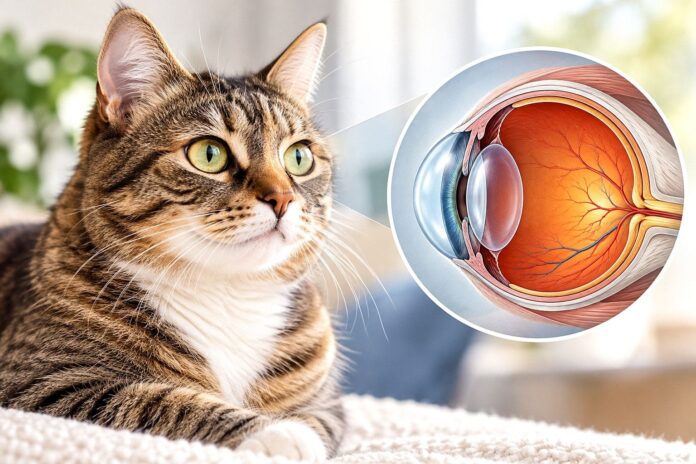
One of the best-known effects is retinal degeneration, in which damage to the retina can impair vision and may eventually lead to blindness. Taurine deficiency can also interfere with reproduction and healthy development.
The heart is another important area. Low taurine has been associated with dilated cardiomyopathy, a condition in which the heart becomes enlarged and its ability to pump effectively is reduced.
Research in cats helped establish this connection decades ago. Some cats with taurine-associated heart disease showed substantial improvement after taurine supplementation. That does not mean every case of feline heart disease is caused by taurine deficiency, however, or that adding taurine is a general treatment for heart problems.
These conditions illustrate why an adequate dietary supply matters; they are not a checklist for diagnosing deficiency at home. If you notice changes in your cat’s vision, general health, appetite, activity, or behavior, veterinary assessment is more useful than assuming a nutritional supplement will solve the problem.
Does Your Cat Need Extra Taurine?
Knowing how important taurine is can make adding a supplement seem like an obvious precaution. For most cats eating an appropriate complete diet, it usually isn’t necessary.
A complete cat food is already formulated to provide taurine as part of the animal’s overall nutritional requirements. Giving additional taurine is therefore different from correcting a known deficiency or following a veterinarian’s recommendation for a particular cat.
If you are concerned about taurine intake, start by looking at the diet as a whole: what your cat eats regularly, whether the main food is complete for cats, and how much of the diet comes from homemade foods, treats, or other additions.
Supplementation may have a role in individual cases, but it should not replace figuring out whether the underlying diet is nutritionally appropriate.

Getting Taurine Right Without Overcomplicating Feeding
Your cat needs taurine, but you don’t need to manage it as an isolated nutrient. For most cats, the simplest and most reliable approach is a complete diet appropriate for their life stage.
Homemade diets require more careful planning, and supplements are best used when there is a specific nutritional or medical reason for them rather than as a substitute for a balanced diet.
Ultimately, good feline nutrition isn’t about getting one ingredient right. It’s about providing everything your cat needs, consistently and in the right balance.
Sources & Further Reading
- Spitze, A. R., Wong, D. L., Rogers, Q. R., & Fascetti, A. J. (2003). Taurine concentrations in animal feed ingredients; cooking influences taurine content. Journal of Animal Physiology and Animal Nutrition, 87(7–8), 251–262.
- Dragnes, B. T., Larsen, R., Ernstsen, M. H., Mæhre, H., & Elvevoll, E. O. (2009). Impact of processing on the taurine content in processed seafood and their corresponding unprocessed raw materials. International Journal of Food Sciences and Nutrition, 60(2), 143–152.
- Sturman, J. A., Gargano, A. D., Messing, J. M., & Imaki, H. (1986). Feline maternal taurine deficiency: Effect on mother and offspring. The Journal of Nutrition, 116(4), 655–667.
- Pion, P. D., Kittleson, M. D., Rogers, Q. R., & Morris, J. G. (1987). Myocardial failure in cats associated with low plasma taurine: A reversible cardiomyopathy. Science, 237(4816), 764–768.
- VCA Animal Hospitals. (n.d.). Taurine in Cats. VCA Animal Hospitals.
- Cornell Feline Health Center. (n.d.). Feeding Your Cat. Cornell University College of Veterinary Medicine.
- Case, L. P., Daristotle, L., Hayek, M. G., & Raasch, M. F. (2011). Canine and Feline Nutrition: A Resource for Companion Animal Professionals (3rd ed.). Mosby.
- National Research Council. (2006). Nutrient Requirements of Dogs and Cats. National Academies Press.

