


Your dog starts gathering blankets into a nest. She carries a favorite toy around carefully, perhaps even guarding it, and her mammary glands seem larger than usual. There is just one confusing detail: as far as you know, she cannot be pregnant.
Pregnancy-like changes can occur even when no puppies are developing. In unspayed female dogs, this is often associated with pseudopregnancy, also known as false or phantom pregnancy.
The signs can be surprisingly convincing because the hormonal changes behind them are real. But pregnancy is not the only possibility, and not every change after a heat cycle should automatically be explained away as pseudopregnancy. Understanding what is happening helps make sense of some unusual behavior while also making it easier to recognize when something does not fit the usual pattern.
What Is False Pregnancy in Dogs?
Pseudopregnancy describes physical and behavioral changes that resemble pregnancy in a dog who is not actually pregnant. She may nest, behave maternally toward an object, develop enlarged mammary glands, or even produce milk despite there being no developing puppies.
To understand why, it helps to look briefly at what happens after a heat cycle.
After ovulation, progesterone rises whether or not a dog has become pregnant. Later, those progesterone levels fall. Prolactin, a hormone involved in mammary development and milk production, is thought to play an important role in the signs of pseudopregnancy as this hormonal shift occurs, although the process is more complicated than a single hormone rising or falling.
Signs often become noticeable around 45 to 60 days after heat, although both the timing and intensity can vary. Because the hormonal pattern following ovulation shares some features whether pregnancy has occurred or not, a dog’s body can sometimes produce changes that look remarkably maternal without an actual pregnancy.
For many dogs, those changes are mild and settle on their own. The important distinction is between a pattern that fits pseudopregnancy and signs that are persistent, worsening, painful, or accompanied by illness.
Similar Signs Can Have Other Causes
Once you know pseudopregnancy exists, it can be tempting to use it as the explanation for every unusual change after heat. That is where some caution is useful.
Other reproductive problems can overlap with parts of the same picture. Pyometra, a potentially serious infection of the uterus, is an especially important example in an unspayed female dog. Other underlying conditions affecting hormone metabolism may also alter or prolong pregnancy-like changes.
This does not mean that a dog nesting after heat is likely to be seriously ill. It means that timing, symptoms, and how she seems overall matter. A veterinarian can consider the whole pattern rather than relying on one behavior or physical change in isolation.
What Changes Might You Notice?
Pseudopregnancy can look quite different from one dog to another. Some dogs mainly show behavioral changes, while others develop more obvious physical signs.
You might notice:
- Restlessness or agitation, sometimes accompanied by whining
- Nesting behavior, such as arranging bedding or choosing a particular place as though preparing for puppies; some dogs may also dig
- Adopting an object, often carrying, protecting, or staying close to a toy as though it were a puppy
- Changes in mood or behavior, including increased irritability or aggression toward people or other animals
- Enlarged mammary glands, sometimes accompanied by a milk-like secretion
- Changes in appetite or weight, which can vary between dogs
- Reduced activity or seeming quieter than usual
None of these signs proves pseudopregnancy on its own. Pregnancy can produce some of the same changes, and certain illnesses can overlap with parts of the picture as well.
There are also signs that deserve more caution. Vomiting, marked lethargy, abnormal vaginal discharge, or a swollen or painful abdomen should not simply be treated as expected features of a false pregnancy. In an unspayed dog, they can indicate another problem, including pyometra, and warrant prompt veterinary assessment. Severe weakness or collapse is an emergency.

How Is False Pregnancy Diagnosed?
From the outside, real pregnancy and pseudopregnancy can sometimes look remarkably similar. Nesting, mammary enlargement, behavioral changes, and milk production do not necessarily tell you which one is happening.
That makes your dog’s recent history useful. Your veterinarian will want to know when her last heat occurred, when the changes began, and whether there was any possibility of mating. If you are not completely sure about contact with an intact male, say so; uncertainty is useful information too.
What you observe at home can also help. Behaviors such as nesting or carrying an adopted toy may disappear completely once your dog reaches the clinic, so a short phone video can give the veterinarian a much better idea of what you have been seeing.
From there, the history and physical examination help determine whether further testing is needed. If pregnancy is possible, pregnancy testing or imaging may be useful depending on how much time has passed. Blood tests, urine tests, or imaging may also be appropriate if the veterinarian is concerned about another condition.
There is no single test that simply returns a result of “pseudopregnancy.” The diagnosis usually comes from recognizing a compatible pattern while, when necessary, ruling out pregnancy or another cause. That also means not every dog needs the same set of tests.
What Can You Do If Your Dog Has a False Pregnancy?
If pregnancy and other concerning causes have been considered and the signs are mild, pseudopregnancy can often be monitored while it resolves naturally.
Many uncomplicated episodes settle within about one to three weeks, although the course can vary between dogs. More pronounced or persistent signs may need veterinary treatment, and any signs of illness should shift the focus away from home management.
One area that deserves particular care is the mammary glands. It may seem logical to express the milk or cover the glands tightly, but stimulating mammary tissue can encourage continued milk production. Binding the glands is not recommended.
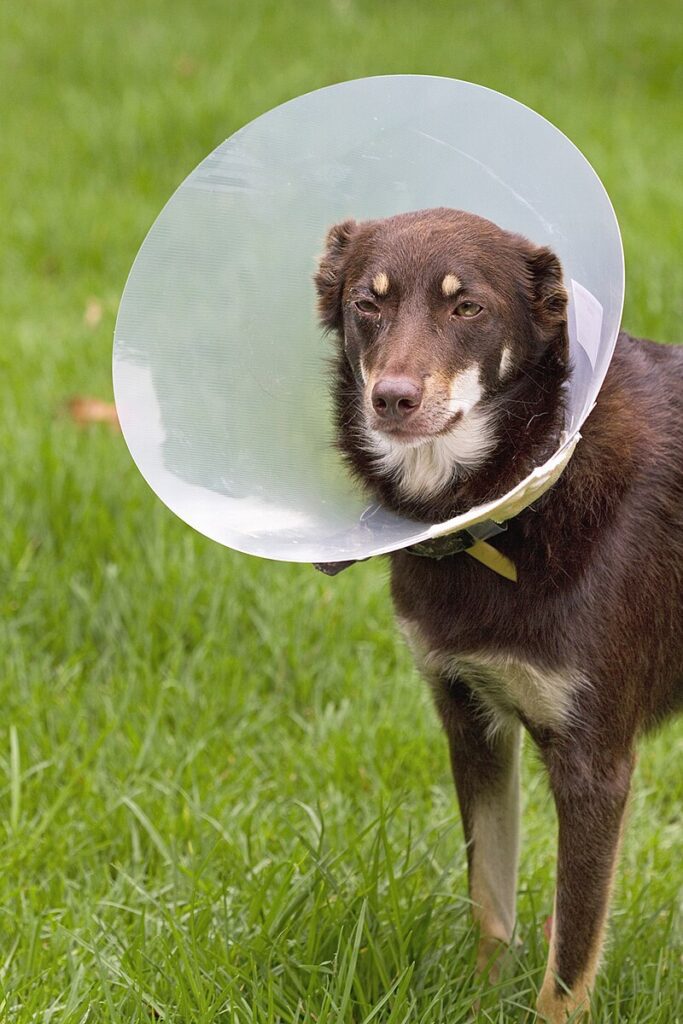
Licking can have a similar effect. If your dog is repeatedly licking or nursing her own mammary glands, gently preventing access may help reduce that stimulation. Depending on the dog, a comfortable Elizabethan collar or a suitable shirt may be useful if she tolerates it well.
There is no need to start manipulating food or water in an attempt to stop milk production. Keep her normal routine and access to water unless your veterinarian gives you a specific reason to do otherwise, and do not fast her as a home treatment.
Medication is sometimes used when signs are more severe, persistent, or uncomfortable. One option a veterinarian may prescribe is cabergoline, a dopamine agonist that reduces prolactin and can help suppress lactation associated with pseudopregnancy. It is not something every dog needs, and whether medication is appropriate depends on the signs, their severity, and the dog’s overall health.
What If She Has “Adopted” a Toy?
One of the more striking behaviors during pseudopregnancy is treating an object almost as though it were a puppy. A dog may carry a stuffed toy carefully, take it to her bed, stay beside it, or become protective when someone approaches.
Seeing this can make owners wonder whether they should immediately take the object away.
There is no universal reason to do so. How the dog responds matters more than the fact that she has chosen an object. If she seems calm and the behavior is not creating a problem, removing it suddenly may simply add unnecessary stress.
If she is intensely guarding the object, becoming distressed, or finding it difficult to settle, the situation deserves more individual attention. Your veterinarian can help you decide whether changing access to the object is likely to help and how to do it without creating an additional behavioral problem.
Can False Pregnancy Be Prevented?
Spaying prevents future pseudopregnancy because the reproductive cycles that produce it no longer occur. The timing, however, matters.
If a dog is currently showing pseudopregnancy signs, elective spaying during that hormonal phase may prolong those signs. Rather than treating surgery as something that should happen immediately, it makes more sense to plan the timing with your veterinarian once the current episode has resolved.
The broader decision about when to spay also involves more than pseudopregnancy. You may come across very confident claims that spaying before the first heat dramatically reduces the risk of mammary tumors, but the evidence used to quantify that effect has important limitations. Spay timing can involve several potential benefits and tradeoffs, and the best decision is not necessarily identical for every dog.
That conversation is more useful when it considers the individual animal: her breed, age, health, lifestyle, reproductive history, and the reasons for considering surgery in the first place.
When the Pattern Does Not Quite Fit
Pseudopregnancy can explain some surprisingly dramatic changes in an unspayed dog, from nesting and toy-carrying to mammary enlargement and milk production. In many cases, the episode is temporary and settles without extensive treatment.
But knowing that false pregnancy exists should not make every post-heat change look harmless. The timing of the signs, whether they are improving or worsening, and whether your dog otherwise seems well all help determine whether monitoring is reasonable or an examination is needed.
If something about the pattern does not fit—particularly if your dog seems ill, painful, unusually lethargic, or develops abnormal discharge—let the symptoms change the question. At that point, the important issue is no longer simply whether she is having a false pregnancy, but whether something else needs attention.
Sources & Further Reading
- Gobello, C. (2021). Revisiting Canine Pseudocyesis. Theriogenology, 167, 94–98.
- Hagman, R. (2018). Pyometra in Small Animals. Veterinary Clinics of North America: Small Animal Practice, 48(4), 639–661.
- Beauvais, W., Cardwell, J. M., & Brodbelt, D. C. (2012). The Effect of Neutering on the Risk of Mammary Tumours in Dogs – A Systematic Review. Journal of Small Animal Practice, 53(6), 314–322.
Featured image by Ri Butov