
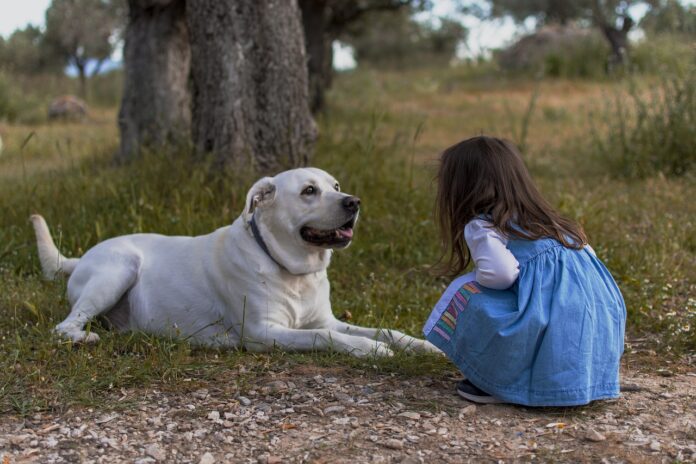
A dog comes home from a walk carrying traces of the outside world on its paws, coat, and nose. Most of the time, that is simply part of sharing a home with an animal. But researchers have become interested in a less obvious question: could living with a dog also influence the microbial environment a baby encounters early in life?
That question matters because infancy is a period of rapid change in both the gut microbiota and the developing immune system.
Studies have found differences in the gut bacteria of infants who live with dogs or other furry pets. Other research has reported associations between early pet exposure and some allergic conditions.
The tempting conclusion is that dogs protect children from allergies. The evidence does not support making that leap.
What it does suggest is more interesting: dogs may be one part of an early-life environment that influences microbial exposure and gut development, and researchers are still working out whether those changes affect later allergy risk.
Why Does the Gut Microbiota Enter the Picture?
The gut microbiota is the community of bacteria and other microorganisms living in the digestive tract. It changes rapidly during infancy as babies encounter new foods, people, places, medications, and microbes from the environment around them.
At the same time, the developing immune system is learning how to respond to an enormous range of signals. Allergies occur when the immune system reacts to substances that are normally harmless, so researchers have long been interested in whether early microbial exposure might influence how those responses develop.
Dogs are particularly interesting in this context because they interact with the environment very differently from people. They investigate soil, plants, other animals, floors, parks, and countless surfaces before returning home. In doing so, they may change the mixture of microbes and other biological material present in the household.
That does not mean children simply need more “dirt.” Dog-owning homes can differ from pet-free homes in many ways, and finding different gut bacteria in one group does not tell us whether those differences are helpful, harmful, or simply different.
What Did the 2017 Study Actually Find?
One of the studies that helped draw attention to this question came from the Canadian CHILD cohort.
Tun and colleagues examined stool samples from 746 infants, collected when the babies were around three months old. They compared infants from homes reporting furry-pet exposure during pregnancy and early infancy with infants from homes without that exposure.
Two groups of bacteria, Ruminococcus and Oscillospira, were more abundant among pet-exposed infants across several birth scenarios. The researchers were interested in these bacteria partly because earlier studies had linked them with lower rates of atopy—the tendency to develop allergic conditions such as eczema, hay fever, or allergic asthma.
Some of the results varied depending on factors such as mode of birth and antibiotic exposure during labor. Rather than pointing to one simple pet effect, those differences suggested that a baby’s early microbial environment is shaped by many influences working together.
Most importantly, the study measured infant gut microbiota. It did not show that the bacterial differences caused lower rates of allergy, nor did it follow the children to prove that furry-pet exposure prevented allergic disease.
That distinction became even more important as later research expanded the picture.
Later Research Looked at Dogs More Directly
A 2023 study focused more specifically on indoor dogs and followed infants over a much longer period. The study included 141 mother-child pairs, with usable microbiome data available from 131 infants. Researchers collected stool samples from the first week of life through 18 months.
Infants exposed to dogs tended to have a greater variety of gut microbes across infancy, with some of the clearest differences appearing between three and six months. Dog exposure was also associated with differences in how common several bacterial groups were.
But not every comparison showed the same pattern. When researchers compared the infants’ gut microbial communities as a whole, a clear difference appeared only among formula-fed infants.
That detail matters because it suggests that dog exposure does not act in isolation. Feeding, birth circumstances, antibiotics, and many other parts of early life may also influence the developing microbiota.
Because the researchers followed the infants over time, the study adds something the earlier snapshot could not: it suggests that associations with dog exposure may appear during the way the gut microbiota develops across infancy.
The limitation remains the same: a different microbiota is not automatically a healthier microbiota. The study did not demonstrate that these changes protected children from allergic disease, and the researchers called for studies that connect dog-related microbial differences directly with later health outcomes.
What Happens When Researchers Look at Allergies Instead?
Other studies have approached the question from the opposite direction. Rather than asking what happens to gut bacteria, they have asked whether children exposed to dogs actually develop allergies at different rates.
A 2019 analysis from the EAT study followed infants whose food-allergy status was assessed during the first three years of life. Dog ownership when the babies were three months old was associated with substantially lower odds of developing food allergy.
That finding was striking, but it came from an observational study. Researchers did not randomly assign some families to live with dogs and others to remain pet-free. Dog-owning households may differ from other households in many ways, some of which are difficult to measure or fully account for.
A much larger Japanese study published in 2023 found another association between early pet exposure and food allergy. It included more than 97,000 mothers and children and reported that exposure to indoor dogs or cats during fetal development or early infancy was associated with a lower incidence of certain food allergies by age three.
The pattern was not identical for every animal or every food. The timing of exposure also appeared to matter. In addition, some of the allergy information came from caregiver reports of a doctor’s diagnosis rather than from food challenges performed specifically for the study.
Taken together, these findings make a possible relationship between early pet exposure and food allergy harder to dismiss. They still do not show that bringing a dog into a home will prevent food allergy in a particular child.
The Asthma Story Is Less Straightforward
If dog exposure broadly protected children from allergic disease, we might expect to see a similarly clear pattern with asthma. That is not what researchers have found.
A 2022 meta-analysis combined information from more than 77,000 children across nine European studies that followed children from birth. Overall, early dog ownership was not associated with a clear increase or decrease in school-age asthma.
Researchers also looked at allergic sensitization to dogs. Sensitization means that the immune system has developed measurable reactivity to dog allergens, although that does not always mean a child has obvious clinical symptoms. Early dog ownership was not associated overall with a clear difference in dog-specific sensitization either.
That does not mean dogs have no relationship with asthma or allergy. For children who do become allergic to dogs, exposure can be clinically important, and the effects may differ depending on when exposure occurs, whether sensitization is already present, and other characteristics of the child and household.
Recent reviews therefore describe a much less tidy picture than either “pets prevent allergies” or “pets cause allergies.” Early exposure may be associated with protective effects for some outcomes or in some populations, while dog allergens can also trigger symptoms in children who develop an allergy to dogs.
Those are not contradictory statements. They are different questions about different children, different outcomes, and different stages of life.
A Plausible Mechanism Is Not Yet a Proven Chain
The microbiota explanation is attractive because several pieces seem to fit together.
Dog exposure has been associated with differences in infant gut microbiota. Separately, researchers have found associations between early gut microbial patterns and later allergic disease.
But placing those findings next to each other does not prove this sequence:
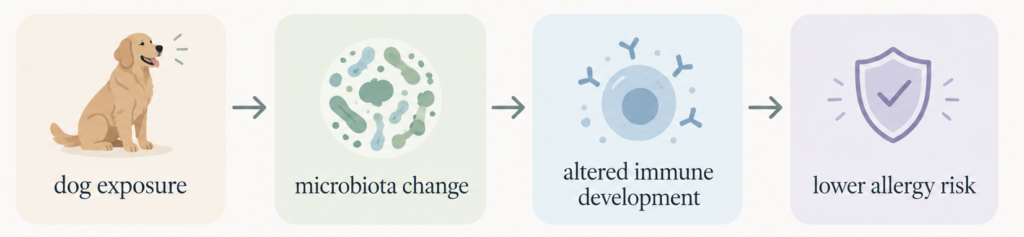
Each step still needs to be demonstrated.
A 2024 systematic review examined 21 studies of infant gut microbiota and six studies of maternal gut microbiota, involving 5,319 participants overall. The review was not specifically about dogs. Instead, it looked more broadly at whether early gut microbial patterns were associated with allergic disease in children.
Researchers found several associations between particular microbial patterns and later allergy outcomes. What they did not find was a simple bacterial signature that could reliably tell us which children would or would not develop allergic disease.
That distinction is important. The microbiome may well be part of the explanation, but science has not yet connected the pieces strongly enough to turn dog ownership into an allergy-prevention strategy.
What Questions Are Still Open?
Research since 2017 has answered some questions, but it has also produced better ones.
- Which part of living with a dog matters? Is it microbes carried indoors, changes to household dust, more contact with the outdoors, direct contact with the animal, or some combination of these?
- When does exposure matter most? Exposure during pregnancy, the first months after birth, and later infancy may not have identical effects.
- Does the microbiota actually help explain allergy risk? Researchers still need studies that follow the same children from dog exposure, through microbial changes, to later diagnosed allergic disease.
- Why do the results differ between food allergy, asthma, eczema, and allergic sensitization? These conditions share some underlying biology, but they are not interchangeable.
- Why might some children respond differently from others? Genetics, family history, mode of birth, feeding, antibiotics, existing allergies, and many other exposures may all influence the relationship.
Those questions are more useful than trying to decide whether dogs are simply “good” or “bad” for a developing immune system.

What Can Families Take From the Research?
For families who already live with a dog, the research offers an interesting perspective on how deeply animals can become part of the biological environment of a home.
It does not offer a guarantee that a child will be less likely to develop allergies. Nor does the current evidence justify getting a dog specifically to prevent allergic disease.
Dog ownership is a long-term commitment involving exercise, behavior, veterinary care, companionship, and the animal’s welfare. An uncertain health effect should not be the reason a family brings one home.
The opposite conclusion would also go too far. Studies of early-life exposure do not support the idea that every family should avoid dogs simply to prevent future allergy. If a child already has allergic symptoms, asthma, or suspected sensitivity to a pet, however, that becomes an individual medical question rather than a general prevention question.
What has changed since the original 2017 study is not that researchers have proved dogs prevent allergies. Later research has added to the evidence linking dog exposure with measurable differences in infant gut microbiota, while some large studies have also found intriguing associations with food allergy.
At the same time, asthma findings remain mixed, individual susceptibility matters, and the biological path connecting a dog in the home with a child’s later immune health is still being worked out.
Studies have linked living with dogs to measurable differences in infants’ gut microbiota. What those differences mean for a child’s later allergy risk remains an open question.
Sources & Further Reading
- Tun, H. M., Konya, T., Takaro, T. K., et al. (2017). Exposure to household furry pets influences the gut microbiota of infants at 3–4 months following various birth scenarios. Microbiome, 5, 40.
- Marrs, T., Logan, K., Craven, J., Radulovic, S., McLean, W. H. I., Lack, G., Flohr, C., Perkin, M. R., & EAT Study Team. (2019). Dog ownership at three months of age is associated with protection against food allergy. Allergy, 74(11), 2212–2219.
- Pinot de Moira, A., Strandberg-Larsen, K., Bishop, T., et al. (2022). Associations of early-life pet ownership with asthma and allergic sensitization: A meta-analysis of more than 77,000 children from the EU Child Cohort Network. Journal of Allergy and Clinical Immunology, 150(1), 82–92.
- Panzer, A. R., Sitarik, A. R., Fadrosh, D., et al. (2023). The impact of prenatal dog keeping on infant gut microbiota development. Clinical & Experimental Allergy, 53(8), 833–845.
- Okabe, H., Hashimoto, K., Yamada, M., et al. (2023). Associations between fetal or infancy pet exposure and food allergies: The Japan Environment and Children’s Study. PLOS ONE, 18(3), e0282725.
- Mousavian, A.-H., Zare Garizi, F., Ghoreshi, B., Ketabi, S., Eslami, S., Ejtahed, H.-S., & Qorbani, M. (2024). The association of infant and mother gut microbiomes with development of allergic diseases in children: A systematic review. Journal of Asthma, 61(10), 1121–1135.
- Ahmed, U., & Nasser, S. (2026). Pets and allergic disease in children: Friend, foe or both? Paediatrics and Child Health, 36(6), 175–182.
Featured image by Stephen Chantzis

