
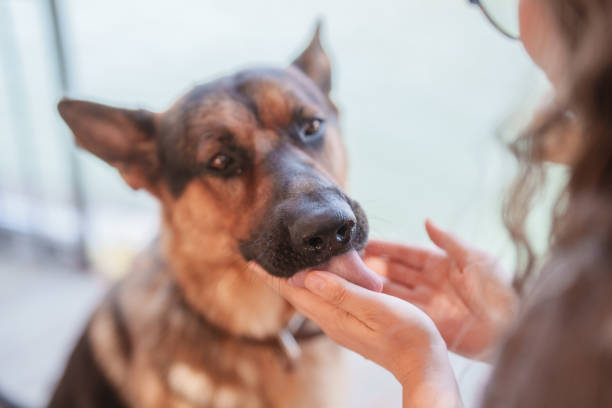
You come home, reach down to greet your dog, and feel a familiar wet tongue brush across your hand. It is a small gesture, often so ordinary that you barely think about it. But why do dogs do it?
Licking can be part of a friendly interaction, a way to investigate an interesting scent or taste, or a response to something happening around the dog. The same behavior can appear in very different situations, so understanding why your dog licks your hands means looking beyond the gesture itself.
An Old Behavior With Different Meanings
Licking has a much longer history than the relationship between dogs and people. Wolf pups, for example, may lick around the mouths of adults when soliciting food. Adult wolves sometimes respond by regurgitating food for the pups, making licking part of an important interaction early in life.
That evolutionary background is interesting, but it does not mean a domestic dog licking your hand is asking for food. Behaviors can take on different roles depending on the animal and the situation. Their history provides useful context without necessarily explaining what motivates a particular dog today.
Your Hands Are Full of Interesting Information
Think about everything your hands touch throughout the day. Food, plants, soil, soap, and countless everyday objects can leave traces of scent behind. To a dog, whose sense of smell plays such an important role in exploring the world, your hands may be worth investigating.
Sniffing is one way to gather information, and licking adds taste to the experience. If you have just prepared food, for example, your dog may be interested in something left on your skin. That does not mean dogs can reconstruct your entire day from a taste of your hand, but sensory curiosity offers one plausible explanation for the behavior.
Licking can also occur during social interactions. A dog may lick a familiar person’s hand while greeting them or spending time together, and the behavior may form part of an affectionate exchange.
The important distinction is that licking can accompany affection without being a reliable measure of it. A dog that rarely licks people is not necessarily less attached to them than one that does.
What If Your Dog Starts Licking More Than Usual?
An occasional lick during a greeting is one thing. A dog that suddenly begins licking repeatedly, or seems increasingly difficult to interrupt, presents a different question. Changes in a dog’s usual behavior can sometimes tell us more than the behavior itself.
Stress is one possible contributor to repetitive licking, but a new or marked behavioral change can also accompany medical problems or other difficulties. Notice whether the licking has become more frequent or intense, interferes with normal activities, causes irritation or injury, or appears alongside changes in health or behavior.
There is no particular number of licks that separates normal behavior from a problem. What matters is the pattern and its effect on the individual dog. If the change is persistent, increasingly difficult to interrupt, or accompanied by other concerning signs, a veterinarian can help investigate possible medical and behavioral causes.
Look at What Happens Around the Licking
One of the most useful ways to understand licking is to notice what happens immediately before and after it.
Consider a dog that licks your fingers after you have handled food. Sensory interest is one plausible explanation. Now imagine the same dog giving your hand a few gentle licks while resting beside you. In that situation, licking may simply be part of a familiar social interaction.
If the behavior appears during tense or unfamiliar moments, stress becomes another possibility worth considering. These different situations offer clues about what may be happening, even if they cannot tell us exactly what the dog is feeling.
Pay attention to when the behavior occurs, how frequently it happens, and whether your dog settles once the situation changes. Comparing those observations over time can help you distinguish an ordinary habit from a change that deserves closer attention.
What If You Don’t Want Your Dog to Lick You?
Not everyone enjoys being licked, even by a much-loved dog. If you would rather your dog interact with you in another way, you can calmly move your hand away and encourage an alternative behavior without scolding them for licking.
For some dogs, a favorite toy, a calm greeting, or another familiar activity can provide an alternative way to interact. Rather than offering it immediately as a reward for licking, first move your hand away calmly and wait for or encourage another behavior, such as sitting, settling, or simply keeping all four paws on the floor. Then give attention or start the alternative activity.
What works will depend on the dog and the situation. The aim is not to treat licking as something inherently wrong, but to reinforce ways of interacting that feel comfortable for both of you.
A Small Gesture Worth Understanding
The next time your dog licks your hand, think about what might have prompted it. Perhaps you have just handled something interesting. Perhaps your dog is greeting you after a period apart. Or perhaps licking is simply part of the way that particular dog interacts with familiar people.
There may not be one clear explanation, and that is part of what makes animal behavior interesting.
A lick cannot tell you everything your dog is feeling, but the circumstances surrounding it can help you understand the behavior a little better.
Sometimes, paying attention to those small everyday interactions reveals more than trying to assign a fixed meaning to every gesture.
Sources & Further Reading
- VCA Animal Hospitals. (n.d.). Why Do Dogs Lick Humans?. VCA Animal Hospitals.
- International Wolf Center. (n.d.). How Do Wolves Communicate?. International Wolf Center.
- Merck Veterinary Manual. (n.d.). Behavior Problems of Dogs. Merck Veterinary Manual.
- Merck Veterinary Manual. (n.d.). Diagnosis of Behavior Problems in Animals. Merck Veterinary Manual.
- Horowitz, A. (2009). Inside of a Dog: What Dogs See, Smell, and Know. Scribner.

