

Your suitcase is open on the bed. You’re trying to remember whether you’ve packed everything, and your cat has already decided that the pile of clothes makes an excellent place to sleep.
Then you bring out the carrier.
For some cats, that is enough to end their interest in the packing process. The cat who was happily supervising a moment ago is suddenly nowhere to be found.
Travel can be a strange experience for an animal whose everyday life revolves around familiar places, smells, and routines. A car journey, a busy station, or a room that smells of strangers may be considerably less exciting to your cat than it is to you.
Some cats cope surprisingly well with traveling. Others find even a short trip difficult. Whether you’re moving house, visiting family, or planning a longer journey, preparation can make a real difference.
And the first decision may be whether your cat should travel at all.
First, Does Your Cat Really Need to Come?
If the trip is optional, ask yourself whether bringing your cat is actually the best choice for them.
For a short holiday, staying in familiar surroundings with a reliable cat sitter may be less disruptive than spending hours traveling only to arrive somewhere completely new. Cats can form strong attachments to people, but familiarity with their environment also matters.
Bringing a cat because you would enjoy having them with you is not automatically the kinder option.
Of course, some journeys are unavoidable. You may be moving house, relocating to another country, staying away for an extended period, or facing circumstances where leaving the cat at home simply is not practical.
In that case, the question changes from Should they come? to How can I make this journey safer and easier for them?
If your cat has a health condition, is elderly, has breathing problems, or has struggled badly with previous journeys, talk to your vet early in the planning process.
Make the Carrier Something Other Than Bad News
For many cats, the carrier has acquired a terrible reputation.
It appears from a cupboard, somebody tries to persuade them to get inside, and the next thing they know, they’re on their way to the vet.
From the cat’s point of view, avoiding it makes perfect sense.
That is why it helps to stop treating the carrier as something that appears only before an unpleasant journey. Leave it somewhere accessible at home well before the trip, with the door open if appropriate and familiar bedding inside.
Your cat does not need to start sleeping in it for this to be useful. Simply being able to investigate the carrier without immediately being shut inside can make it a more ordinary part of the environment.
You can occasionally put a treat or favorite toy near the entrance or inside if your cat responds well to that. Once they are comfortable going in, you can gradually introduce closing the door briefly, lifting the carrier carefully, and eventually taking short practice journeys if that is practical.
There is no need to rush. Repeatedly forcing a frightened cat into the carrier is unlikely to teach them that it is a safe place.
Choosing the Right Carrier
Your cat should have enough room to stand, turn around, and lie down comfortably. Look for a sturdy, well-ventilated carrier with secure fastenings and a design that is easy to clean.
A removable top can be particularly useful because it may allow a nervous cat to stay in the lower half during parts of a veterinary examination instead of being pulled through a small door.
If you’re flying or using public transport, check the transport provider’s carrier requirements before buying one. A perfectly good carrier for car travel may not meet an airline’s size or design rules.
And if you’re traveling with several cats, plan on one carrier per cat for routine travel. Cats that happily sleep together at home may feel very differently when confined in a small space during a stressful journey.

Check the Rules Before You Book
International pet travel is one area where generic internet advice can become outdated surprisingly quickly.
Requirements depend on where you are leaving from, where you are going, any countries you pass through, how you travel, and sometimes how you return. They may involve identification, vaccinations, veterinary certificates, tests, permits, quarantine arrangements, approved routes, or other conditions.
Transport companies have their own rules as well.
So rather than relying on a checklist from an article like this one, check the current official requirements for your exact journey before you commit to tickets or accommodation.
For readers in the United States, USDA APHIS is a useful starting point for current pet-travel requirements. In Great Britain, check the official GOV.UK pet travel guidance. Canadian travelers can use the Canadian Food Inspection Agency, while Australia’s Department of Agriculture, Fisheries and Forestry provides detailed guidance for bringing cats and dogs into the country.
If you live elsewhere, look for the relevant government veterinary, agriculture, border, or biosecurity authority rather than relying on an airline blog or an old travel forum.
Check the return journey too. Meeting the requirements to enter another country does not automatically mean you have everything needed to come home.
Some steps also have waiting periods, so this is something to investigate before booking, not during the final week of packing.
Your vet can help with your cat’s health, vaccinations, certificates, and other veterinary requirements, but the official authority for your route is the place to confirm what the law currently requires.
What Should You Pack for Your Cat?
Cats do not need a miniature suitcase full of belongings, but a little planning can prevent a surprisingly inconvenient problem halfway through a journey.
Depending on the length and type of trip, consider bringing:
- Your cat’s usual food, with enough for delays
- Fresh water and suitable bowls
- Any prescribed medication and its instructions
- Familiar bedding
- A travel litter box and familiar litter when appropriate
- Absorbent pads, spare bedding, and cleaning supplies
- Identification details and required travel documents
- A recent photo of your cat
- Contact details for a vet near your destination
For longer journeys, think beyond simply packing the items. Work out when and where your cat will be able to drink, eat, and use a litter box safely.
Check the destination too. A hotel described as pet-friendly may welcome dogs but not cats, and an unfamiliar rental can contain windows, balconies, vents, fireplaces, or other escape routes you would never have to think about at home.
Can Medication Help a Nervous Cat Travel?
Sometimes preparation is not enough.
A cat may cry for the first few minutes of a journey and then settle. Another may remain intensely distressed, become nauseated, or struggle every time they travel.
If your cat has a history of difficult journeys, speak to your vet before the trip.
Medication may be appropriate for some cats, but reducing anxiety and simply making an animal sleepy are not the same thing. Different medications have different effects, and the right choice depends on the cat, their health, and the type of journey.
If your vet prescribes something for travel, ask whether they want you to observe your cat’s response at home before departure. Follow their instructions rather than experimenting with timing or dosage yourself.
Never give your cat human travel medication unless your vet has specifically told you to use that medication for that cat.
Flying deserves extra caution. IATA advises against routine sedation or tranquilization of animals during air transport because of the potential for adverse effects. If medication is needed, it should be discussed with the vet and the airline rather than treated as a simple way to keep the cat quiet.
The aim is not to produce a silent traveler. It is to help the cat cope as safely as possible.
Traveling by Car: Keep Your Cat in the Carrier
A car journey may feel straightforward because you control the route, temperature, and stops.
Your cat is having a rather different experience. The floor vibrates, the engine makes unfamiliar sounds, the surroundings keep moving, and none of the usual landmarks smell right.
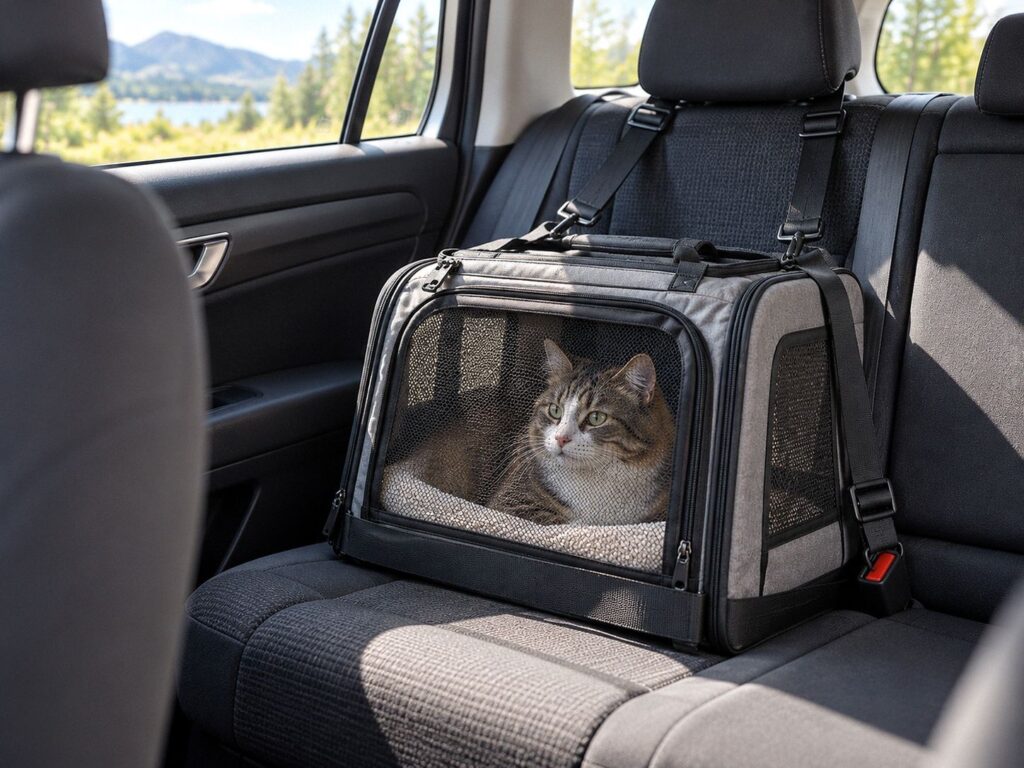
For safety, keep your cat inside a secure carrier while the vehicle is moving. A loose cat can distract the driver, get under the controls, or be badly injured during a sudden stop or collision.
Position the carrier somewhere stable and secure, following the instructions for both the carrier and vehicle. Depending on their design, that may mean an appropriate restraint or a secure position on the vehicle floor. Do not assume that looping a seatbelt around any carrier automatically makes it safe.
Keep the car comfortably ventilated and avoid direct heat or strong airflow onto the carrier. Smooth driving and moderate noise can also make the journey less chaotic.
Some cats settle better when part of the carrier is covered with a light familiar cloth, provided ventilation remains clear.
And never leave a cat alone in a parked car. A comfortable outside temperature does not guarantee that the inside of the vehicle will remain safe.
What About Stops on a Long Drive?
When you stop, resist the temptation to open the carrier beside the road so your cat can stretch their legs.
A frightened cat can escape in seconds, including one who would normally never leave your side at home.
Keep the carrier closed while vehicle doors or windows are open. For a long journey, plan in advance how food, water, and litter-box needs can be managed without creating an escape opportunity.
If your cat has a medical condition or the trip will be unusually long, ask your vet to help you plan around those needs before departure.
Taking Your Cat on a Train
Train travel brings its own collection of noises and movement. People may walk past the carrier, announcements come over loudspeakers, other animals may be nearby, and busy stations can be difficult places for a nervous cat.
Check the operator’s pet policy for every part of the journey. A connection may be operated by a different company with different rules about reservations, carrier sizes, fees, or where animals are allowed.
If you have a choice, a quieter service may mean fewer people crowding around the carrier. Keep your cat contained throughout the journey and carry cleaning supplies in case of an accident.
A light cover over part of the carrier may reduce visual stimulation for some cats, as long as airflow remains good and your cat does not become too warm.
Flying With Your Cat Takes Extra Planning
Flying is rarely just the time spent in the air.
There is the journey to the airport, check-in, security, waiting, boarding, the flight itself, arrival procedures, and finally another journey at the other end. For a cat, that is a lot of unfamiliar activity compressed into one day.
Before booking, find out exactly how your cat would travel on that route.
Some airlines allow certain cats in the passenger cabin, subject to their own carrier, size, booking, and route restrictions. Other journeys may involve cargo arrangements, and some airlines or routes may not carry pets at all.
Do not assume that a policy you find on an airline’s main page applies to a particular aircraft, codeshare, connection, destination, or return flight. Confirm the actual itinerary.
When practical, a direct flight can reduce transfers and extra handling, although the best option still depends on the route and the individual cat.
Plan for Airport Security Too
Security screening is one of the easiest parts of air travel to overlook.
Procedures vary by country and airport, so check the current instructions for wherever you are traveling. In the United States, for example, TSA normally requires small pets to be removed from their carrier while the empty carrier goes through X-ray screening.
The animal itself should never be placed inside a baggage X-ray machine.
That creates an obvious challenge with a frightened cat: you may have to open the carrier in one of the busiest environments they have ever encountered.
Find out what to expect before reaching the checkpoint. If your cat is likely to panic, ask the relevant security authority what options are available, including whether more private screening can be arranged.
Once aboard, follow the airline’s instructions about where the carrier must remain. Do not assume you will be allowed to open it or take your cat out during the flight.
Give Your Cat a Quiet Start When You Arrive
After hours of planning and traveling, it can be tempting to open the carrier and let your cat investigate the entire destination.
But from their perspective, almost everything has changed at once.
Start with a quiet room if possible. Before opening the carrier, check doors and windows carefully and make sure there are no accessible gaps, balconies, vents, fireplaces, or other places where a frightened cat could escape or disappear.
Set out fresh water, the usual food, a litter box, and familiar bedding. Then put the carrier in the room, open the door, and let your cat decide when to come out.
Some cats begin exploring almost immediately. Others remain inside the carrier or move straight to a hiding place.
Neither response needs to be rushed.
Keep the carrier available as a familiar retreat and maintain the usual feeding and play routine as much as the new setting allows. Once your cat seems comfortable, you can gradually give them access to more of the accommodation if it is safe.
Keep an eye on eating, drinking, urination, and general behavior as well. Travel can temporarily unsettle a cat, but a significant loss of appetite, difficulty urinating, vomiting, breathing problems, or signs of illness should not automatically be blamed on travel stress.
If your cat is struggling to breathe or repeatedly trying to urinate without producing urine, seek emergency veterinary care immediately.
The Best Journey Is One That Considers Your Cat
Travel is often appealing to us because it means new places, new experiences, and a break from routine.
For many cats, those are not particularly strong selling points.
Their version of comfort may involve familiar smells, predictable surroundings, safe hiding places, and knowing where everything is. We cannot make every necessary journey stress-free, but we can avoid turning it into a series of preventable surprises.
That means introducing the carrier before departure day, checking the actual rules for the route, planning around the cat rather than just the timetable, and giving them somewhere quiet to settle when they arrive.
And sometimes it means recognizing that the best travel plan is for the cat not to travel at all.
Whether your cat comes with you or stays safely at home, the important thing is to make the decision with their needs in mind—not just your itinerary.
Sources & Further Reading
- UC Davis School of Veterinary Medicine. (n.d.). Traveling with Cats. UC Davis School of Veterinary Medicine.
- American Animal Hospital Association. (n.d.). Helping Your Cat Cope with Veterinary Visits. AAHA.
- Rodan, I., et al. (2022). 2022 AAFP/ISFM Cat Friendly Veterinary Interaction Guidelines: Approach and Handling Techniques. Journal of Feline Medicine and Surgery, 24(11), 1093–1132.
- Cats Protection. (n.d.). How to Choose and Use a Cat Carrier. Cats Protection.
- U.S. Food and Drug Administration. (n.d.). Travel Training for You and Your Pets. FDA.
- International Air Transport Association. (n.d.). Traveling with Pets. IATA.
- Transportation Security Administration. (n.d.). TSA Travel Tips. TSA.
- European Union. (n.d.). Travelling with Pets and Other Animals in the EU. Your Europe.
- Cats Protection. (n.d.). Going on Holiday Without Your Cat. Cats Protection.

