
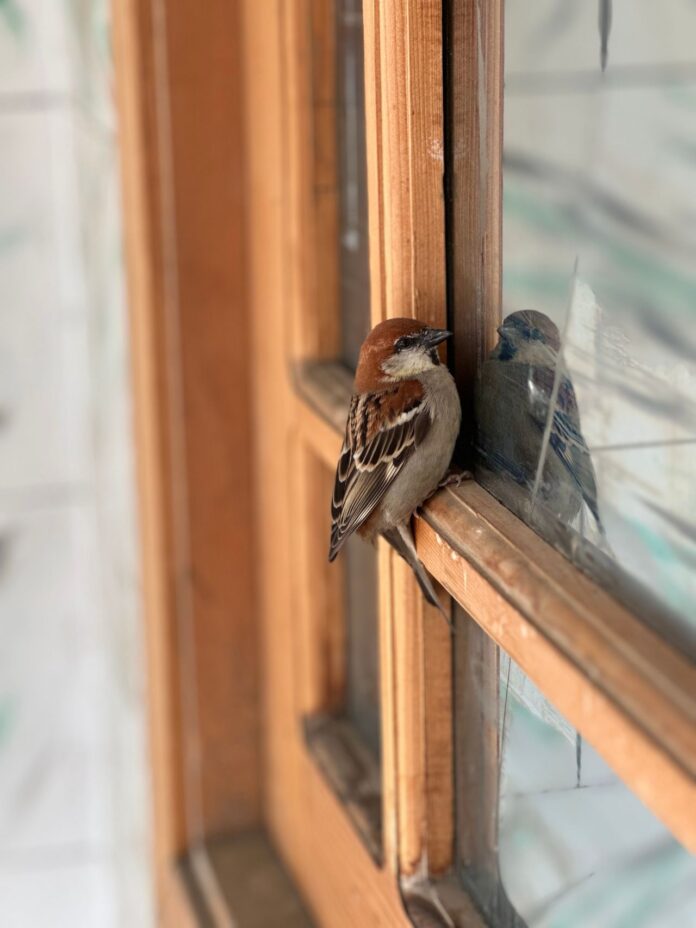
A sudden thud interrupts your breakfast. You look toward the window, then outside, and find a small bird on the ground beneath it.
The glass seemed perfectly obvious to you. There’s a window frame, a reflection of the garden, and the familiar view you’ve looked through hundreds of times. Yet to a bird approaching from outside, that same pane may have appeared to be open sky or a leafy tree with space to fly between its branches.
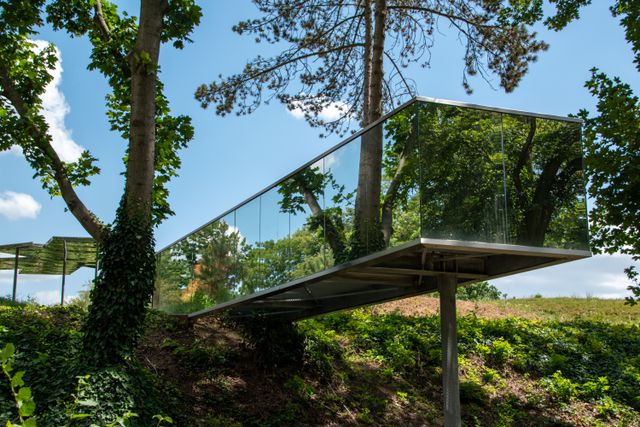
Birds collide with windows because glass can reflect the places they want to fly toward or appear transparent enough to fly through. The problem isn’t simply that birds have poor eyesight. It’s that the visual information presented by glass can make a solid barrier look like part of the surrounding environment.
These collisions are a serious conservation problem. Research indicates that more than a billion birds die annually following building collisions in the United States alone, including at ordinary homes.
Fortunately, many collisions are preventable. Making windows safer doesn’t necessarily require replacing the glass, but it does require understanding which treatments work, why their placement matters, and what the scientific evidence actually tells us.
Why Do Birds Fly Into Glass?
Imagine a robin flying across a garden toward a tree. It can see branches, leaves, and small gaps through which it might pass. From the bird’s perspective, there’s nothing unusual about continuing in that direction.
But the tree may not be there at all. It could be a reflection in a window.
Birds have sophisticated visual systems, yet reflections can create convincing images of habitat. When the outdoors is bright and the room behind a window is relatively dark, the glass may behave almost like a mirror, reflecting vegetation, sky, or nearby buildings.
A bird approaching that reflection doesn’t necessarily receive a clear visual signal that a solid surface interrupts its flight.
Sometimes the Bird Sees Straight Through
Reflection is only half the problem. Transparent glass can create a different illusion, particularly when a building has windows on opposite sides.
From certain angles, a bird approaching one pane may see daylight, plants, or open space through another window beyond it. The building appears to offer a passage, even though the route is blocked by glass.
The same problem can occur with glass balcony railings, transparent garden barriers, and bus shelters.
Lighting and viewing angle make matters more complicated. A window that reflects a tree in the morning may become relatively transparent later in the day. A pane that appears harmless from one direction can look like an open route from another.
This explains why collisions can happen at windows that seem perfectly ordinary to the people living behind them. The bird isn’t necessarily behaving carelessly; it may be responding to visual information that doesn’t reveal the barrier.
The most effective prevention strategies address that problem directly: they change how the glass appears to birds approaching from outside.
The Most Important Fix: Make the Glass Visible
One common approach is to put a sticker on a window, perhaps shaped like a hawk or another bird of prey. The idea is understandable: if approaching birds see something threatening, perhaps they’ll turn away.
Unfortunately, a single silhouette doesn’t make the surrounding glass disappear. A bird may simply aim for an apparently open area beside it.
The same limitation applies to a handful of decorative decals scattered across a large pane. They may make individual spots visible while leaving broad areas that still resemble open space.
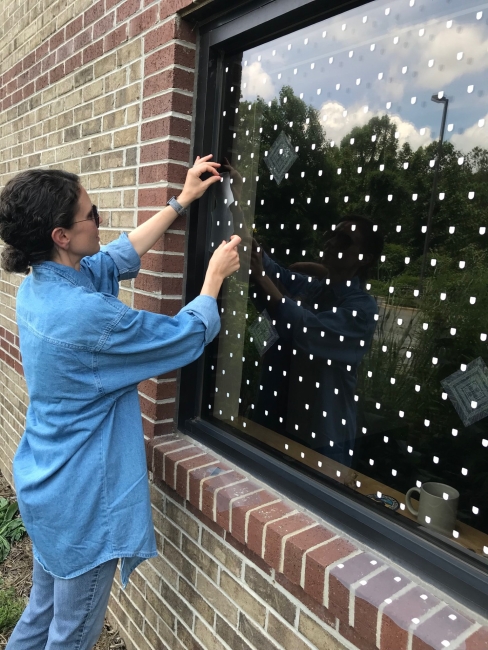
A more useful approach is to create a closely spaced pattern across the glass, using dots, lines, or other visible markings. The pattern interrupts reflections and apparent openings, helping birds recognize that the surface isn’t a safe route.
Why the Spacing Between Markers Matters
The distance between individual markings is just as important as the markings themselves.
The American Bird Conservancy recommends spacing of approximately 2 inches (5 centimeters) or less in both directions for many two-dimensional window patterns. This is commonly known as the 2-by-2 rule.
The reasoning is straightforward. Birds regularly fly through small gaps between branches and leaves. If the markings on a window leave a large, apparently clear opening, an approaching bird may still try to pass through it.
A pattern of small, closely spaced dots can therefore provide better coverage than a few much larger stickers.
Not every treatment uses exactly the same spacing. Vertical cords, continuous lines, and specialized films may follow different design rules. The important thing is to use a pattern appropriate for the product and follow its installation guidance rather than assuming any decorative arrangement will be equally effective.
Why the Outside of the Window Matters
There’s another detail that is easy to overlook: which side of the glass receives the treatment.
Imagine carefully arranging a pattern of bird-deterrent stickers on the inside of a living-room window. From the room, the markings are perfectly visible. Outside, however, the glass may still reflect the sky or garden strongly enough to obscure them.
Exterior treatments avoid much of that problem because birds encounter the markings before the reflected image.
A controlled study published in 2023 compared two window films applied to the internal and external surfaces of glass. One used ultraviolet-reflective properties, while the other provided signals in a longer-wavelength range visible to birds.
Both produced stronger avoidance responses when installed externally. Neither demonstrated the same protective effect when applied to the inside surface under the conditions tested.
That doesn’t mean every imaginable interior treatment is useless. Closing curtains or blinds, for example, can reduce a transparent view through a building. But an interior solution may leave a strong exterior reflection largely unchanged.
For products intended to break up reflections, exterior placement is generally the more reliable choice.
Do Window Markers Actually Reduce Bird Collisions?
It’s reasonable to ask whether window markers genuinely prevent collisions or simply seem like a sensible idea.
Researchers have investigated that question in controlled experiments and real-world settings. Although individual studies have limitations, the evidence for properly installed exterior markers is encouraging.
What a Study of Bus Shelters Found
In a study published in 2022, scientists examined glass-walled bus shelters in Stillwater, Oklahoma.
Some shelters received a commercial treatment consisting of closely spaced exterior markers, while others remained untreated. Researchers compared collisions before and after installation and also examined differences between treated and untreated shelters.
The results showed significantly fewer collisions at shelters fitted with the markers. Collisions declined at treated shelters even as they increased at those left untreated.
The researchers estimated that treating half of Stillwater’s bus shelters had reduced the total annual number of collisions across the city’s shelters by approximately 64%, relative to their earlier baseline.
That is substantial evidence that changing the appearance of glass can make a difference outside a laboratory.
Bus shelters have particular characteristics, however. Their transparent walls and open sides create different visual conditions from those found at many homes and larger buildings. The results support the treatment tested, but they don’t establish that every window-marker design will achieve a 64% reduction everywhere.
What a 2026 Building Study Added
A study published in May 2026 extended this line of research to glass façades on university buildings.
Researchers installed small white-dot markers approximately 5 centimeters apart on six façades belonging to two buildings at Oklahoma State University. They also monitored untreated façades for comparison.
After installation, the researchers observed collision rates at the treated façades that were approximately 67–72% lower than before treatment.
That sounds impressive, and the observed reduction is certainly encouraging. But there’s an important qualification.
The study’s main statistical analysis did not establish a significant treatment effect. With only six treated façades, the researchers had limited statistical power to distinguish the treatment’s impact from other sources of variation.
The authors therefore presented the observed reductions as supportive evidence rather than definitive proof of a precisely measured effect.
Taken together, the 2022 and 2026 studies strengthen the case for closely spaced exterior markers. They also illustrate why percentages from individual studies shouldn’t be turned into promises about how much safer a particular household window will become.
The practical lesson is not that one brand of stickers guarantees a particular result. It’s that well-designed, properly installed exterior patterns can substantially reduce collision risk.
Screens, Shades, and Hanging Cords Can Help Too
Window markers aren’t the only way to make glass safer. Depending on the building and how its windows are used, other treatments may offer practical advantages.
Exterior Window Screens
A screen installed outside a window can help in two ways. It makes the surface more visually apparent and interrupts the uninterrupted reflections that often attract approaching birds.
A suitably positioned screen can also provide a physical buffer between the bird and the hard glass, potentially reducing the consequences of an approach that would otherwise end in a collision.
The American Bird Conservancy recommends exterior insect screens as a useful option for existing windows. Because a screen can cover the entire pane, it avoids the problem of leaving large gaps between individual markers.
However, coverage matters. A screen protecting only the lower half of a window may leave the upper section exposed.
If your home already has exterior screens, consider which panes they cover before deciding where additional treatment is needed.
Exterior Shades and Hanging Cords
Exterior shades can also change how a window appears. By covering or breaking up large reflective areas, they reduce the uninterrupted visual illusion presented by the glass.
A 2016 study at a museum in San Francisco found that external shades and other features interrupting large expanses of glass were associated with fewer bird collisions. The results came from an observational study rather than a direct comparison of every available treatment, but they support considering shades as part of a prevention strategy.
Another option is to hang vertical cords in front of a window. Sometimes called bird savers, these arrangements create a series of visible lines outside the glass without requiring anything to be attached directly to the pane.
The cords need to be appropriately spaced and positioned so that they continue to provide a visible pattern. Cornell Lab guidance describes designs with cords spaced approximately 4 inches (10 centimeters) apart, although the specifications of the particular system should guide installation.
These alternatives may be particularly appealing when homeowners want to preserve a clear view, avoid adhesive products, or use an existing screen or shade.
There isn’t enough direct comparative evidence to declare one of these approaches universally superior. Window size, available access, the surrounding reflections, and the treatment’s design all matter.
What About Invisible UV Window Stickers?
An almost invisible window treatment has obvious appeal. You could keep an unobstructed view of your garden while making the glass easier for birds to recognize.
The concept is based on a genuine feature of avian vision: many birds can detect ultraviolet wavelengths that humans cannot.
Manufacturers have used this difference to develop films and markers that reflect ultraviolet light while remaining relatively inconspicuous to people.
And some of these products have performed well in scientific tests.
In a study published in 2020, researchers examined an externally applied UV-reflective film using zebra finches and brown-headed cowbirds. Under controlled flight-tunnel conditions, the birds were less likely to approach the treated windows on a collision course.
In comparisons designed to more closely resemble the difference between fully treated and untreated windows, the estimated reduction in collision likelihood was approximately 30–50%, depending on the species.
The researchers also observed that birds approached treated windows more slowly, potentially reducing the force of an impact if a collision still occurred.
These are meaningful findings, but they concern a particular film, two bird species, and controlled testing conditions.
Bird species differ in their sensitivity to ultraviolet light, while the visibility of UV-based patterns can depend on lighting conditions. Different products may also use different materials and designs.
That means a label describing a window film as UV-reflective or bird-safe is not, by itself, evidence that the product will perform as expected.
Before buying, look for independent testing of the specific treatment. Consider whether the evidence comes from controlled flight trials, field studies, or manufacturer claims, and check whether the product is intended for exterior installation.
Some UV treatments can help, but not every UV sticker has demonstrated effectiveness. For homeowners who prefer a straightforward, visible solution, closely spaced exterior markings or a suitable screen remain sensible starting points.
How to Make Your Own Windows Safer
Knowing which treatments have supporting evidence is useful, but preventing collisions also depends on identifying the problem areas in your home.
Start by examining your windows from outside, particularly those where collisions have already occurred.
A kitchen window may reflect a nearby hedge. Patio doors might mirror the sky above the garden, while windows on opposite sides of a room could create the appearance of a clear route through the building.
Try looking at the glass from more than one direction. If possible, check it at different times of day, when changing light may alter the strength of reflections.
This won’t reproduce exactly what every bird sees, but it can help reveal the visual conditions that make a particular pane hazardous.
Treat the Whole Problem Pane
If you decide to apply markings, cover the entire area that presents the reflection or apparent opening.
A small cluster of decals around the point of a previous collision may leave large sections of glass looking unchanged. Birds can approach from different directions, so treating only the spot where one bird struck may not solve the underlying problem.
Commercial markers and films are convenient options, but they aren’t the only choices.
The American Bird Conservancy also recommends non-toxic tempera paint as an inexpensive way to create temporary patterns on the outside of windows.
Dots, lines, or decorative designs can all be suitable, provided the markings are sufficiently visible and closely spaced. A carefully painted pattern can make a window safer without requiring a specialized product.
Whatever treatment you choose, make sure it can withstand the conditions it will encounter and follow any cleaning or installation requirements.
And don’t put yourself at risk trying to reach difficult glass. If a window is high, awkward to access, or subject to building restrictions, ask a qualified installer or building manager about suitable exterior options.
Think About Where You Place Bird Feeders
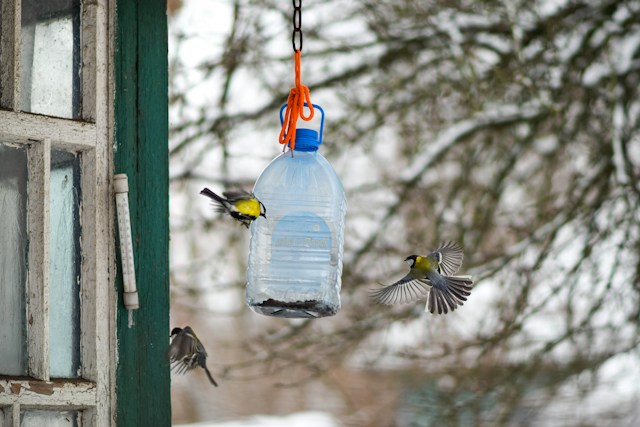
Bird feeders bring welcome activity to gardens, but their placement can influence the risk of collisions.
A feeder close to a reflective window may attract birds into an area where they repeatedly encounter glass. If startled by a predator or another disturbance, a feeding bird may suddenly fly toward the apparent opening.
Cornell Lab guidance recommends placing feeders either within approximately 3 feet (1 meter) of a window or more than 30 feet (9 meters) away.
A feeder very close to the glass gives a departing bird less distance to build up speed before a possible impact. A feeder farther away can reduce the likelihood of birds flying directly toward the window during feeder activity.
These distances are practical guidance, not a guarantee that collisions won’t occur.
Feeder placement should be treated as an additional precaution rather than a substitute for making hazardous glass visible. Birds that aren’t visiting a feeder can still strike an untreated window.
Don’t Forget the Lights at Night
Most household advice about window collisions focuses on reflections during daylight, but artificial lighting creates another risk, especially for migrating birds.
Many species migrate at night, and bright buildings can attract or disorient them. Birds drawn toward artificial lights may encounter windows and other structures they would otherwise have avoided.
Turning off unnecessary outdoor lighting, reducing light escaping from buildings, and closing blinds or curtains after dark can help lessen that attraction.
These precautions are particularly worthwhile during migration periods. They can also save energy and reduce light pollution.
However, nighttime lighting and daytime reflections are related but distinct problems. Switching off lights at night doesn’t make reflective glass safe during the day.
A sensible prevention strategy addresses both.
What Should You Do if a Bird Hits Your Window?
Even with precautions in place, a collision may still happen.
If you find a bird sitting motionless beneath a window, don’t assume it’s unharmed simply because there is no obvious bleeding or broken wing. A collision can cause head trauma and other injuries that aren’t immediately visible. Even a bird that eventually flies away may have been injured.
The International Wildlife Rehabilitation Council recommends contacting a licensed wildlife rehabilitator as soon as possible after a window strike.
If the bird is grounded and you can safely handle it, gently place it in a small ventilated cardboard box or an appropriate paper bag, following local wildlife rehabilitation guidance. Keep the container closed in a quiet, dark, comfortably warm place away from children and pets while arranging professional advice.
Do not offer food or water, and avoid unnecessary handling. Wash your hands thoroughly afterward.
A bird that is bleeding, cannot stand normally, holds its wings unevenly, or shows unusual movements needs prompt professional assistance. But the absence of obvious symptoms doesn’t necessarily rule out injury, so a rehabilitator should advise on the next step rather than relying on whether the bird manages to fly.
Once the immediate situation has been addressed, return to the window where the collision happened. If one bird mistook it for open space, another may do the same.
The priority is to help the injured animal appropriately and prevent the next collision—not to assume that a bird flying away means everything is fine.
A Small Change to the Glass Can Make a Real Difference
Windows are such familiar parts of our homes that it’s easy to forget how differently they can appear from outside.
A pane that gives us a pleasant view of the garden may present a bird with a convincing reflection of trees and sky. Another may seem to offer a route straight through a building.
Those illusions help explain why collisions happen, but they also point toward practical solutions.
Closely spaced exterior markers have reduced collisions in field studies. Screens, shades, and hanging cords provide useful alternatives, while certain UV-reflective films have shown promise under controlled conditions.
The details matter: a treatment needs to be visible from outside, cover the hazardous area, and be installed according to an appropriate design.
For homeowners, the starting point is simple. Look at the glass from the direction a bird would approach, identify the surfaces that resemble open habitat, and make those surfaces easier to recognize as barriers.
You can still enjoy the view through your windows. The difference is that the birds outside have a better chance of recognizing what’s between them and the garden.
Sources & Further Reading
- Lawson, R. R., O’Connell, T. J., Elmore, J. A., Riding, C. S., Riggs, G. J., & Loss, S. R. (2026). Window Markers Reduce Bird–Window Collisions in a Real-World Application. Ornithological Applications, 128(3).
- Riggs, G. J., Barton, C. M., Riding, C. S., O’Connell, T. J., & Loss, S. R. (2022). Field-Testing Effectiveness of Window Markers in Reducing Bird-Window Collisions. Urban Ecosystems, 26, 713–723.
- American Bird Conservancy. (n.d.). Solutions for Homes. American Bird Conservancy.
- American Bird Conservancy. (n.d.). Glass Collisions Products. American Bird Conservancy.
- Swaddle, J. P., Emerson, L. C., Thady, R. G., & Boycott, T. J. (2020). Ultraviolet-Reflective Film Applied to Windows Reduces the Likelihood of Collisions for Two Species of Songbird. PeerJ, 8, e9926.
- Swaddle, J. P., et al. (2023). Window Films Increase Avoidance of Collisions by Birds but Only When Applied to External Compared With Internal Surfaces of Windows. PeerJ.
- Kahle, L. Q., Flannery, M. E., & Dumbacher, J. P. (2016). Bird-Window Collisions at a West-Coast Urban Park Museum. PLOS ONE, 11(1), e0144600.
- Cornell Lab of Ornithology. (2025). These DIY Home Improvements Will Help Save Birds This Spring. Cornell University.
- Cornell Lab of Ornithology. (n.d.). It’s Clear—Glass Kills. How to Prevent Bird Collisions at Your Home. Bird Academy.
- U.S. Fish & Wildlife Service. (n.d.). Threats to Birds: Collisions (Buildings & Glass). U.S. Fish & Wildlife Service.
- International Wildlife Rehabilitation Council. (n.d.). A Bird Hit My Window—What to Do. IWRC.
- Klem, D., Jr. (2021). Solid Air: Invisible Killer: Saving Billions of Birds from Windows. Hancock House Publishers.
Featured image by Rohaan Arshad

