
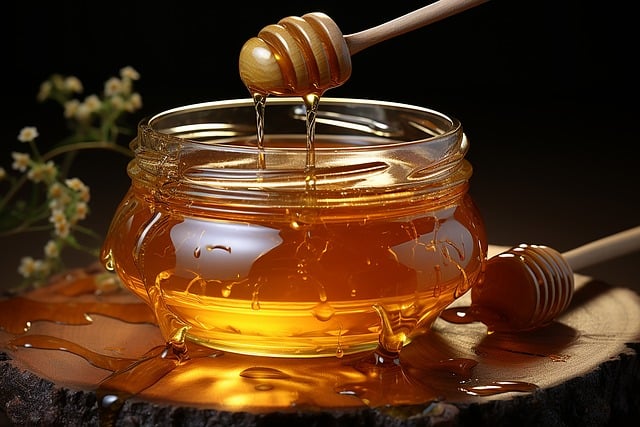
Take a spoonful of honey and let it slowly fall back into the jar. Thick, golden, wonderfully sticky.
Now imagine that same honey beginning as a watery drop of nectar inside a flower.
The transformation is remarkable. Bees do not simply collect honey from flowers and carry it home. They collect nectar, move it through a series of physical and chemical changes, remove much of its water, and eventually store the finished food in honeycomb.
And although we tend to picture one busy bee flying from flower to flower, much of the process depends on the shared work of the colony.
So how does a tiny drop of nectar become the honey we recognize?
It All Starts With a Flower
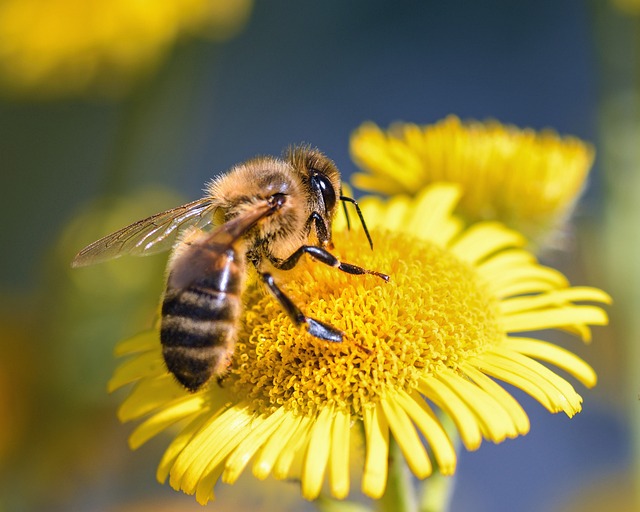
On a warm day, a worker honey bee lands on a flower and begins searching for nectar.
Flowers produce nectar partly to attract visitors such as bees. As a bee moves between flowers, pollen may also be carried from one flower to another, contributing to pollination.
For the bee, though, nectar is food.
Using a specialized mouthpart called a proboscis, she takes up the sugary liquid and carries it in a pouch called the crop, often nicknamed the honey stomach.
Despite that name, the crop is not simply the stomach where the bee digests an ordinary meal. It acts as a transport reservoir, allowing the forager to carry nectar back toward the colony.
One flower rarely provides a full load. A bee may visit many blooms during a single trip, collecting small amounts as she goes.
What she carries away is still nectar, however—not honey.
Honey Making Can Begin Before the Bee Gets Home
The journey back to the hive is not necessarily just transportation.
Research on honey bees collecting dilute nectar from Aloe flowers found that nectar in the crop became progressively more concentrated while the bees were still foraging and during the return flight. The researchers suggested that bees were exposing nectar at their mouthparts and allowing some water to evaporate before reaching the hive.
That does not mean every nectar source follows exactly the same pattern. Humidity, nectar concentration, weather, and other conditions can change what happens during a foraging trip.
But it reveals something important: honey production is not a single event that starts only after the bee crosses the entrance to the hive.
The transformation can begin remarkably early.
Inside the Hive, the Work Is Shared
When the forager returns, she may pass nectar to another worker through a mouth-to-mouth exchange called trophallaxis.
From there, nectar may be handled by other bees and eventually placed in the wax cells of the honeycomb.
It is tempting to imagine this as a neat assembly line: one bee collects, another adds enzymes, another evaporates water, and a final worker closes the cell.
Real colonies are not quite that tidy.
Nectar may be handled and transferred more than once, and different workers can contribute at different stages. Not every transfer changes it by the same amount, and honey production does not depend on one bee completing a fixed sequence from beginning to end.
That shared work is one of the most interesting parts of the process. A jar of honey is not the product of one extraordinarily industrious insect; it emerges from the activity of many workers across the colony.
The Nectar’s Chemistry Begins to Change
Nectar is largely water with sugars dissolved in it. Honey contains sugars too, but those sugars have been altered during processing.
Bee enzymes help drive some of that transformation.
One important enzyme is invertase, which helps break sucrose into the simpler sugars glucose and fructose.
Another, glucose oxidase, contributes to reactions that produce compounds including gluconic acid and hydrogen peroxide. These chemical changes become part of the distinctive composition of honey.
The process begins as bees collect and handle nectar and continues as the material moves through the colony.
None of this is visible when you look into a honeycomb. To us, a cell may simply contain a shiny drop of liquid. Chemically, however, that liquid is already changing.
But altering the sugars is only part of the problem.
Nectar still contains far too much water to become the thick, concentrated food we know as honey.
Where Does All the Water Go?
Fresh nectar can be surprisingly watery. Honey is much more concentrated.
Bees help bridge that difference by encouraging water to evaporate.
Some water may already have been lost during collection and the journey home. Inside the colony, workers continue processing the nectar, and it is eventually spread into honeycomb cells where evaporation can continue.
Bees can also expose small amounts of liquid during processing, increasing the surface available to the air. Meanwhile, workers fan their wings inside the hive, helping move air through the colony and promoting evaporation.
The speed of that process depends on more than wing-fanning alone. Temperature, humidity, the amount of nectar, its starting concentration, ventilation, and how much surface area is exposed can all matter.
As water disappears, the sugars become increasingly concentrated and the liquid thickens.
Finished honey is often described as containing roughly 17–20% water, but that should not be treated as a biological finish line that every colony reaches at exactly the same percentage.
International food standards also set moisture limits for honey, but those are standards for the finished product and can vary by honey category. They are not evidence that bees measure a universal percentage before deciding a cell is ready to cap.
The important transformation is broader: watery nectar becomes a much more concentrated food that can be stored for later use.
Why Do Bees Cover Honey With Wax?
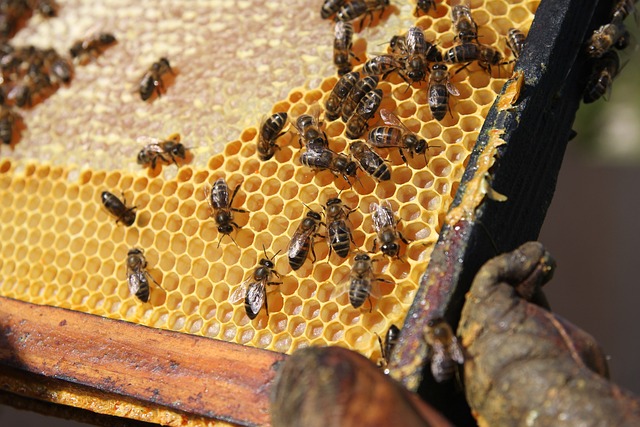
Look closely at a honeycomb and you may see open cells containing liquid beside other cells covered with pale wax.
Those wax coverings are caps made by the bees.
When honey has ripened enough for storage, workers can seal the cell with a thin layer of beeswax. Within the journey we are following, capping marks the transition from actively processing the food to keeping it stored in the comb.
It should not be thought of as a magical airtight seal that guarantees honey will remain unchanged forever, nor as proof that every capped cell contains precisely the same percentage of water.
It is better understood as part of the colony’s storage system.
The honeycomb itself serves several purposes. Bees build its familiar hexagonal cells from wax, using them to store food and to raise young. Capped honey cells are the pantry portion of that architecture: concentrated food waiting for a time when the colony needs it.
How Many Flowers Does It Take to Make Honey?
A single flower may offer only a small amount of nectar, so producing a substantial quantity of honey requires an enormous number of visits.
You may have heard the claim that bees visit around two million flowers to make one pound of honey.
There is some reasoning behind the famous figure, but it is better treated as an illustration than a universal count.
The Canadian Honey Council provides a calculation based on assumptions about the amount of nectar carried in a load, how concentrated that nectar is, and the number of flowers tapped during a trip. Using its assumptions, the estimate actually comes out at more than 2.6 million flower visits for one pound, or about 454 grams, of honey.
Real foraging is much messier than that calculation.
Different flowers produce different amounts and concentrations of nectar. A bee may obtain a useful load from relatively productive flowers or have to visit many more when each bloom offers little. Weather and landscape also affect what is available.
So there is no meaningful rule saying that every pound of honey represents exactly a particular number of flowers.
What the estimate captures well is the scale.
A colony can contain tens of thousands of bees during its busiest periods, with large numbers of workers repeatedly traveling between the hive and food sources. The honey in one jar represents the combined result of an extraordinary number of small collections, flights, transfers, and processing steps.
Why Does Honey Taste Different From One Jar to Another?
Not all honey is pale gold, and not all of it tastes alike.
The plants providing the raw material help shape the finished honey’s color, aroma, and flavor.
Clover honey is commonly light and relatively mild. Buckwheat honey tends to be darker and more robust. Honey sold as wildflower honey can vary considerably because the mixture of plants available to bees changes with location and season.
In that sense, a jar of honey can carry something of the landscape in which it was made.
That does not mean bees neatly label different flowers and store every plant source in a separate compartment. Foragers use whatever rewarding sources are available, and the plant origins represented in the final honey depend on what the colony has been collecting.
There is also an important exception to the familiar flower-to-hive story.
Not all honey starts as flower nectar.
Honey bees can also collect honeydew, a sugary material associated with sap-feeding insects such as aphids and scale insects. Bees process that material into honey too.
So while nectar gives us the classic route from flower to comb, honey making is slightly more varied than the familiar story suggests.
Why Do Bees Make Honey in the First Place?
Humans tend to meet honey at the end of the story: in a jar, on toast, stirred into tea, or drizzled over food.
For the bees, honey has a much more important job.
It is stored food for the colony.
Flowering conditions change throughout the year. Nectar can be abundant during one period and scarce during another, depending on the climate, season, vegetation, and weather.
By converting nectar into a concentrated food that can remain in the comb, honey bees build reserves for times when fresh forage is limited.
Those stores help meet the colony’s energy needs when workers cannot simply fly out and find enough nectar.
How much a colony needs is not fixed. A colony facing a long cold season may have different requirements from one living somewhere with a very different climate and flowering pattern.
That is also why there is no universal amount of stored honey that can automatically be considered surplus for a beekeeper to remove. The bees made those stores for themselves first.
A Spoonful of Honey, a Whole Colony’s Work
The next time you open a jar of honey, think about where it began.
A worker collected a tiny amount of nectar. Some water may already have disappeared before she reached home. Other workers handled the nectar, enzymes changed its sugars, and more water evaporated as it was processed and stored in the comb.
Eventually, a wax cap marked the cell as part of the colony’s food reserves.
Multiply that process across many workers and countless foraging trips and the scale begins to emerge.
There is no single bee directing the operation and no tiny factory manager assigning each step. Honey results from ordinary behaviors repeated across a social colony.
That golden spoonful began as dilute plant nectar and became stored food through flowers, chemistry, evaporation, and the shared work of thousands of bees.
Sources & Further Reading
- Lewkowski, O., Mureșan, C. I., Dobritzsch, D., Fuszard, M., & Erler, S. (2019). The Effect of Diet on the Composition and Stability of Proteins Secreted by Honey Bees in Honey. Insects, 10(9), 282.
- Yang, S., Meng, Q., Ye, T., Wang, J., Zhao, W., Tian, Y., & Dong, K. (2025). Impact of Comb Cell Diameter on Nectar Evaporation Efficiency in Honey Bees. Insects, 16(1), 71.
- Nicolson, S. W., & Human, H. (2008). Bees Get a Head Start on Honey Production. Biology Letters, 4(3), 299–301.
- Codex Alimentarius Commission. (1981; revised 1987, 2001; amended 2019, 2022). Standard for Honey (CXS 12-1981). FAO/WHO Codex Alimentarius.
- Canadian Honey Council. (n.d.). How to Make a Pound of Honey. Canadian Honey Council.
- U.S. Department of Agriculture, Agricultural Marketing Service. (n.d.). Extracted Honey Inspection Instructions. USDA Agricultural Marketing Service.
- DK. (2016). The Bee Book. DK.
- Tautz, J. (2008). The Buzz About Bees: Biology of a Superorganism. Springer.

