

Your Labrador has just finished dinner. The bowl is empty, but the moment someone opens a cupboard or rustles a packet, there they are again, watching closely in case something edible appears.
It is easy to assume that a dog who keeps asking for food must still be hungry. But wanting another bite and actually needing more food are not necessarily the same thing.
Labradors have a reputation for loving their meals, and researchers have found something interesting behind that enthusiasm. Some carry a particular change in a gene called POMC, which has been linked to stronger food motivation and weight-related traits.
The gene does not explain every Labrador’s appetite, and it certainly does not decide whether an individual dog will become overweight. But it offers a fascinating example of how biology can make food especially hard for some dogs to ignore.
Why Are Labradors Prone to Weight Gain?
Labrador Retrievers are among the breeds recognized as having a higher risk of gaining excess weight.
That does not mean every Labrador will become overweight. Dogs of the same breed can differ considerably in activity, body condition, eating habits, health, and how much food they actually need.
But the breed-level risk made researchers interested in whether biology might help explain why weight management seems easier for some Labradors than for others.
In 2016, a team led by Eleanor Raffan identified a genetic variation associated with body weight, body fat, and food motivation in Labrador Retrievers. The same variation was also found in the closely related Flat-Coated Retriever.
The change is surprisingly small: a deletion of just 14 base pairs in the POMC gene.
Small does not necessarily mean unimportant. Those missing pieces affect substances involved in the body’s systems for regulating appetite and energy.
What Does the POMC Gene Do?
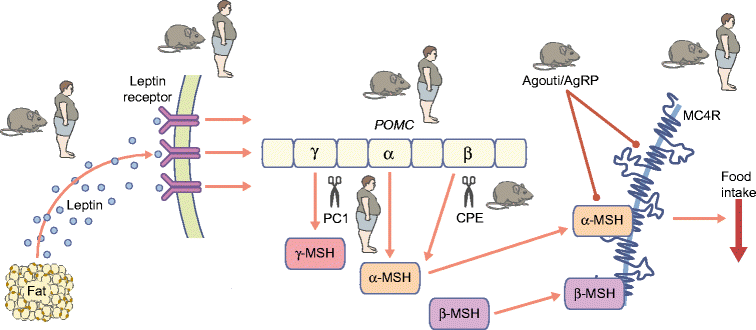
Genes contain instructions the body uses to make proteins. The protein made from POMC is later cut into several smaller signaling molecules, each with different jobs in the body.
Two of those molecules are called β-MSH and β-endorphin.
The deletion found in some Labradors disrupts the coding sequences for both of them in the affected copy of the gene.
β-MSH is especially interesting because it can activate receptors involved in appetite and energy balance. One of those receptors, MC4R, is part of a signaling pathway that helps regulate food intake and energy use.
Another related molecule, α-MSH, also comes from POMC. Importantly, the Labrador deletion does not remove the sequence that produces α-MSH, and the 2024 research found no evidence that α-MSH was depleted.
The biology gets complicated quickly, and researchers still cannot neatly separate the effects of losing β-MSH from those of losing β-endorphin. We should not imagine that one missing molecule explains every hopeful stare at the dinner table.
What the research does give us is a plausible biological reason why food might be especially motivating for some dogs.
The Experiment With the Unreachable Sausage
One of the clearest parts of the research is also very easy to picture.
In a study published in 2024, Labradors were given a meal. Three hours later, researchers showed them a sausage and placed it inside a perforated plastic box.
The dogs could smell the sausage and knew it was there, but they could not get to it.
Some of the Labradors carried one copy of the POMC deletion, while others did not carry it. The researchers then watched how long the dogs continued trying to reach the food.
The dogs with one copy of the deletion spent significantly more time interacting with the box and trying to get at the sausage. The inaccessible food held their attention for longer, even though they had already eaten.
That sounds like strong evidence of hunger—but there is an important twist.
The researchers also gave the dogs an opportunity to eat repeated portions of food and measured how much they consumed. In that test, there was no significant difference in the amount eaten between the groups.
That distinction matters.
A dog can be extremely motivated to find or obtain food without necessarily eating a larger meal when given the chance. Food-seeking behavior and actual food requirements are not the same thing.
The experiment also cannot tell us exactly what hunger feels like to each dog. Researchers can measure how persistently a dog works for food, but they cannot directly measure the dog’s private experience.
So a Labrador who stares at the cupboard, follows you into the kitchen, or searches the floor for crumbs is not automatically underfed. Nor can you tell from that behavior alone whether the dog carries the POMC deletion.
What About Metabolism?
The 2024 study also looked at another part of the weight equation: how much energy dogs use while resting.
Here the details matter, because this part of the study was not carried out in Labradors with one copy of the deletion.
Researchers measured resting energy expenditure in a small group of Flat-Coated Retrievers. Dogs carrying two copies of the POMC deletion used less energy at rest than Flat-Coated Retrievers without the deletion.
That is an interesting result because body weight depends on both sides of the equation: how much energy comes in and how much the body uses.
But it would be a mistake to turn that finding into “Labradors with this gene have slow metabolisms.”
The study does not establish that Labradors carrying one copy of the deletion burn fewer calories at rest, and it cannot tell you how many calories your individual Labrador needs.
What it does suggest is that changes in POMC may affect more than one part of the system involved in body-weight regulation.

Does the POMC Gene Mean a Labrador Will Become Overweight?
No.
The POMC deletion is one factor among many.
Not every Labrador carries it, and carrying it does not mean a dog is destined to gain too much weight. Food intake, activity, age, health, neuter status, daily routine, treats, and individual differences all help shape body condition.
You also cannot identify the gene simply by watching a dog’s behavior.
A Labrador who appears every time someone opens the fridge may be highly food-motivated for all sorts of reasons. Begging is not a genetic test, and it does not tell you how much food belongs in the bowl.
The research is useful because it changes how we can think about that behavior.
Calling a dog “greedy” makes food-seeking sound like a character flaw. For some Labradors, biology may genuinely make food more compelling.
Understanding that does not mean giving more food every time the dog asks. It means recognizing that strong food motivation may need to be managed rather than blamed.

Helping a Food-Loving Labrador Stay Healthy
If your Labrador would happily investigate every crumb in the kitchen, the best guide to feeding is not how convincingly they ask for more.
Look instead at body condition, weight over time, muscle condition, activity, and the dog’s individual needs.
Veterinary organizations such as AAHA and WSAVA recommend taking an individual approach to nutrition and weight management rather than relying on breed or appetite alone.
A few everyday habits can make that easier:
- Measure meals consistently. Knowing roughly how much food goes into the bowl makes it much easier to adjust portions if your dog’s weight changes.
- Count the extras. Treats, chews, table scraps, and training rewards all add to the day’s intake.
- Watch body condition as well as weight. The number on the scale matters, but it does not tell the whole story about body fat and muscle.
- Keep your dog active in ways that suit them. Walks, games, swimming, training, and other activities can all play a part depending on age, health, and ability.
- Reassess when things change. A dog that becomes less active, gains or loses weight, develops a health problem, or gets older may need a different feeding plan.
For a Labrador who finds food especially rewarding, you can also use part of the normal daily ration for training or suitable food puzzles rather than automatically adding more calories through extra treats.
That lets the dog enjoy working for food without turning every food-related activity into additional intake.
If you are unsure whether your Labrador is at a healthy weight or how much they should be eating, your vet can help assess body condition and adjust the plan for that particular dog.
Food Motivation Is Not the Same as Food Need
There is something instantly recognizable about a Labrador appearing at the sound of a packet opening or watching every movement near the kitchen.
It is easy to laugh at that determination, and plenty of Labradors really are extremely interested in food.
Research into the POMC gene suggests that, for some of them, that enthusiasm may have a biological component. A small genetic difference can affect signaling pathways involved in appetite, and dogs carrying the deletion have shown greater persistence when trying to obtain inaccessible food.
But the research also gives us an equally important lesson: wanting food very badly is not the same as needing more food.
The best guide is not how long your Labrador stares at the treat cupboard after dinner. It is whether the amount you feed is keeping that particular dog healthy.
Sources & Further Reading
- Raffan, E., Dennis, R. J., O’Donovan, C. J., Becker, J. M., Scott, R. A., Smith, S. P., Withers, D. J., Wood, C. J., Conci, E., Clements, D. N., Summers, K. M., German, A. J., Mellersh, C. S., Arendt, M. L., Iyemere, V. P., Withers, E., Söder, J., Wernersson, S., Andersson, G., Lindblad-Toh, K., Yeo, G. S. H., & O’Rahilly, S. (2016). A Deletion in the Canine POMC Gene Is Associated With Weight and Appetite in Obesity-Prone Labrador Retriever Dogs. Cell Metabolism, 23(5), 893–900.
- Dittmann, M. T., et al. (2024). Low Resting Metabolic Rate and Increased Hunger Due to β-MSH and β-Endorphin Deletion in a Canine Model. Science Advances, 10(10), eadj3823.
- American Animal Hospital Association. (2021). 2021 AAHA Nutrition and Weight Management Guidelines: Prevention of Obesity. AAHA.
- World Small Animal Veterinary Association. (n.d.). Global Nutrition Guidelines and Toolkit. WSAVA.
- Fascetti, A. J., Delaney, S. J., Larsen, J. A., & Villaverde, C. (Eds.). (2023). Applied Veterinary Clinical Nutrition. Wiley-Blackwell.

