

You put the bowl down.
Ten seconds later, dinner is gone.
The dog looks at you as if there has been some administrative error and surely another meal must be coming.
Dogs can eat impressively fast, and it is tempting to assume there must be something wrong: perhaps they are anxious, badly fed or still following some ancient survival instinct that tells them another dog is about to steal dinner.
Usually, the explanation is less dramatic.
Some dogs simply eat faster than others. Excitement around food, previous competition, the way meals are offered and individual appetite can all influence eating speed. The useful question is not why your dog has failed to develop table manners.
It is whether eating this quickly is causing a problem — and, if it is, how to slow things down without inventing one.
There Is No Stopwatch for “Too Fast”
There is no established rule saying that a dog of a particular size should take exactly three, five or ten minutes to finish a meal.
What matters is the pattern.
A dog that eats enthusiastically, finishes quickly and then carries on with the day may simply be a fast eater. A dog that appears frantic around food, coughs or gags while eating, regularly brings food back up, fights other animals for access to meals or has suddenly become dramatically hungrier deserves more attention.
A change matters too.
If your dog has always treated dinner like a competitive sport, that is different from a dog that suddenly becomes ravenous while losing weight, drinking excessively or developing gastrointestinal problems.
Fast eating is a behavior.
A sudden increase in appetite can be a clinical sign.
Those are not the same thing.

Why Do Some Dogs Eat So Quickly?
A common explanation usually sounds something like this: dogs descended from wolves, lower-ranking animals had to eat before dominant animals took the food, and modern dogs still carry that instinct.
It makes a good story.
It is much harder to demonstrate.
Domestic dogs have enormously variable feeding behavior, and there is no need to invoke a rigid dominance hierarchy to explain why one Labrador empties a bowl in seconds while another dog eats one piece of kibble at a time.
Competition can certainly matter. In a multi-dog household, a dog that expects another animal to approach the bowl may have good reason to eat quickly. Previous experiences with limited access to food could also influence behavior.
But some dogs with no history of deprivation or competition are simply extremely food-motivated. In some Labradors, for example, genetics can influence that interest in food, although food motivation and eating speed aren’t necessarily the same thing.
The important distinction is between a plausible influence and a universal explanation.
There is equally little justification for claiming that fast eating normally begins when puppies compete for milk and then becomes a lifelong habit. That may sound biologically plausible, but plausibility is not evidence.
Fast Eating and Bloat: The Story Is More Complicated
This is where advice about fast eating often becomes much more frightening.
You will frequently read that a dog gulps food, swallows large amounts of air, the stomach expands and then twists, producing gastric dilatation-volvulus (GDV).
GDV is real, life-threatening and requires immediate veterinary treatment.
The problem is the neat causal chain.
Researchers have investigated rapid eating as a possible GDV risk factor for decades. Some observational studies found an association. Others did not. A review of the available evidence concluded that the studies were mixed and generally insufficient to determine whether eating speed itself changes GDV risk.
Meal size appears to matter too. In a prospective study of high-risk breeds, dogs receiving larger volumes of food per meal had greater GDV risk, particularly when a large amount was fed once daily.
So slowing a dog down is perfectly reasonable.
What we should not promise is that buying a slow feeder prevents GDV.
GDV is a multifactorial disease. Breed, body conformation, age, family history and feeding-related factors can all be relevant, and some dogs are at much higher risk than others.
If a dog develops a swollen abdomen, repeated unproductive retching, severe restlessness, weakness or collapse, that is an emergency — not a problem to solve by changing bowls tomorrow.

A Slow-Feed Bowl Does One Job Quite Well
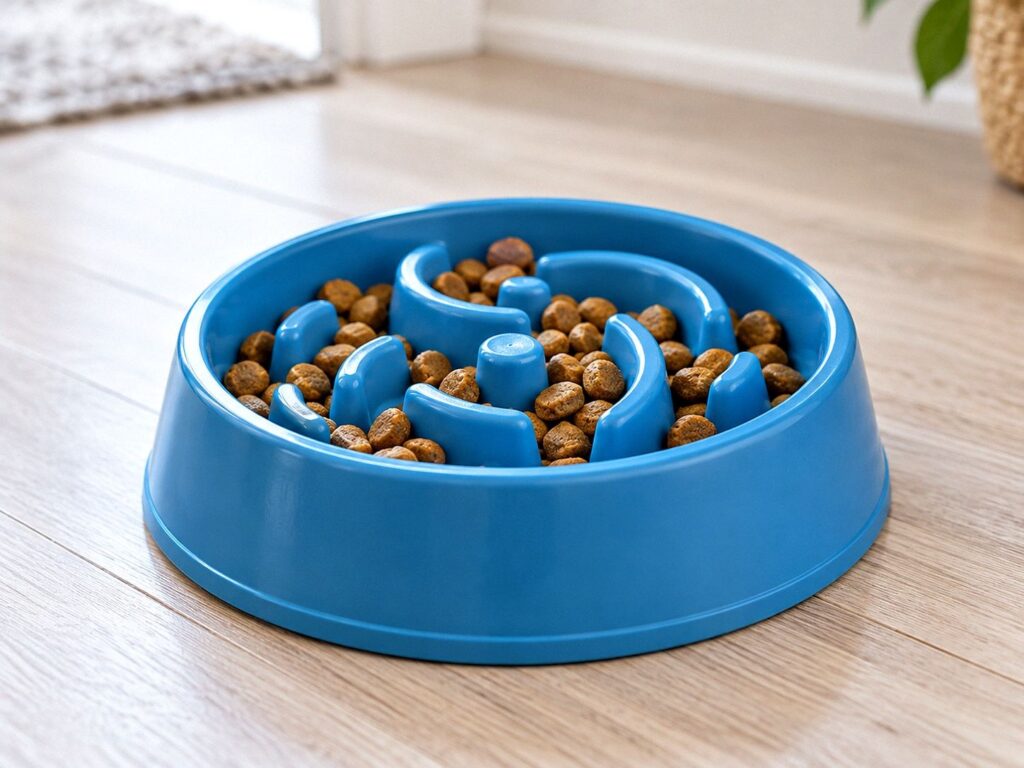
A slow feeder is refreshingly simple.
Instead of giving the dog unrestricted access to an open bowl of food, ridges and channels make it harder to take a large mouthful at once.
And unlike many pet products, the basic claim is testable.
In a small study of ten pet dogs, dogs ate more slowly from a slow-feeding device than from a normal bowl. They became somewhat quicker at using it with experience, but the device still altered the rate at which they could consume the food.
That does not make every slow feeder automatically good.
The design needs to suit the dog’s muzzle and size. It should be easy to clean, stable enough not to become another object to throw around the kitchen and challenging without turning every meal into a frustrating puzzle.
The purpose is not to make eating difficult.
It is to make gulping less easy.
Food Toys Can Change the Meal Completely
A meal does not have to arrive in a bowl.
Food-dispensing toys and puzzle feeders can stretch the same amount of food over a longer period while giving the dog something to manipulate, search or work on.
There is some evidence that feeding enrichment changes canine behavior, although claims about major welfare or health benefits often run ahead of the research. Studies in kenneled dogs have found that food toys increase time spent in feeding-related activity, and surveys show that owners commonly use enrichment feeding for mental stimulation and to slow dogs that eat quickly.
The dog’s reaction still matters.
A puzzle that produces curiosity and persistence is doing something useful.
A puzzle that produces frantic pawing, barking and frustration may simply have replaced one stressful meal with another.
Start easy enough that the dog can succeed.
Sometimes the Simplest Fix Is More Space
If two dogs eat beside each other and one inhales dinner while repeatedly checking the other bowl, the problem may not require a more elaborate feeder.
It may require two rooms.
Dogs that compete over food should be able to eat without another animal approaching, staring at them or waiting to take whatever remains.
This is particularly important when there is tension or resource guarding.
Removing competition can change the emotional context of the meal rather than merely placing obstacles between the dog and the food.
And if one dog finishes first, keeping them separated until both meals are over prevents the faster eater from discovering that speed comes with the bonus of investigating someone else’s dinner.
Smaller Meals Can Help — But Four or Five Meals Are Not a Rule
Dividing the same daily ration into smaller meals can be useful for some dogs, especially if the aim is to reduce the amount consumed in a single sitting. There is nothing magical about feeding four or five meals a day, though: the schedule has to be practical, and total daily calories still matter.
Four meals of too much food are still too much food.
Automatic feeders can make smaller meals easier in some households. For other dogs, twice-daily feeding combined with a slow feeder or food toy may solve the practical problem perfectly well.
The method should fit the dog rather than an arbitrary feeding schedule.
When Hunger Is Telling You Something Else
Eating quickly does not, by itself, mean a dog has parasites or is receiving poor-quality food. Fast eating and abnormal hunger are different questions. Markedly increased appetite, particularly when it is new, can occur with medical disease.
Diabetes mellitus, for example, can produce increased appetite alongside weight loss, increased thirst and increased urination. Hyperadrenocorticism can also cause polyphagia, and gastrointestinal disease or problems affecting nutrient absorption can alter appetite and body weight.
Certain medications can change appetite as well.
The useful question is therefore not simply:
Does my dog eat fast?
It is:
Has their relationship with food changed?
A dog that has always finished dinner in thirty seconds is one situation.
A dog that suddenly behaves as though no amount of food is enough is another.
The Goal Is Not to Teach Table Manners
Dogs do not need to eat with human ideas of elegance.
If your dog eats quickly but comfortably, maintains an appropriate body condition and has no associated medical or behavioral problems, there may be very little to fix.
If meals are genuinely frantic, slowing them down is straightforward enough.
A suitable slow feeder can physically limit large mouthfuls. A food-dispensing toy can turn the meal into an activity. Dogs that compete can be fed separately. Large meals can sometimes be divided into smaller ones.
What matters is matching the solution to the actual problem.
Because “my dog eats too fast” sounds like a diagnosis.
Most of the time, it is only the beginning of the question.
Sources & Further Reading
- Buckley, L. A. (2016). Are Dogs That Eat Quickly More Likely to Develop a Gastric Dilatation (+/- Volvulus) Than Dogs That Eat Slowly?. Veterinary Evidence, 1(4).
- Buckley, L., & Lees, J. (2016). Go Slow Feeding Bowls: How Effective Are They at Getting Dogs to Eat More Slowly?. Veterinary Evidence, 1(4).
- Raghavan, M., Glickman, N. W., McCabe, G., Lantz, G. C., & Glickman, L. T. (2004). Diet-Related Risk Factors for Gastric Dilatation-Volvulus in Dogs of High-Risk Breeds. Journal of the American Animal Hospital Association, 40(3), 192–203.
Featured image by mattycoulton

